

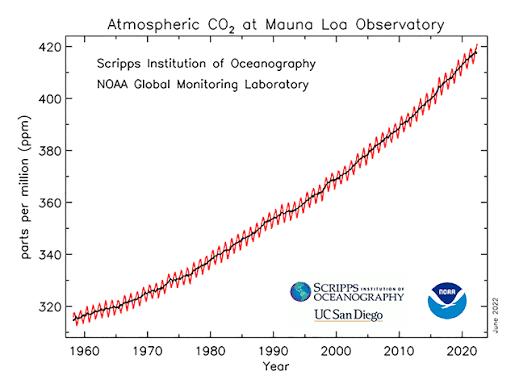
Anthropogenic activities have greatly increased the amount of carbon dioxide (CO2) in Earth’s atmosphere. CO2 levels have risen from 340 ppm in 1980 to more than 420 ppm in 2025. Lifetime exposure to increasing atmospheric CO2 may negatively impact the normal physiology of living organisms. A recently published study suggested that increased atmospheric CO2 concentrations have already produced measurable physiological changes in humans.
Analyzing data from the US National Health and Nutrition Examination Survey (NHANES), the study found that average serum bicarbonate levels increased by 7% between 1999 and 2020. Serum calcium decreased by 2% and phosphorus has decreased by 7% over this period. If these trends continue, blood bicarbonate values could reach the healthy maximum limit of 30 mEq/L by 2076. Calcium and phosphorus will reach the limit of their healthy ranges by 2099 and 2085, respectively.
During this study interval, serum bicarbonate increased by 0.34% per year and atmospheric CO2 has increased by 0.5% per year. This trend suggests there may be a causal link between ambient CO2 and serum bicarbonate.
For most of human evolution, humans have been exposed to a stable atmospheric CO2 level of less than 300 ppm. Human physiology now has to adapt to steadily rising atmospheric CO2 levels above 420 ppm. The trends detected in study indicate that human physiology has already started compensating for breathing increasing levels of atmospheric CO2. If atmospheric CO2 continues to increase, it will be interesting to determine if human physiology will be able to cope with CO2 overload.
References
Larcombe AN, Bierwirth PN, Carbon dioxide overload, detected in human blood, suggests a potentially toxic atmosphere within 50 years, Air Quality Atmosphere Health, 2026;19:44.
McQuillan C, Planetary Health Research Digest, The Lancet Planetary Health, 2026; 10(5):101467



 How to resolve AdBlock issue?