

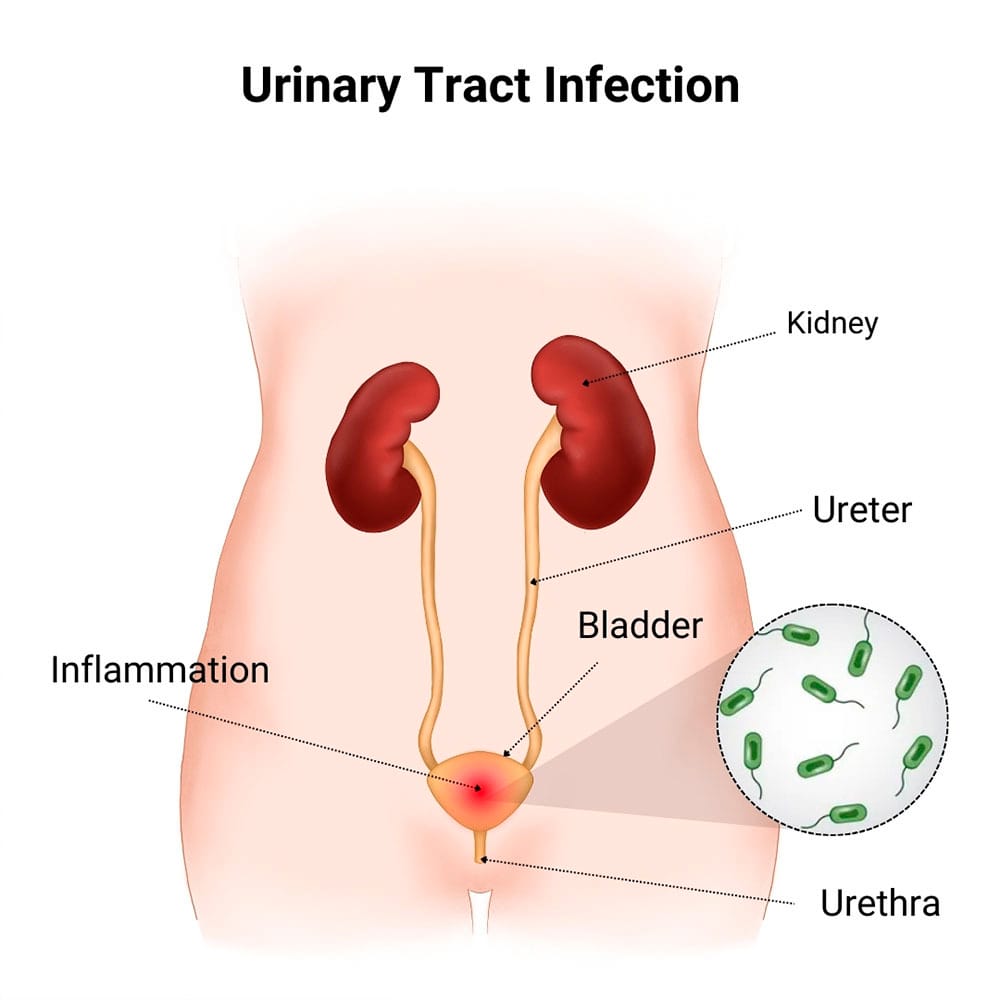
The urinary tract includes the kidney, ureters, bladder, and urethra. Normally, urine flows one way, from the kidneys to the urethra. Sometimes, bacteria from the skin or rectum can travel from the urethra to the bladder, causing a urinary tract infection (UTI). Women have a shorter urethra than men, which increases the likelihood of an UTI. Approximately 60% of women and 10% of men have at least one UTI during their lifetime.
UTIs are caused by both Gram-negative and Gram-positive bacteria, as well as by certain fungi. Escherichia coli is the most common cause of uncomplicated community-acquired UTI. Other causes of uncomplicated UTI are: Klebsiella pneumoniae, Staphylococcus saprophyticus, Enterococcus faecalis, group B Streptococcus (GBS), Proteus mirabilis, Pseudomonas aeruginosa, Staphylococcus aureus and Candida spp. Complicated UTI are usually caused by Enterococcus spp., K. pneumoniae, Candida spp., S. aureus, P. mirabilis, P. aeruginosa and GBS.
UTIs are becoming increasingly difficult to treat due to the emergence of antibiotic resistance. E coli and Klebsiella have become resistant to third generation cephalosporins as well as other antibiotics.
Traditionally, a urine sample is sent to a clinical laboratory for culture and antibiotic susceptibilities. Urine is inoculated onto sheep blood agar and eosin methylene blue agar using a calibrated loop. Following 18 to 24 hours of incubation, semiquantitative colony counts are determined and disease-causing organisms or possible disease-causing organisms are identified using one or a combination of the following techniques: commercial identification panels, matrix-assisted laser desorption/ionization-time of flight mass spectrometry, biochemical tests, carbon source utilization, real-time polymerase chain reaction, and nucleic acid sequencing of the 16S ribosomal RNA gene. Generally, the isolation of more than 100,000 colony forming units/mL of an organism is indicative of a urinary tract infection.
Antimicrobial susceptibility testing is performed using an agar dilution method. The agar dilution method employs the use of antimicrobial agents incorporated in agar plates. The antimicrobial is added to agar in various concentrations depending upon levels attainable in serum, urine, or both. A standardized suspension of the organism is applied to the agar plates, which are incubated for a minimum of 16 to 18 hours at 35 degrees C. Complete inhibition of all but one colony or a very fine residual haze represents the endpoint
Evvy, a direct-to-consumer company, has launched an at-home test for urinary tract infection (UTI). Its new UTI+ Test is a PCR test test that detects 12 uropathogens and 7 antibiotic-resistance genes in urine.
Users collect a urine sample at home and send it to Evvy’s lab. The company then provides results in one business day. Since the test determines both the specific pathogen and the antibiotic resistance, an Evvy clinician can prescribe the appropriate antibiotic.
The test is currently available in the U.S. at $248, or $218 for those with an Evvy subscription. It is not currently available in Alaska, Hawaii or New York.
Reference
Plescia M, Evvy Introduces At-Home UTI Test to Expedite Care, MedCityNews, December 10, 2025



 How to resolve AdBlock issue?