

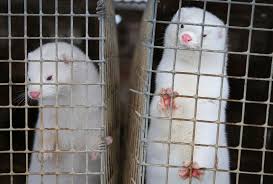
Fur farming is a global industry, although most farms are found in Europe and China. In 2016, farms in Europe produced 39.05 million mink pelts; Chinese farms produced 26.16 million such pelts. As the COVID-19 pandemic illustrated, fur farms harbor viruses that can infect people. Early in the pandemic, SARS-CoV-2 spread through mink farms across Europe. Mink farms have also had outbreaks of highly pathogenic H5N1 avian influenza virus. Raccoon dogs were also infected with SARS-CoV-2.
Researchers recently sought to identify the viruses circulating in fur farms in China. Most of the animals lived in breeding facilities in northeastern China. The rest came from farmed and wild animals in eastern China that were raised for fur as well as for food and traditional medicine. These animals included guinea pigs, deer and rabbits. All of the animals had been sick and had probably died of an infectious disease.
The researchers swabbed lung and gut tissue samples for 461 animals that died between 2021 and 2024. Of these animals, 164 came from four species farmed exclusively for fur: mink (Neogale vison), red fox (Vulpes vulpes), Arctic fox (Vulpes lagopus) and raccoon dog. The DNA and RNA in these samples were sequenced.
Altogether, 125 viruses were identified, including 36 that had never before been detected in these animals and 39 that were potentially at high risk for cross-species transmission. For instance, they found Japanese encephalitis virus in guinea pigs and norovirus in mink. Three subtypes of influenza A virus—H1N2, H5N6 and H6N2—were detected in the lungs of guinea pig, mink and muskrat, respectively. And most notably, they found mink infected with a HKU5-like coronavirus that previously had been identified only in bats. Laboratory studies have shown that some HKU5 viruses might be able to adapt to the human ACE2 receptor to enter cells, similar to SARS-CoV-2.
Raccoon dogs and mink carried the highest number of potentially high-risk viruses, while viruses from the Coronaviridae, Paramyxoviridae and Sedoreoviridae families commonly infected multiple hosts.
This study revealed potential virus transmission between farmed animals, wild animals, and humans. Fur farming represents an important transmission hub for viral zoonoses.
References
Mallapaty S. Fur Farming a ‘viral highway’ that could spark next pandemic, say scientists. Nature, September 6, 2024, https://doi.org/10.1038/d41586-024-02871-y
Zhao, J. et al. Farmed fur animals harbor viruses with zoonotic spillover potential. Nature, September 4, 2024, https://doi.org/10.1038/s41586-024-07901-3 (2024).



 How to resolve AdBlock issue?