

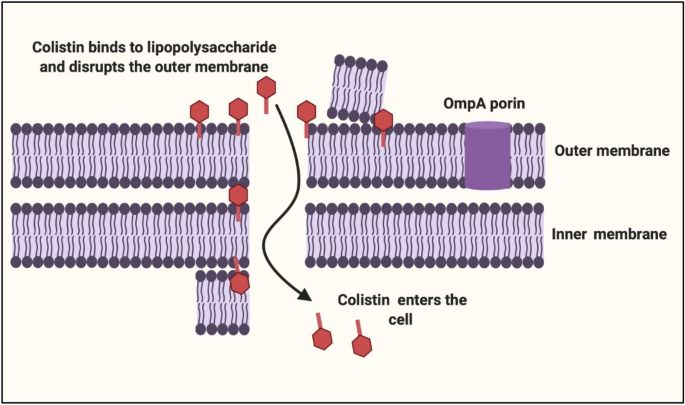
Colistin is active against a diverse number of clinically important gram-negative bacteria, including the family Enterobacteriacea and Pseudomonas aeruginosa. Colistin is considered to be an antimicrobial of last resort for the treatment of infections due multi-drug resistant gram-negative bacteria. Colistin is often one of the only remaining antimicrobials with in-vitro activity against multidrug-resistant Enterobacteriaceae, including those that produce carbapenemase enzymes such as the Klebsiella pneumoniae carbapenemase and New Delhi metallo-β-lactamase.
Colistin binds to lipid A on the outer membrane of Gram negative bacteria. After binding, colistin disrupts the membrane by displacing magnesium and calcium, resulting in cell death.
The mcr-1 gene confers resistance to polymixin antibiotics, such as colistin (polymyxin E). MCR-1 is an acronym for Mobilized Colistin Resistance. The mcr-1 gene codes for an enzyme called phosphatidylethanolamine transferase. This enzyme transfers phosphatidylethanolamine (PE) to lipid A of the Gram negative bacterial cell membrane. The addition of PE lowers the affinity of the lipid A to colistin (and other related polymyxins), rendering the antimicrobial inactive and making the bacteria resistant. To date six different variants of mcr-1 have been found.
The mcr-1 gene is plasma-mediated, meaning it can easily be transmitted from one bacterium to another. The movement of resistance genes between different bacterial species through plasmid-mediated horizontal gene transfer increases the variety of bacterial populations possessing multi-drug resistance.
The mcr-1 gene has been found in the Enterobacteriaceae, a group of Gram negative bacteria. Most reports to date have identified the mcr-1 gene in E. coli, but it has also been reported from Salmonella species, Shigella sonnei, and K. pneumoniae as well as in E. aerogenes, and E. cloacae. The gene has been found in bacteria from food animals, raw meat, and human samples.
In May 2016, the Department of Defense (DOD) notified stakeholders that its Multidrug-resistant Organism Repository and Surveillance Network (MRSN) at the Walter Reed Institute of Research had identified the first colistin-resistant mcr-1 E. coli in a person in the United States. By October 2017, CDC had detected mcr-1 in 27 human samples in 15 states and 2 animal samples in 2 states.
Challenges in laboratory testing and interpretive reporting of colistin are related to its physicochemical properties and the relative lack of clinical data to correlate with isolate MICs. The large size and amphipathic (hydrophobic and hydrophilic) nature of the polymyxins hamper the performance of disk diffusion and agar gradient diffusion. The polymyxins are also cationic, which increases adsorption of these agents to plastic surfaces.
Broth microdilution is the only approved method for polymyxin B. For colistin. CLSI states that broth microdilution, broth disk elution, and the colistin agar test MIC are the only acceptable methods. Colistin broth disk elution and colistin agar test MIC method are approved for Enterobacterales and P. aeruginosa only. For Acinetobacter spp., only broth microdilution can be used for testing.
References
Yi-Un L, etal. Emergence of plasmid-mediated colistin resistance mechanism MCR-1 in animals and human beings in China: a microbiological and molecular biological study. The Lancet Infectious Diseases, February 2016;16:161-168.
American Society for Microbiology, Plasmid-Mediated Colistin Resistance due to mcr-1-Update, November 2022.
Centers for Disease Control and Prevention. Health Alert Network (HAN). Alert to U.S. Healthcare Facilities: First mcr-1 Gene in E. coli Bacteria found in a Human in the United States. CDCHAN - 00390. https://emergency.cdc.gov/han/han00390.asp
Stoesser N, Mathers AJ, Moore CE, Day NP, Crook DW. Colistin resistance gene mcr-1 and pHNSHP45 plasmid in human isolates of Escherichia coli and Klebsiella pneumoniae. Lancet Infect Dis. 2016 Mar;16(3):285-286.



 How to resolve AdBlock issue?