

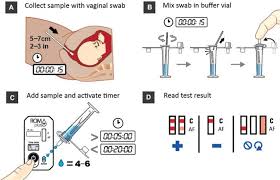
Preterm premature rupture of membranes (PPROM) refers to rupture of fetal membranes prior to labor in pregnancies of less than 37 weeks. It occurs in 3 percent of pregnancies and is responsible for one-third of preterm births. The best method of confirming the diagnosis of PPROM is direct observation of amniotic fluid coming out of the cervical canal or pooling in the vaginal fornix. If PPROM is not obvious after visual inspection, the diagnosis can be confirmed by testing the pH of the vaginal fluid with nitrazine paper or looking for a ferning pattern in dried fluid. False-negative and false-positive test results occur in up to 5% of cases.
Point of care immunochromatographic assays have been developed to improve diagnostic accuracy. AmniSure® was the first commercially available assay that detects trace amounts of placental alpha microglobulin-1 protein (PAMG-1) in vaginal fluid after rupture of fetal membranes.
Rom Plus was introduced later. It is an immunochromatographic assay that detects both placental protein 12 (PP12, aka IGFBP2) and alpha fetoprotein (AFP). PP12 is synthesized by the decidua of the placenta and reaches a very high concentration in amniotic fluid early in the first trimester. AFP is synthesized by the fetal liver and yolk sac and reaches its peak concentration late in the second or early in the third trimester. The use of 2 proteins increases the chance that the proteins will be detected in the pre-term patients.
Rom Plus has a sensitivity of 99% and specificity of 91%. In comparison, the fern test had a sensitivity of 78% and specificity of 79%. When Rom Plus and Amnisure were compared on the same patient population, sensitivities were 96% and 89% and specificities were 99% and 100% for Rom Plus and Amnisure, respectively.
References
McQuivey RW, Block JE, ROM Plus: accurate point-of-care detection of ruptured fetal membranes, Med Devices, 2016;9:69-74.
Rogers LC, Scott L, Block JE. Accurate point-of-care detection of ruptured fetal membranes: Improved diagnostic performance characteristics with a monoclonal/polyclonal immunoassay. Clin Med Insights Reprod Health. 2016;10:15-18..
Mercer BM, et al. The Preterm Prediction Study: prediction of preterm premature rupture of membranes through clinical findings and ancillary testing. The National Institute of Child Health and Human Development Maternal-Fetal Medicine Units Network. Am J Obstet Gynecol. 2000;183(3):738–745.
Igbinosa I, et al, Comparison of rapid immunoassays for rupture of fetal membranes, BMC Preg Childbirth, 2017;17:128.



 How to resolve AdBlock issue?