

Murine Leukemia Viruses (MLVs) are gamma retroviruses that are widespread in animals and cause a wide range of diseases including cancer, immunodeficiency, and neurological disorders. Xenotropic murine leukemia virus-related virus (XMRV) is an endogenous MLV that infects cells from non-mouse species including humans. XMRV is unrelated to the better known human retroviruses, Human Immunodeficiency Virus (HIV) and Human T-lymphotropic Virus (HTLV).
XMRV was first reported in humans in 2008 when its genome was detected in prostatic tissue from a cohort of men with localized prostate cancer undergoing radical prostatectomy. One other study reported XMRV DNA in 6% of prostate cancer specimens. However, most subsequent studies have failed to detect XMRV in prostate cancer patients.
More recently, XMRV has also been associated with Chronic Fatigue Syndrome (CFS). In October 2009, the journal Science published a study from the National Institutes of Health (NIH) that detected XMRV DNA in peripheral blood lymphocytes of 67% of 101 CFS patients and 3.7% of 218 healthy controls. In contrast, XMRV was not detected in two independent studies of 186 and 170 clinically well-characterized symptomatic CFS patients in the United Kingdom nor in a third Dutch study of 32 CFS patients. A subsequent United States study conducted by the Centers for Disease Control and Prevention (CDC) also failed to detect XMRV in any CFS patients or healthy controls. Many scientists now believe that the blood samples used in the original NIH study were contaminated in the laboratory.
Given that XMRV is a retrovirus and the NIH detected XMRV in peripheral blood mononuclear cells, transmission through blood transfusion is theoretically possible. Although XMRV transmission through transfusion has never been documented, as a precautionary measure, blood establishments in several countries including the United Kingdom, Australia and Canada began deferring individuals with CFS from blood donation in November 2009. In the United States, in June 2010, AABB (formerly known as the American Association of Blood Banks) recommended that blood collecting organizations actively discourage potential donors who have ever been diagnosed with CFS from donating blood or blood components. In December 2010 the Red Cross also decided to indefinitely defer donors who revealed a medical history of CFS. Donor screening for XMRV has not been implemented because no commercially approved/licensed tests are available and a causal association of XMRV with human disease has never been established.
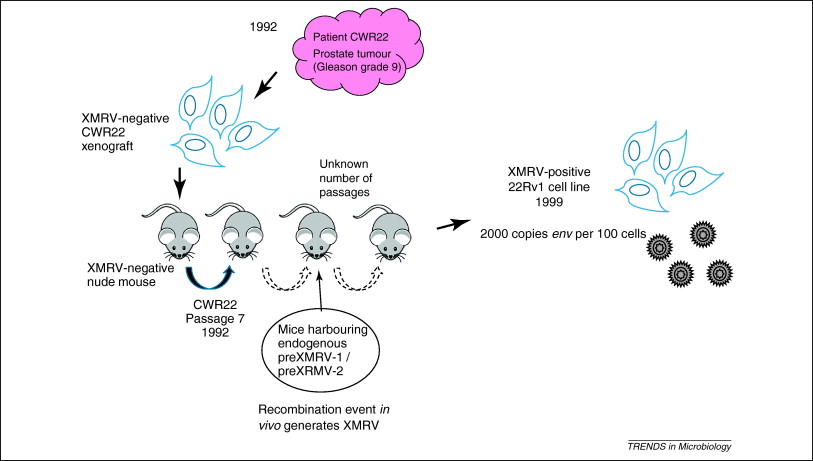
After considerable controversy, etiologic links between XMRV and these two diseases were disproven. XMRV was determined to have arisen during passage of a human prostate tumor in immunocompromised nude mice, by activation and recombination between two endogenous murine leukemia viruses from cells of the mouse. The resulting XMRV had a xenotropic host range, which allowed it replicate in the human tumor cells in the xenograft.
No other laboratories were able to reproduce the finding of XMRV in individuals with CFS. The were unable to detect anti-XMRV antibody, XMRV virions, or viral integration sites in patient samples. The Lo and Lombardi articles were eventually retracted by the authors.
References
Arias M, Fan H, The sage of XMRV: a virus that infects human cells but is not a human virus, Emerg Microbes Infect, 2014;3(4): doi: 10.1038/emi.2014.40.
Fischer N, et al. Prevalence of human gammaretrovirus XMRV in sporadic prostate cancer. J Clin Virol. 2008;43:277–283.
Schlaberg R, et al, XMRV is present in malignant prostatic epithelium and is associated with prostate cancer, especially high-grade tumors. Proc Natl Acad Sci USA. 2009;106:16351–16356.
Lombardi VC, et al. Detection of an infectious retrovirus, XMRV, in blood cells of patients with chronic fatigue syndrome. Science. 2009;326:585–589.
Lo SC, et al. Detection of MLV-related virus gene sequences in blood of patients with chronic fatigue syndrome and healthy blood donors. Proc Natl Acad Sci USA. 2010;107:15874–15879.
Satterfield BC, et al. Serologic and PCR testing of persons with chronic fatigue syndrome in the United States shows no association with xenotropic or polytropic murine leukemia virus-related viruses. Retrovirology. 2011;8:12.
Simmons G, et al. Failure to confirm XMRV/MLVs in the blood of patients with chronic fatigue syndrome: a multi-laboratory study. Science. 2011;334:814–817.
Racacniello, V, Authors retract paper on detection of murine leukemia virus-related sequences in CFS patients, Virology Blog, December 26, 2011.



 How to resolve AdBlock issue?