

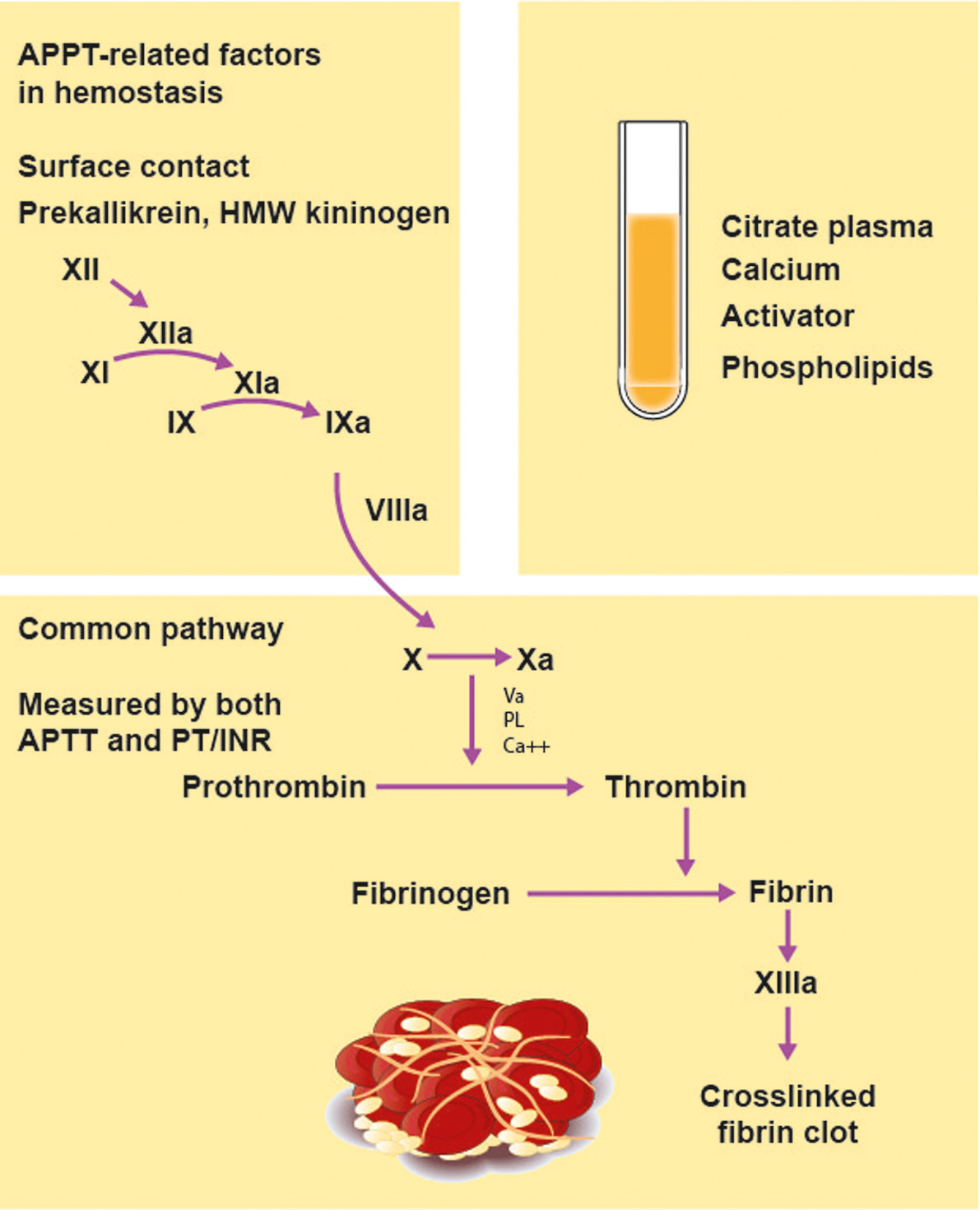
The activated partial thromboplastin time (APTT) is a measure of the integrity of the intrinsic and common pathways of the coagulation cascade. The APTT is the time, in seconds, for patient plasma to clot after the addition of an intrinsic pathway activator (kaolin, celite, silica or elagic acid), phospholipid and calcium. The APTT reagent is called a partial thromboplastin because tissue factor is not included with the phospholipid as it is with the protime (PT) reagent. The activator initiates the contact system. Then, the remaining steps of the intrinsic pathway take place in the presence of phospholipid.
Deficiencies or inhibitors of coagulation factors within the intrinsic (factors XII, XI, VIII, IX, prekallikrein, and high molecular weight kininogen) and common pathways (V, X, II, and fibrinogen) result in prolongation of the APTT. The APTT will generally be prolonged when a clotting factor level is less than 30-40%. Since the normal range for most clotting factors is 50-150% (and 70-130% for factor XI), a normal APTT does not rule out the possibility of a mild factor deficiency.
There are 6 causes of a prolonged APTT (with PT normal or slightly prolonged):
- Pre-analytical errors
- Heparin
- Coagulation factor deficiency associated with risk of hemorrhage
- Coagulation factor deficiency with no risk of hemorrhage
- Lupus anticoagulant
- Specific coagulation factor inhibitor
In the investigation of a prolonged APTT, pre-analytical errors should be ruled out first. The most common pre-analytical cause of a prolonged APTT is contamination with heparin in a sample drawn from an arterial or central line (APTT will often be >200 seconds). Another source of error is an altered plasma to citrate ratio, which may be seen with a high hematocrit (>55%) or as a result of either overfilling or underfilling the collection tube. Other pre-analytical problems include dilution of a sample drawn above an IV, clotting due to inadequate sample mixing, delay in transport or processing of a sample (>4 hours), and inadequate centrifugation.
Therapeutic IV administration of unfractionated heparin is the most common cause of a prolonged APTT. Subcutaneous administration of therapeutic doses of low molecular weight heparins seldom prolongs the APTT more than 40 seconds. Heparin order sets within the Saint Luke’s Health System hospitals no longer use the APTT for heparin monitoring and dose adjustments. Revised heparin order sets with dosing guidelines based on heparin levels (heparin anti-factor Xa assay) were introduced in July 2008.
Acquired coagulopathies, such as liver disease and DIC, are more common than inherited coagulation factor deficiencies and usually involve multiple plasma coagulation factors. Consequently, there is a concurrent derangement of several coagulation tests as shown in following table.
|
Acquired Condition |
Coagulation Defect |
|
Amyloidosis |
Factor X deficiency, Abnormal PT & PTT |
|
Liver disease –moderate to severe |
Abnormal PT, PTT, D-Dimer, platelet function |
|
Acute DIC |
PT, PTT, low platelet count, low fibrinogen, elevated D-Dimer |
|
Postoperative bleeding |
Minimal PT & PTT elevation, low platelet count |
|
Massive Transfusion |
Minimal PT & PTT elevation, low platelet count |
|
Myeloproliferative disease |
Factor V deficiency Abnormal PT & PTT |
|
Vitamin K deficiency, mild |
Abnormal PT (decreased factor VII) |
|
Vitamin K deficiency, moderate to severe |
Abnormal PT & aPTT ( decreased II, VII, IX, X) |
Hereditary coagulation factor deficiencies which selectively prolong the APTT and are associated with a bleeding tendency include factors VIII, IX and XI. Hereditary coagulation factor deficiencies which selectively prolong the APTT but are not associated with a risk of hemorrhage include deficiencies of factor XII, prekallikrein and high molecular weight kininogen (HMWK).
Congenital Coagulation Factor Deficiencies
|
Coagulation Factor |
Prevalence |
Inheritance |
PT |
APTT |
Minimal Hemostatic Level |
Circulating half-life |
|
I fibrinogen |
Very rare |
|
Prolonged |
Prolonged |
100 mg/dL |
3 - 5 days |
|
II Prothrombin |
Very rare |
Autosomal |
Prolonged |
Normal or Prolonged |
20 - 40% |
2 - 5 days |
|
V |
1 per million births |
Autosomal |
Prolonged |
Prolonged |
25% |
15 - 36 hours |
|
VII |
1 per 500,000 births |
Autosomal |
Prolonged |
Normal |
10 - 20% |
4 - 7 hours |
|
VIII |
1 per 5,000 male births |
X-linked recessive |
Normal |
Prolonged |
30% |
9 - 18 hours |
|
VWF |
1 per 1,000 births |
Autosomal |
Normal |
Normal or Prolonged |
25 - 50% |
Few hours |
|
IX |
1 per 30,000 male births |
X-linked recessive |
Normal |
Prolonged |
25 – 50% |
20 - 24 hours |
|
X |
1 per 500,000 births |
Autosomal |
Prolonged |
Normal or Prolonged |
10 – 25% |
32 - 48 hours |
|
XI |
4% Ashkenazi Jews |
Autosomal |
Normal |
Prolonged |
15 - 25% |
2.5 - 3.5 days |
|
XIII |
Very rare |
Autosomal |
Normal |
Normal |
5% |
7 days |
A mixing study is used to differentiate between a coagulation factor deficiency and the presence of an inhibitor. The test is performed by mixing patient’s plasma with normal pooled plasma in a 1:1 ratio and then repeating the PTT. If the Protime (PT) is normal, a correction of a prolonged PTT suggests a deficiency in the intrinsic pathway. Clotting factor assays should be performed for factors VIII, IX, XI and XII. Although assays for HMWK and prekallikrein are available in a few reference laboratories, they are not commonly performed, since these deficiencies do not predispose to bleeding.
If the PTT does not correct to normal when a mixing study is performed, then an inhibitor is most likely present. Inhibitors are classified into 3 general categories:
- Medications such as heparin and direct thrombin inhibitors (lepirudin, argatroban)
- Specific coagulation factor inhibitors such as a factor VIII inhibitor
- Nonspecific inhibitors such as lupus anticoagulants
Heparin and direct thrombin inhibitors (e.g. lepirudin, argatroban) can be ruled by reviewing the clinical history and medication list. However, this review cannot detect a sample that is contaminated by heparin at the time of collection. In this situation, a thrombin time and reptilase time can be performed. Both types of drugs prolong the thrombin time but not the reptilase time. Heparin can be confirmed by performing a heparin anti-Factor Xa assay.
Approximately 15% of patients with severe factor VIII or IX deficiency develop alloantibodies (inhibitors) to transfused factor concentrate. Autoantibodies against clotting factors may also arise spontaneously, or associated with various diseases and drugs, most commonly directed against factor VIII. The inhibitor-factor complexes are rapidly cleared, resulting in factor deficiency and a severe bleeding tendency.
Lupus anticoagulants are acquired inhibitors directed against phospholipid-binding proteins, which interfere in vitro with phospholipid-dependent coagulation tests, and are a common cause of APTT prolongation. Two assays are commonly used to test for lupus anticoagulants. The first is based on the APTT and consists of adding phospholipid (platelet or synthetic) to the APTT. The second assay is based on adding phospholipid to the dilute Russell Viper venom test. Shortening of the clotting time in either or both of these assays confirms that inhibition of the APTT is phospholipid dependent. In vivo, lupus anticoagulants do not interfere with coagulation factor complex formation on the platelet phospholipid surface, and are thus not usually associated with a bleeding tendency.
Little if any attention has been given to the significance of a shortened APTT. There is evidence that increased levels of several coagulation factors (factors VIII, IX, XI, II, and fibrinogen) are independent risk factors for venous thromboembolism (VTE). A shortening of the APTT reflects increased levels of these factors.
The adult APTT reference range is 24-33 seconds.
Specimen requirement is blue-top tube of blood containing 3.2% sodium citrate. Evacuated collection tubes must be filled to completion to ensure a proper blood-to-anticoagulant ratio. Plasma specimens for APTT must be tested within 4 hours of collection. If this is not possible, the plasma can be stored frozen. Because platelet contamination of plasma can alter the PTT result, specimens should be centrifuged and the plasma separated promptly.
References
Triplett DA. Coagulation abnormalities. In McClatchey KD, ed. Clinical Laboratory Medicine. 2nd ed. Philadelphia, Pa: Lippincott Williams and Wilkins; 2002:1033-1049.
Elbaz C, Sholzberg M, An illustrated review of bleeding assessment tools and common coagulation tests, Res Pract Thromb Haemost, 2020;4:761-773.
Black L, et al, Bloody easy Coagulation Simplified, ORBCON, March 2013.
Adcock DM, Kressin DC, Marlar RA. Effect of 3.2% vs 3.8% sodium citrate concentration on routine coagulation testing. Am J Clin Pathol. 1997; 107(1):105-110.
Reneke J, Etzell J, Leslie S, Ng VL, Gottfried EL. Prolonged prothrombin time and activated partial thromboplastin time due to underfilled specimen tubes with 109 mmol/L (3.2%) citrate anticoagulant. Am J Clin Pathol. 1998; 109(6):754-757.
Olson JD, et al. College of American Pathologists Conference XXXI on Laboratory Monitoring of Anticoagulant Therapy: Laboratory Monitoring of Unfractionated Heparin Therapy. Arch Pathol Lab Med, 1998; 122(9):782-798.



 How to resolve AdBlock issue?