

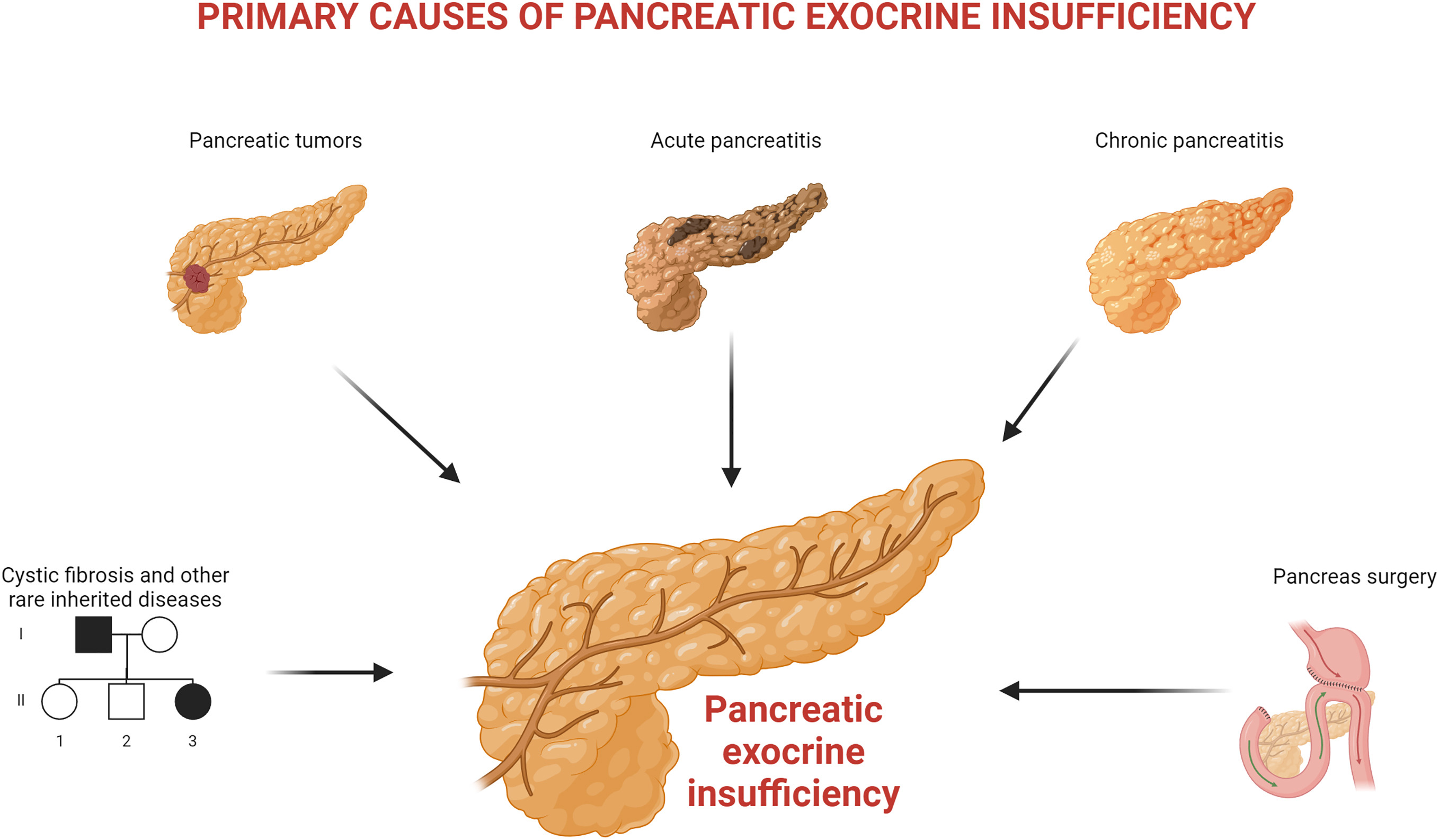
Exocrine pancreatic insufficiency is caused by a loss of pancreatic enzyme production or delivery that results in maldigestion. It is most commonly caused by a loss of pancreatic tissue due to cystic fibrosis, chronic pancreatitis, acute pancreatitis, pancreatic duct blockage, and pancreatic surgery.
Clinical manifestations of exocrine pancreatic insufficiency include steatorrhea, weight loss, sarcopenia, and vitamin deficiencies. Patients may note malodorous stools and an oily film in toilet water.
The diagnosis of exocrine pancreatic insufficiency is based on the presence of both fat malabsorption and decreased pancreatic exocrine function. The American Gastroenterological Association recommends the fecal elastase-1 test as the initial test for diagnosing exocrine pancreatic insufficiency. Pancreatic elastase-1 is a proteolytic enzyme produced by pancreatic acinar cells. It is secreted as a zymogen, which is then converted to an active enzyme in the duodenum by trypsin. Pancreatic elastase degrades proteins so that they can be digested.
A normal fecal elastase-1 concentration is greater that 200 micrograms per gram of stool. The sensitivity of a fecal elastase-1 concentration less than 200 ug/g of stool is 94% and specificity is 69%. A more stringent cutoff of 100 ug/g of stool decreases sensitivity to 88% but increases specificity to 82%. The moderate specificity leads to a significant false-positive rate when fecal elastase is ordered in patients with low pretest probability of exocrine pancreatic insufficiency.
Fecal elastase-1 is measured using an enzyme immunoassay. Specimen requirement is 3 grams of stool placed in a screw-capped plastic vial without preservative.
Reference range is 200 ug elastase per gram of feces or higher. Moderate pancreatic insufficiency is associated with levels between 100 ug and 200 ug of elastase per gram of feces. A level below 100 ug elastase per gram of feces is consistent with severe pancreatic deficiency.
References
Whitcomb DC, Buchner AM, Forsmark CE. AGA, Clinical Practice Update on the epidemiology, evaluation, and management of exocrine pancreatic insufficiency: expert review. Gastroenterology. 2023;165(5):1292-1301.
de la Iglesia D, Agudo-Castillo B, Galego-Fernández M, Rama-Fernández A, Domínguez-Muñoz JE. Diagnostic accuracy of fecal elastase-1 test for pancreatic exocrine insufficiency. United European Gastroenterol J. 2025;13(8):1571-1582.
Ramsey JL, Forsmark CE, Exocrine Pancreatic Insufficiency, JAMA, published online June 10, 2026,



 How to resolve AdBlock issue?