

Hepatitis C virus is a single stranded RNA virus. Hepatitis C virus (HCV) is a major cause of chronic liver disease in the United States. Approximately 4 million people in the United States are currently infected. Of those known to be infected, 2.7 million have chronic liver disease. An estimated 40,000 new infections are suspected each year. Of the six different HCV genotypes, genotype 1 is most common, followed by 2 and 3.
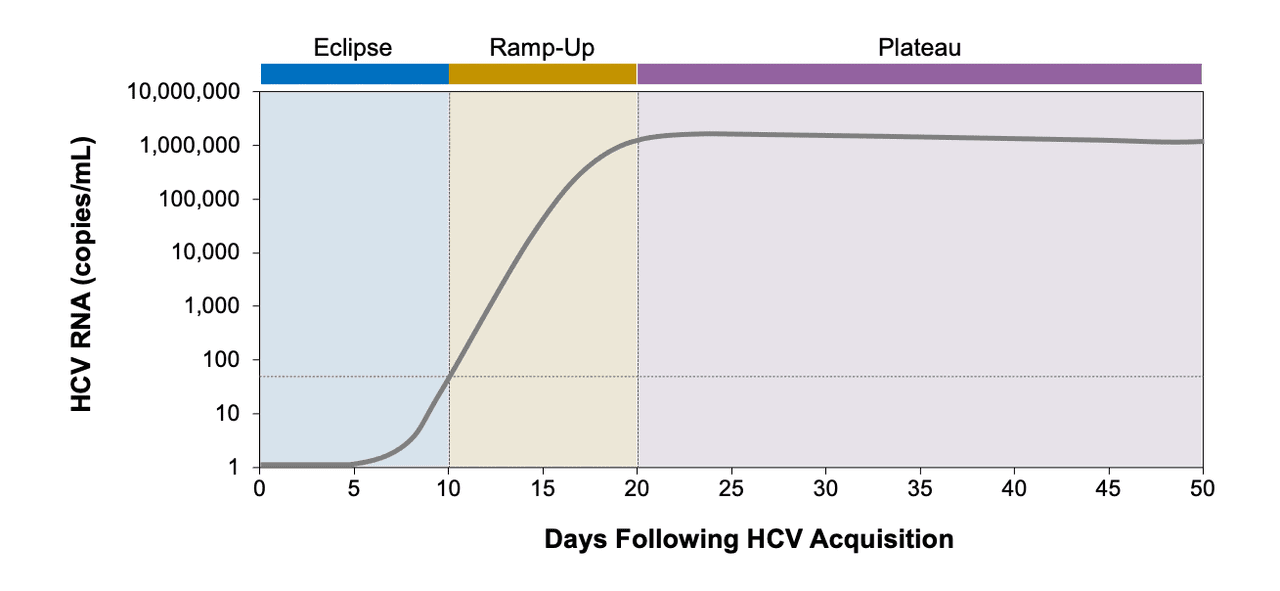
The initial test for hepatitis C (HCV) infection is an immunoassay that detects antibodies to multiple HCV proteins. Supplemental or confirmatory testing is recommended for all reactive HCV antibody tests to determine the presence of active infection. Detection of HCV RNA in the blood by polymerase chain reaction (PCR) is indicative of active infection. PCR testing has been available since September 1995. In this assay, a DNA copy of viral RNA is synthesized by reverse transcription. This DNA molecule is amplified millions of times by PCR. Because of its high sensitivity, PCR can detect HCV infection much sooner than antibody tests. Most patients have detectable levels of HCV RNA in plasma within 1 to 2 weeks of exposure. HCV RNA detection precedes ALT elevation by 10 to 12 weeks and seroconversion by 10 to 24 weeks. The highest levels of circulating viral RNA are found during the early course of infection, suggesting that patients are most infectious during this time. Variation among HCV genotypes is less likely to affect PCR test performance than antibody tests, because PCR primers are based on the highly conserved untranslated region of the HCV genome.
Once HCV infection has been established, quantitative HCV PCR (viral load) can provide prognostic information. Predictors of response to antiviral therapy include viral load of less than 2,000,000 IU/mL, genotype other than 1, shorter duration of infection, female gender, and low body weight. The HCV positive patient with negative viral load should have the test repeated in 3 to 4 months, because some patients with active infection have intermittently undetectable viral loads.
Direct-acting antivirals (DAAs) are oral drugs that are used in combination to target multiple phases of the HCV life cycle. DAAs include inhibitors of the nonstructural 5B RNA polymerase, nonstructural 5A protein, and serine nonstructural 3/4A protease. Because of their high rates of viral eradication and excellent safety profile, current guidelines recommend treatment of all persons infected with HCV unless their life expectancy is less than 1 year due to non–HCV comorbidities. The goal of therapy is to cure HCV infection to prevent cirrhosis, liver decompensation, hepatocellular carcinoma and death. Recommended duration of treatment is 8 to 12 weeks.
Currently available direct acting agents (DAA) for HCV can achieve a sustained virologic response (SVR), which is defined as the absence of detectable virus 12 weeks after completion of treatment. SVR is indicative of a cure of HCV infection. Cure is defined as a sustained viral response, which means undetectable HCV RNA using a sensitive PCR assay with a lower limit of detection (LOD) and lower limit of quantitation (LOQ) of 15 IU/mL.
Virologic relapse is rare 12 weeks or longer after treatment completion (<2 in 1,000 patients). Over 90% of HCV infected persons can be cured of HCV infection regardless of HCV genotype, with 8 to12 weeks of oral therapy. Guidelines recommend confirming SVR 24 to 48 weeks after therapy. More often, viremia after SVR at 12 weeks represents reinfection due to new exposure.
Almost all patients with chronic HCV infection have HCV RNA concentrations greater than 1,000 IU/mL. HCV RNA levels usually rapidly decline after initiation of treatment with DAA. Most patients who relapse will have HCV RNA concentrations above 1,000 IU/mL at 12 to 24 weeks.
The introduction of DAA has decreased the need for assessment of HCV viral load during therapy. HCV RNA quantitation can minimally be done at baseline to establish the need for treatment and 12 weeks after initiation of therapy to assess SVR. More commonly HCV RNA testing is also done at 4 weeks to assess patient compliance.
Most HCV RNA PCR assays target a well conserved 5' NTR region of the HCV genome and are calibrated to a WHO standard which has dramatically improved concordance between different assays. Sensitive HCV RNA PCR have a LLoQ of less than 10 IU/mL. HCV RNA can be detected in blood as early as 2 to 3 weeks after infection.
Many laboratories report results as both IU/mL and log 10 IU. All HCV testing guidelines refer to IUs. HCV copy number reporting is no longer appropriate.
Reference value is negative for HCV-RNA.
Specimen requirement is one SST tube of blood. Tubes containing heparin cannot be used. Serum needs to be separated from cells within six hours of collection and refrigerated or frozen to avoid degradation of viral RNA. Following separation, serum can be frozen and stored for prolonged periods.
References
https://www.hcvguidelines.org/evaluate/monitoring
https://www.mayomedicallaboratories.com/test-catalog/Clinical+and+Interpretive/97291
https://www.hepatitisc.uw.edu/go/treatment-infection/monitoring/core-concept/all
Marks K and Naggie S. Management of Hepatitis C in 2019. JAMA 2019;322:355-56.



 How to resolve AdBlock issue?