

Herpes simplex virus (HSV-1 and HSV-2) infections are found worldwide, even in remote populations. Nearly all adults have antibodies to HSV-1 by the fifth decade of life, and the seroprevalence of HSV-2 has increased at an alarming rate over the last decade.
Herpes simplex virus (HSV) infections occur throughout the year. The incubation period ranges from 1 to 26 days (median 6-8 days). Contact with active ulcerated lesions or asymptomatically excreting persons can result in transmission. The efficiency of transmission is greater during symptomatic periods of viral excretion. HSV has been isolated from nearly all visceral and mucocutaneous sites and is associated with a variety of clinical syndromes including mucocutaneous infections, central nervous system and visceral infections. HSV infections vary widely in severity, from common cold sores to life-threatening infections in infants and immunocompromised hosts. Both viral subtypes, HSV 1 & 2, can cause genital and oral-facial infections.
HSV lesions persist 15 to 20 days in primary infections and about 10 days in recurrent infections. HSV lesions progress through several stages from maculopapules, vesicles, pustules, ulcers, and crusted surfaces. The amount of virus present in lesions is a function of the duration of the infection. The earliest lesions, maculopapules through pustules, contain the highest virus titers. Titers of recoverable virus decline precipitously once the epithelial surface ulcerates.
Differentiation of HSV-1 from HSV-2 is important prognostically, since genital HSV-2 infection is twice as likely to reactivate and recurs 8-10 times more frequently than genital HSV-1 infections. Likewise, oral-labial HSV-1 infection recurs more frequently than oral-labial HSV-2 infection.
Viral culture has been the gold standard for the diagnosis of mucocutaneous lesions. With the introduction of real-time PCR, herpes virus detection can be accomplished
much more rapidly. Studies have shown real-time PCR to be more sensitive and equally specific compared to virus culture for the identification of HSV in genital lesions.
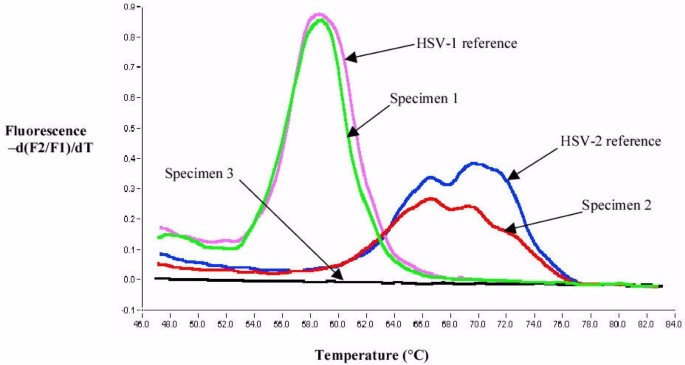
The Roche LightCycler 480 instrument is an automated system that can distinguish HSV-1 from HSV-2 by differences in their melting curves. Reference values are negative results for Herpes simplex virus 1 and 2.
The earliest lesions should be sampled to decrease the incidence of false negative cultures. Fluid should be aspirated from vesicles with a tuberculin syringe and transferred to viral transport media. If lesions are crusted, the crust should be removed with a scalpel blade so that the basal membrane can be swabbed to obtain infected epithelial cells. Dacron, rayon, or cotton swabs should be used and not calcium alginate swabs. Swabs should be immediately placed in viral transport media. All specimens should be refrigerated after collection.
References
Burrows J et al, Detection and subtyping of Herpes simplex virus in clinical samples by LightCycler PCR, enzyme immunoassay and cell culture, BMC Microbiology, 2002;2:1-7.
Binnicker MJ et al, Automated processing, extraction and detection of herpes simplex virus types 1 and 2: A comparative evaluation of three commercial platforms using clinical specimens. J Clin Virol. 2017;89:30-33.



 How to resolve AdBlock issue?