

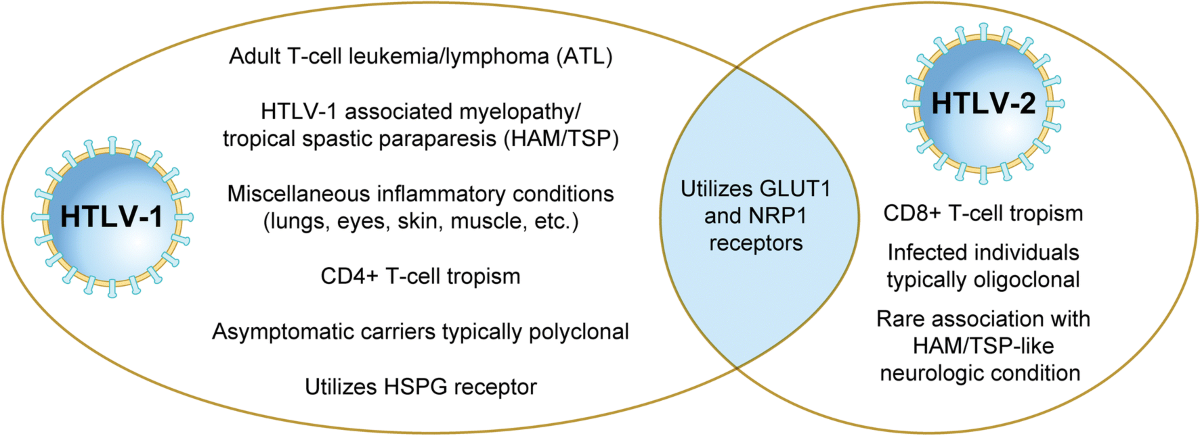
HTLV-1 is a retrovirus that has been associated with adult T cell leukemia/lymphoma (ATLL) and tropical spastic paraperesis (TSP). The latter disease is also known as HTLV-1 associated myelopathy. HTLV-1 infection is endemic in some Asian and African countries as well as in Central America. In the U.S., the virus is found primarily in people of African-American background. HTLV-1 can be transmitted by sexual contact, mother to fetus, needle sharing, and blood transfusion.
ATLL develops in 2 to 5% of infected individuals, mainly those individuals infected at birth. The estimated average time between HTLV-1 infection and malignancy is 20 to 30 years. ATLL is a rapidly aggressive disease with a mean survival of 6 months that presents with symptoms of hypercalcemia, skin infiltration, hepatosplenomegaly, and lytic bone lesions. Leukemic cells have characteristic flower-like lobulated nuclei.
TSP occurs with about the same frequency as ATLL. It is a slow progressive incapacitating myelopathy characterized by spasticity and weakness of lower limbs, paraplegia, sphincter disturbances, and various degrees of sensory loss.
Blood donors are routinely screened for HTLV-1 antibody. In the US, the seroprevalence rate among voluntary blood donors is only 0.016%. Approximately 30% of the recipients, who received HTLV-1 positive units prior to the introduction of testing, have seroconverted. Very few (1%) of these patients have progressed to leukemia or paresis, due to the long latency period.
Another related virus, HTLV-2 was originally isolated from two patients with hairy cell leukemia in 1982. This virus may also cause neurologic disease similar to TSP. It is transmitted by blood and sexual intercourse. Most males in the U.S. with HTLV-2 infection have a history of drug abuse, while most infected females have a history of sexual contact with known IV drug users.
Specimens are initially tested for antibodies to HTLV-1 and HTLV-2 with an enzyme immunoassay (EIA). All positive results should be confirmed by another EIA or Western blot.
A positive Western blot for HTLV-1 is indicated by the presence of IgG antibodies binding to gp21-I/-II band, or 3 or more bands. The sum of the gp46-I and p19-I band intensity should be greater than the gp46-II band intensity.
A positive Western blot HTLV-II is indicated by the presence of IgG antibodies binding to 2 bands that include gp21-I/-II, or 3 or more bands. The gp46-II band intensity should be greater than the gp46-I band intensity and greater than or equal to the sum of the gp46-I and p19-I band intensity.
Results are reported as positive or negative. The reference value is negative.
Specimen requirement is one SST tube of blood.
References
Martinez, M.P., Al-Saleem, J. & Green, P.L. Comparative virology of HTLV-1 and HTLV-2. Retrovirology,2019;16, 21
Gessain A, Mahieux R. Tropical spastic paraparesis and HTLV-I associated myelopathy: clinical, epidemiological, virological, and therapeutic aspects. Rev Neurol (Paris). 2012;168(3):257-269.
Mahieux R, Gessain A. Adult T-cell leukemia/lymphoma and HTLV-I. Curr Hematol Malig Rep. 2007;2(4):257-264.
Marrero Rolon RM, Yao JDC. Laboratory diagnosis of HTLV-1-associated myelopathy. Clin Microbiol Newslett. 2020;42(16)129-134.



 How to resolve AdBlock issue?