

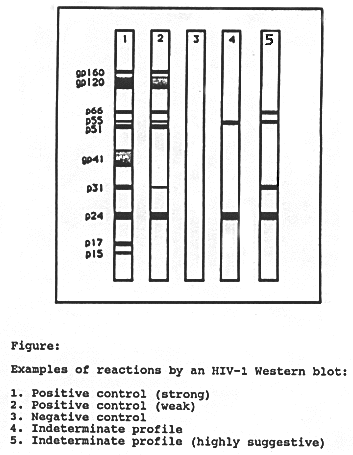
The first enzyme immunoassay (ELISA) for HIV antibody was developed in 1985. It was originally designed to screen blood products, not to diagnose AIDS. Samples that were repeatedly reactive for HIV-1 antibody had to be retested with a more specific confirmatory test to rule out a false positive result. For many years, Western blot was the most widely used serologic test for distinguishing between true and false positive ELISA results.
The Western blot assay detected antibodies that reacted with specific proteins (antigens) of the HIV-1 virus. The gene products that were used to interpret Western blot results are shown in the table below.
|
Gene |
Antigen |
Description |
Immunogenicity |
Detection |
|
Envelope |
gp160 |
gp precursor |
High |
Earliest |
|
|
gp120 |
outer gp |
High |
Earliest |
|
|
gp41 |
transmembrane |
Moderate - High |
2-4 wk later |
|
Gag |
p55 |
gag precursor |
Moderate |
2-4 wk later |
|
|
p24 |
gag protein |
Moderate |
Earliest |
|
|
p17 |
gag protein |
Weak |
Earliest |
|
Polymerase |
p66 |
rev transcriptase |
Moderate |
2-4 wk later |
|
|
p51 |
rev transcriptase |
Moderate |
2-4 wk later |
|
|
p31 |
endonuclease |
Moderate |
3-6 wk later |
A consistent sequence of antibody responses occurs after infection. The earliest antibodies to appear are directed against gp160, gp120, p24, and p17, followed shortly by antibodies to gp41, p55, p66, and p51. Anti-p31 appears later. Antibodies to p24 and p55 decline after the onset of symptoms, while antibodies to envelope glycoproteins persist. Anti-p31 also diminishes, but not to the same extent as anti-p24. In some cases, reactions with gp120 and gp160 may be due to antibodies binding to multimers of gp41.
The criteria established by the Centers for Disease Control and the Association of State and Territorial Public Health Laboratory Directors for interpretation of Western blots are summarized in the following table.
|
Interpretation |
Bands Present |
|
Positive |
Presence of any 2 bands; p24, gp41, gp120/160 |
|
Negative |
absence of bands |
|
Indeterminate |
any other combination of bands |
The majority of indeterminate patterns consisted of p17, p24, or p55 alone, or combinations of these 3 bands. Indeterminate patterns could represent either false positives results or early seroconverters. The complete medical history must be considered in interpreting indeterminate Western blots. Individuals with a positive Western blot lacking the p31 band needed to be counseled that, although they may be infected, the results were inconclusive. These individuals needed to be further evaluated by HIV RNA PCR testing and follow-up HIV serologic testing. Most seroconversions were detected in repeat Western blots within 3 months. Persons with stable indeterminate patterns lasting 6 months or more, in the absence of known risk factors and clinical symptoms, were considered negative for HIV-1 antibodies.
Third generation ELISAs for HIV-antibody were introduced in the 1990’s. They were able to detect seroconversion within 22 days after infection, which was much sooner than Western blots, which required 48 days or more. This the dilemma of repeatedly reactive ELISA results with a falsely-negative Western blot assay.
In 2013, CDC and the Clinical Laboratory Standards Institute (CLSI) designed a new HIV testing algorithm that replaced Western blot with an HIV-1/HIV-2 differentiation immunoassay that was known as Multispot. Besides detecting seroconversion earlier than Western blot, Multispot also eliminated most of the indeterminate Western blot results that occurred due to nonspecific reactivity.
Therefore, the HIV Western blot became obsolete. It is not longer used for clinical diagnosis of HIV infection.
References
Alexander TS. Human Immunodeficiency Virus Diagnostic Testing: 30 Years of Evolution. Clin Vaccine Immunol. 2016 Apr;23(4):249-53.
Cordes RJ, Ryan ME. Pitfalls in HIV testing. Application and limitations of current tests. Postgrad Med. 1995 Nov;98(5):177-80, 185-6, 189.
Houn HY, Pappas AA, Walker EM. Status of current clinical tests for human immunodeficiency virus (HIV): applications and limitations. Ann Clin Lab Sci. 1987 Sep-Oct;17(5):279-85.
HIV Diagnostic Testing, National HIV Curriculum, November 16, 2025, 1-54. https://www.hiv.uw.edu/go/screening-diagnosis/diagnostic-testing/core-concept/all



 How to resolve AdBlock issue?