

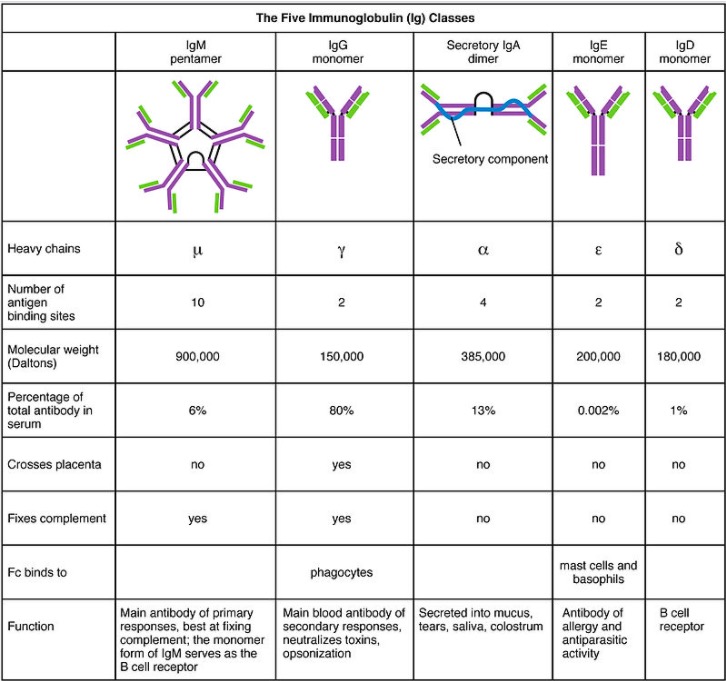
Immunoglobulins are produced by plasma cells following exposure to foreign antigens. IgM antibodies are typically produced first, followed by IgG and IgA antibodies.
Quantitative measurement of immunoglobulins can provide insight into the status of the humoral immune system. Decreased serum immunoglobulin concentrations occur in primary immunodeficiencies as well as in secondary immune insufficiencies that may accompany other diseases.
Elevation of all the immunoglobulins (polyclonal gammopathy) is seen in chronic inflammatory and autoimmune diseases. An increase of a single immunoglobulin (monoclonal gammopathy) occurs in plasma cell dyscrasias such as multiple myeloma, Waldenstrom macroglobulinemia. In these latter conditions, other immunoglobulins may be suppressed.
IgG, IgA, and IgM are measured by nephelometry.
Adult reference ranges are:
|
IgG |
767-1590 mg/dL |
|
IgA |
61-356 mg/dL |
|
IgM |
37-286 mg/dL |
Specimen requirement is one red top or gel-barrier tube of blood.
References
Kyle RA. Detection of quantitation of monoclonal proteins. Clin Immunol Newsletter. 1990;10:84-86.
Webster ADB: Laboratory investigation of primary deficiency of the lymphoid system. Clinics Immunol Allergy. 1985:5:447-468.



 How to resolve AdBlock issue?