

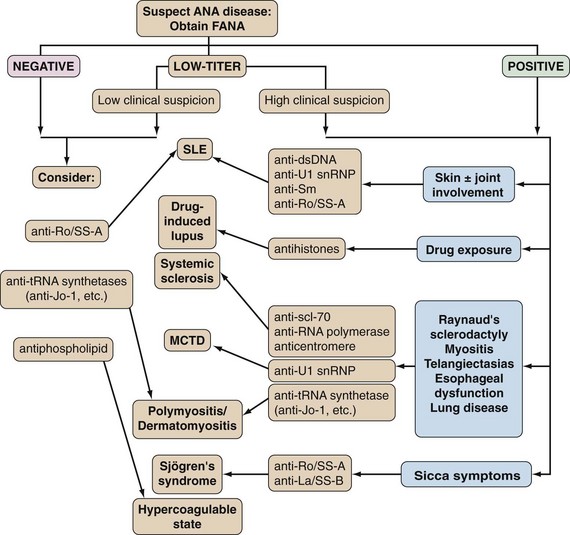
Serologic tests for autoantibodies, including antinuclear antibodies (ANAs) and antibodies to specific nuclear antigens such as double-stranded DNA (dsDNA), play an important role in the diagnosis of systemic rheumatic diseases. However, test results for autoantibodies alone are insufficient to establish the diagnosis of a systemic rheumatic disease. No tests for autoantibodies should be performed without a clinical evaluation that leads to a presumptive diagnosis.
The original discovery of ANA was based on indirect immunofluorescence. Immunofluorescent antibody (IFA) is still the most commonly utilized method for detection of antinuclear antibodies. In this method, diluted patient serum is incubated on a slide containing a monolayer of human epithelial cells. If antibody is present, it binds to cell nuclei. After washing, bound antibody is detected by adding fluorescent anti-human IgG. Positive cells demonstrate bright green nuclear fluorescence with a distinct staining pattern. Patient samples are initially tested at a dilution of 1:40 to 1:160. Positive samples are then diluted and both the fluorescent pattern and titer are reported. The titer is the highest dilution of serum that still shows immunofluorescent nuclear staining.
Hep-2 cells are the preferred cell line due to their human origin, high mitotic activity, and the ability to induce expression of clinically important antigens. HEp-2 cells have an estimated 100 to 150 antigens, the most of any method, allowing for detection of the greatest number of antibody specificities.
Specific follow-up tests for antibodies to the following antigens are available: dsDNA, Sm, RNP, SS-A (Ro), SS-B (La,) Scl-70, histones, and Jo-1. Because the diseases associated with these tests tend to be dynamic, negative findings might need to be rechecked if the clinical circumstances have changed considerably over time.
Patients with dermatomyositis and polymyositis have inflammatory infiltration and destruction of muscle and other organ systems. Autoantibodies to the Jo-1 antigen, have been associated with pulmonary involvement and arthritis. The Jo-1 antigen resides on the enzyme, histidyl-tRNA synthetase, which is usually located in the cytoplasm of cells, rather than the nucleus. For this reason, patients with Jo-1 antibodies may have a negative ANA. Antibodies to the Jo-1 antigen are detected in approximately 25% of adult patients with myositis including; polymyositis, dermatomyositis, and overlap syndromes. Jo-1 antibodies are most commonly found in patients (68%) with a combination of myositis and interstitial pulmonary fibrosis.
Anti-Jo-1 antibodies are also detected in patients with the antisynthetase syndrome, which is a group of inflammatory myopathic disorders. The classic triad of antisynthetase syndrome consists of interstitial lung disease (ILD), myositis, and nonerosive arthritis. Of the 10 identified antiaminoacyl-tRNA synthetases, the syndrome has been most often associated with autoantibodies to 3 of them: anti–Jo-1 antibody (60% of cases), anti–PL-12 (17%), and anti–PL-7 (12%).
Jo-1 antibodies are detected by an enzyme-linked immunoassay. Specimen requirement is one red top tube of blood.
For more comprehensive information, see the articles entitled: “Antinuclear Antibodies” and “Antisynthetase Syndrome.”
References
Ghias A et al. Patient with Pulmonary Symptoms, Dysphagia, and Raynaud Disease, JAMA 2023;330:658-59.
Lundberg IE, Tjärnlund A, Bottai M, et al; International Myositis Classification Criteria Project Consortium, Euromyositis Register, and Juvenile Dermatomyositis Cohort Biomarker Study and Repository (JDRG) (UK and Ireland). 2017 European League Against Rheumatism/American College of Rheumatology classification criteria for adult and juvenile idiopathic inflammatory myopathies and their major subgroups. Ann Rheum Dis. 2017;76(12):1955-1964.
Marco JL, Collins BF. Clinical manifestations and treatment of antisynthetase syndrome. Best Pract Res Clin Rheumatol. 2020;34(4):101503.
Zhao N, Jiang W, Wu H, et al. Clinical features, prognostic factors, and survival of patients with antisynthetase syndrome and interstitial lung disease. Front Immunol. Published online August 10, 2022. doi:10.3389/fimmu.2022.872615
Huang K, Aggarwal R. Antisynthetase syndrome: a distinct disease spectrum. J Scleroderma Relat Disord. 2020;5(3):178-191. doi:10.1177/2397198320902667



 How to resolve AdBlock issue?