

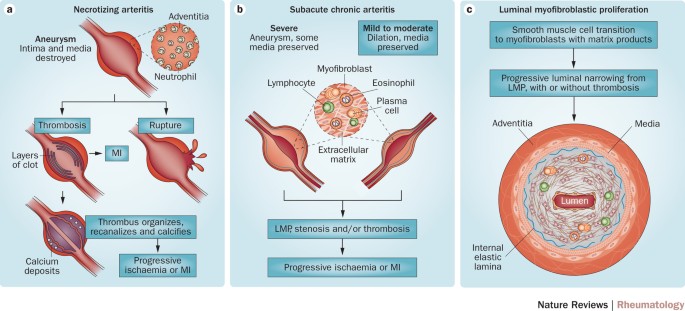
Kawasaki disease (KD) is one of the most common vasculitides of childhood. KD occurs less commonly in adults. It is typically a self-limited condition, with fever and manifestations of acute inflammation lasting for an average of 12 days without therapy. However, complications such as coronary artery aneurysms, heart failure, myocardial infarction, arrhythmias, and peripheral arterial occlusion may develop and lead to significant morbidity and mortality.
The clinical features of KD reflect widespread inflammation of medium and small-sized blood vessels. Diagnosis is based upon evidence of systemic inflammation, as evidenced by fever, in association with signs of mucocutaneous inflammation. Diagnostic guidelines were established by Tomisaku Kawasaki in 1967 and include the presence of fever lasting ≥five days, combined with at least four of the five following physical findings, without an alternative explanation:
- Bilateral nonexudative conjunctivitis
- Oral mucous membrane changes including injected or fissured lips, injected pharynx, or strawberry tongue
- Erythema of palms or soles, edema of hands or feet and periungual desquamation
- Polymorphous rash
- Cervical lymphadenopathy (at least one lymph node >1.5 cm in diameter)
KD remains a clinical diagnosis. No laboratory tests are included among the diagnostic criteria for typical KD. Patients usually have systemic inflammation resulting in elevated CRP, erythrocyte sedimentation rate, leukocytosis and a left-shift in the WBC count. Platelets are often elevated due to a reactive thrombocytosis. Normochromic, normcytic anemia may be present. Urinalysis may reveal positive leukocyte esterase and increased white blood cells. Cerebrospinal fluid (CSF) may display a mononuclear pleocytosis with normal CSF glucose and protein levels. Similarly, arthrocentesis of involved joints typically demonstrates a pleocytosis, with 125,000 to 300,000 white cells/mm3, primarily neutrophils.
Patients may have significant perturbations in serum lipid profiles, including elevated triglycerides and low density lipoproteins, and depressed high density lipoproteins. Lipid results generally revert to normal within weeks or months following IVIG therapy. Hyponatremia (serum sodium <135 mEq/L) may be seen and is associated with an increased risk of coronary artery aneurysms.
Treatment consists of intravenous immune globulin (IVIg) and aspirin. Treatment with IVIG within the first 10 days of illness reduces the prevalence of coronary artery aneurysms fivefold compared with untreated patients. Thus, it is desirable to diagnose KD as soon as possible after the criteria are met. However, timely identification is challenging because the diagnosis is based upon nonspecific clinical signs and there is no definitive diagnostic test.
References
Jone PN, et al. Update on Diagnosis and Management of Kawasaki Disease: A Scientific Statement From the American Heart Association, Circulation 2024;150(23): https://doi.org/10.1161/CIR.0000000000001295
Gerding R. Kawasaki Disease: A Review, J Ped health Care,2011;25(6):379-387.
Day-Lewis M et al. Kawasaki Disease: contemporary perspectives, The Lancet Child Adolescent Health,2024;8(10):781-792.



 How to resolve AdBlock issue?