

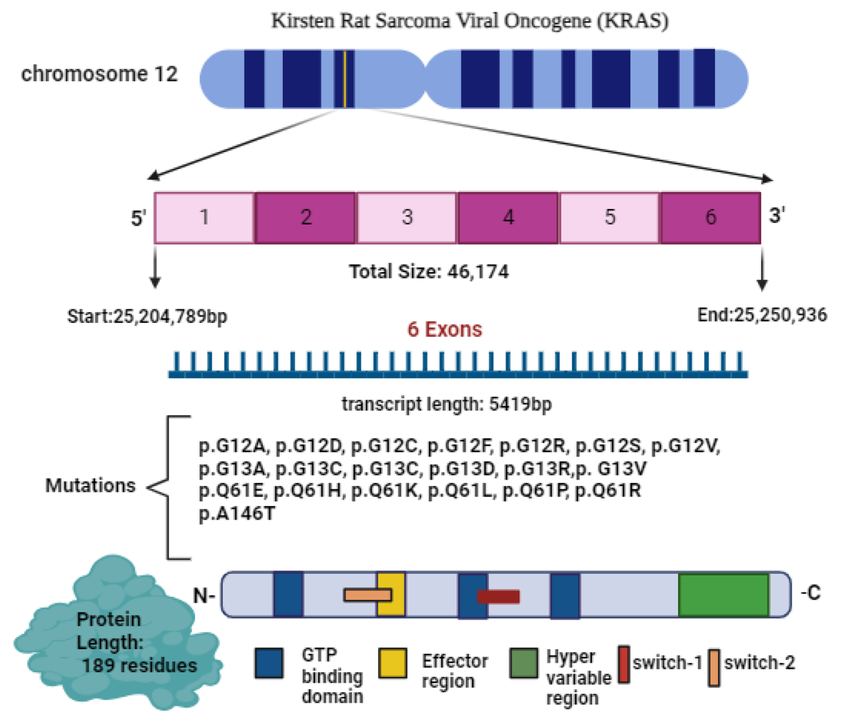
The KRAS oncogene is the cellular homolog of the Kirsten rat sarcoma virus gene. The KRAS gene codes for a guanosine triphosphate (GTP) binding protein involved in downstream cell signaling pathways such as MAPK, JAK-STAT and PI3K. These pathways play key roles in regulating cell proliferation, differentiation and apoptosis. KRAS protein also acts as a key signal transducer for the Epidermal Growth Factor receptor (EGFR).
The EGF cell-signaling pathway has become a major target for treatment of colon, lung and head and neck tumors with both anti-EGFR monoclonal antibody and small-molecule tyrosine kinase inhibitors. Monoclonal antibodies targeted against the EGFR have been shown to be effective treatments in patients with metastatic colon cancer when used alone or added to standard chemotherapeutic regimens.
The mutation frequency for the KRAS gene in metastatic colon cancers has been reported to be in the range of 30–55%. The most commonly mutated codons are 12, 13, 61, and 146. Codon 12 mutations are the most frequent, especially 35G>A (G12D) and 35G>T (G12V). Other significant mutations occur in codon 13 with 38G>A (G13D) being the most common variant. Less frequently, mutations occur in codons 61 and 146.
Key KRAS codons and mutations
- Codon 12: The most frequently mutated codon, with common changes including:
- G12D (Glycine to Aspartic Acid)
- G12V (Glycine to Valine)
- G12C (Glycine to Cysteine)
- G12R (Glycine to Arginine)
- Codon 13: Another common site for mutations, such as:
- G13D (Glycine to Aspartic Acid)
- G13C (Glycine to Cysteine)
- Codon 61: Mutations in this codon include:
- Q61H (Glutamine to Histidine)
- Q61L (Glutamine to Leucine)
- Codon 146: A less common but still significant mutation site includes:
- A146T (Alanine to Threonine)
The presence of a KRAS mutation is a negative predictor of response to anti-EGFR monoclonal antibodies panitumumab (Vectibix™) and cetuximab (Erbitux™) in metastatic colon cancers.
Given the strength of the data from these studies, in 2009 the American Society of Clinical Oncology (ASCO) and the National Comprehensive Cancer Network (NCCN) recommended that colorectal tumor samples be evaluated for KRAS mutations before a monoclonal antibody based therapy against EGFR be considered for a given patient. It is now standard laboratory practice to assess formalin-fixed paraffin-embedded tumor tissues from patients with metastatic colon cancer for KRAS mutation status.
KRAS mutations are detected in 10 to 22% of patients with lung cancer. Mutation frequency is dependent on cancer type (adenocarcinoma vs squamous cell carcinoma), smoking history and presence of other genetic lesions, such as EGFR mutations and ALK gene fusions. Approximately 97% of mutations are found in codons 12 and 13, with the remainder in codons 61 and 146. The presence of a KRAS mutation is associated with resistance to the small-molecule inhibitors erlotinib (Tarceva™) and gefitinib (Iressa™).
Three of the commonly used methods for KRAS mutation detection include nucleic acid sequencing, real-time PCR with melt–curve analysis and allele-specific PCR with various modes used to distinguish mutant from wild-type sequences. PCR methods have a limit of detection (LOD) of 1 to 5% for detecting mutations within a background of wild-type DNA.
Specimen requirement is formalin-fixed, paraffin-embedded (FFPE) tissue block or four unstained slides and one matching H&E-stained slide. Samples with >4 mm² and ≥50% tumor content are preferred. A copy of the pathology report must accompany the specimen.
References
National Comprehensive Cancer Network. NCCN Clinical Practice Guidelines in Oncology: Colon Cancer v2.2015. Fort Washington, Pa: NCCN; 2015.
National Comprehensive Cancer Network. NCCN Clinical Practice Guidelines in Oncology: Rectal Cancer v2.2015. Fort Washington, Pa: NCCN; 2015.
National Comprehensive Cancer Network. NCCN Clinical Practice Guidelines in Oncology: Non-Small Cell Lung Cancer v3.2015. Fort Washington, Pa: NCCN; 2015.
Bokemeyer C, Van Cutsem E, Rougier P, et al. Addition of cetuximab to chemotherapy as first-line treatment for KRAS wild-type metastatic colorectal cancer: Pooled analysis of the
CRYSTAL and OPUS randomised clinical trials. Eur J Cancer. 2012 Jul; 48(10):1466-1475. PubMed 22446022
Douillard JY, Siena A, Cassidy J, et al. Randomized, phase III trial of panitumumab with infusional fluorouracil, leucovorin, and oxaliplatin (FOLFOX4) versus FOLFOX4 alone as first-line treatment in patients with previously untreated metastatic colorectal cancer: The PRIME study. J Clin Oncol. 2010 Nov 1; 28(31):4697-4705. PubMed 20921465
Karachaliou N, Mayo C, Costa C, et al. KRAS mutations in lung cancer. Clin Lung Cancer. 2013 May; 14(3):205-214. PubMed 23122493



 How to resolve AdBlock issue?