

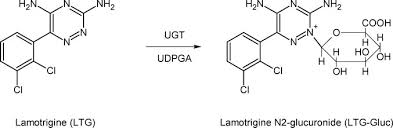
Lamotrigine (Lamictal) is an antiepileptic drug that is widely used for treatment of partial seizures and bipolar disorder. Lamotrigine is the preferred antiepileptic drug to treat pregnant women experiencing seizures.
Lamotrigine is 55% bound to plasma proteins and is metabolized predominantly to an inactive 2-N-glucuronide conjugate. Peak plasma concentration occurs at 1.4 to 4.8 hours following oral administration. The elimination half-life varies from 12 to 70 hours. Longer half-lives occur in patients on concomitant valproic acid therapy. Common adverse effects include dizziness, drowsiness, insomnia, headache, blurred or double vision, ataxia, tremor, nausea, and rash. Serious adverse events include Stevens Johnson syndrome and toxic epidermal necrolysis.
Plasma levels of lamotrigine are measured by homogenous immunoassay. The therapeutic range for trough levels is 2.0-20.0 ug/mL. Toxic effects are more common when the plasma concentration exceeds 15 ug/mL, but some patients can tolerate higher concentrations. Specimen requirement is a red-top or green-top tube of blood. Tubes with gel barriers should not be used.
References
Morris RG, et al. Lamotrigine and therapeutic drug monitoring: Retrospective survey following the introduction of a routine service. Brit J Clin Pharmacol.1998;46(6):547-551.
Patsalos PN, et al. Antiepileptic drugs--best practice guidelines for therapeutic drug monitoring: A position paper by the subcommission on therapeutic drug monitoring, ILAE Commission on Therapeutic Strategies. Epilepsia. 2008;49(7):1239-1276.



 How to resolve AdBlock issue?