

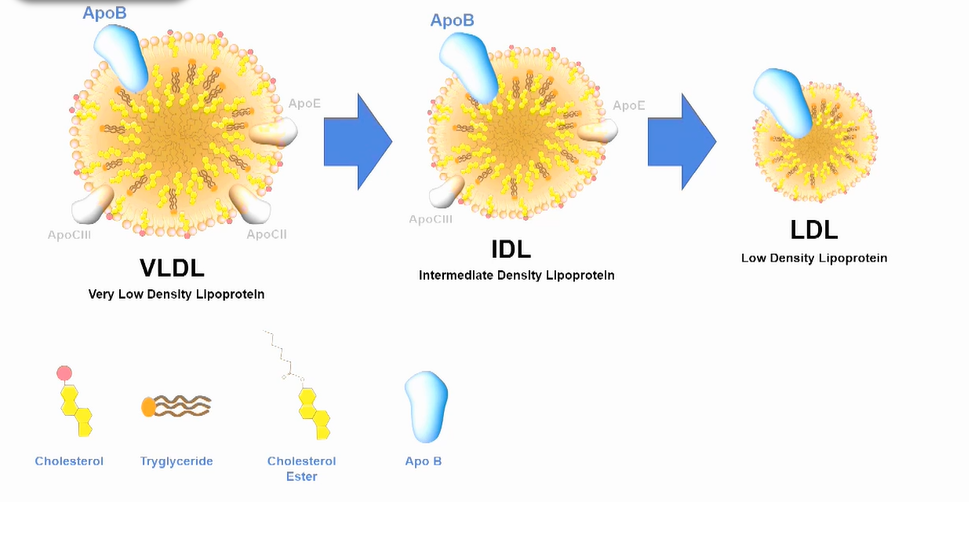
Cholesterol and triglycerides are the major lipids that are transported in plasma by lipoproteins. The liver combines a single apolipoprotein B molecule, triglycerides and cholesterol into an apoB lipoprotein particle (apoB). After the liver secretes apoB into plasma, it is called very low- density lipoprotein (VLDL).
Triglycerides are rapidly removed by the enzyme lipoprotein lipase and used for energy consumption and storage. As triglycerides are progressively removed, the lipoprotein is referred to as a VLDL remnant particle. After most of the triglycerides have been removed, the lipoprotein becomes denser and is referred to as low-density lipoprotein (LDL). The conversion of VLDL to LDL takes approximately 6 hours. It is important to realize that a VLDL particle, a VLDL remnant particle, and an LDL particle are really different names for the same circulating apoB lipoprotein at different stages in its lifecycle, depending on its lipid content.
LDL remains in the circulation for about 48 hours. Under normal physiological conditions, LDL is removed from the circulation by LDL receptors on hepatocytes. At any point in its lifecycle, regardless of its lipid content, an apoB lipoprotein less than 70 nm in diameter can cross the endothelium, where it may be returned to circulation via the lymphatic system or become trapped in an arterial wall. Trapping of apoB lipoprotein in the arterial wall increases endothelial permeability and causes inflammation. Endothelial cells express adhesion molecules that capture monocytes which transform to macrophages. Release of cholesterol to macrophages results in the creation of foam cells. Over time, the atherosclerotic plaque slowly enlarges as more apoB-containing VLDL, remnant, and LDL particles become trapped in the artery wall. Smooth muscle cells are transferred from the middle layer of the arterial wall into the tunica intima and begin forming a fibrous cap. In advanced lesion, smooth muscle cells and macrophages die by apoptosis and contribute extracellular lipid and necrotic debris to the core of the atheroma. If the fibrous cap of a plaque ruptures, the coagulation cascade is activated and thrombosis occurs. Atherosclerotic cardiovascular diseases (ASCVD) include stroke, transient ischemic attack (TIA), coronary artery disease (CAD) with stable angina, acute coronary syndromes (ACS), peripheral vascular disease, and aortic aneurysm.
Elevated LDL cholesterol is a major cause of atherosclerotic cardiovascular disease (ASCVD). The relationship between LDL cholesterol levels and CHD risk is continuous over a broad range of LDL levels. LDL-C is the total cholesterol content carried by LDL particles. LDL-C can either be directly measured by immunoassay or estimated using the Friedewald equation.
LDLC = Total Cholesterol – (HDL cholesterol − Triglycerides/5)
Plasma triglyceride concentration (mg/dL) divided by 5 is an estimate of the cholesterol content carried by triglyceride-rich lipoproteins, which is an estimate of the concentration of circulating VLDL and remnant particles
The Friedewald equation increasingly underestimates the true LDL-C value as triglyceride levels increase. For this reason, most laboratories do not report LDL levels when triglycerides are above 400 mg/dL. But the calculation is affected to some extent at all triglyceride levels above 100 mg/dL. A falsely low LDL-C level may give a patient and their physician a false sense of reassurance. Patients with diabetic dyslipidemia and related conditions, such as the metabolic syndrome, often have elevated triglycerides, low HDL, and relatively normal calculated LDL values.
Another option is to directly measure LDL cholesterol by an enzymatic method. Direct LDL cholesterol can be ordered and performed on the same specimen as a Lipid Panel.
The National Lipid Association and the National Cholesterol Education Program (NCEP) have set the following guidelines for LDL-C in adults (ages 18 years and older):
|
Age |
Desirable |
Borderline |
High |
|
0-19 Years |
109 mg/dL or lower |
110-129 mg/dL |
130 mg/dL or higher |
|
20 Years & Older |
129 mg/dL or lower |
130-159 mg/dL |
160 mg/dL or higher |
For primary prevention in patients with LDL-C of 190 mg/dL or higher, high-intensity statin therapy is recommended to reduce LDL-C by more than 50% and to less than 100 mg/dL.
NCEP guidelines for interpretation are based on serum values. A factor of 1.06 should be used to convert plasma values to serum values.
For a more comprehensive discussion, see the article entitled: “Lipid Panel.”
References
1. Wilson PWF, Polonsky TS, Miedema MD, et al. Systematic review for the 2018 AHA/ACC/AACVPR/ AAPA/ABC/ACPM/ADA/AGS/APhA/ASPC/NLA/PCNA guideline on the management of blood cholesterol [published online November 10, 2018].J AmColl Cardiol. doi:10.1016/j.jacc.2018.11.004
2. Grundy SM, Stone NJ, Bailey AL, et al. 2018 AHA/ACC/AACVPR/AAPA/ABC/ACPM/ADA/AGS/ APhA/ASPC/NLA/PCNA guideline on the management of blood cholesterol [published online November 10, 2018]. J AmColl Cardiol. doi:10.1016/j.jacc.2018.11.003
3. Doran B, Guo Y, Xu J, et al. Prognostic value of fasting versus nonfasting low-density lipoprotein cholesterol levels on long-term mortality. Circulation. 2014;130(7):546-553.
4. Alenghat FJ and Davis AM, Management of Blood Cholesterol, JAMA Clinical Guidelines Synopsis. (published on line Feb 4, 2019) doi:10.1001/jama.2019.0015



 How to resolve AdBlock issue?