

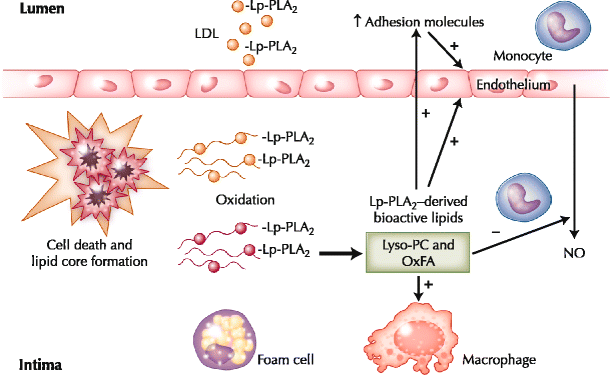
Lipoprotein-associated phospholipase A2 (Lp-PLA2) is an enzyme produced by macrophages that circulates in plasma bound to low-density lipoprotein (LDL). Lp-PLA2 is expressed in greater concentrations by macrophages and foam cells in atherosclerotic plaques. Lp-PLA2 participates in the oxidation of LDL, which is thought to increase inflammation, atherosclerosis and plaque instability.
Because Lp-PLA2 is produced by macrophages and foam cells in the vascular intima, it is thought be a more specific indicator of vascular inflammation than other inflammatory markers such as CRP. After adjustment for traditional risk factors, Lp-PLA2 is an independent risk factor for coronary heart disease and ischemic stroke in the general population.
Because current treatment guidelines recommend statin therapy for patients with LDL >130 mg/dL, there is little justification for ordering Lp-PLA2 activity for patients with moderate or high risk of coronary heart disease. Lp-PLA2 may play a minor role in identifying a small subgroup of patients who do not have elevated LDL cholesterol, but would benefit from statin therapy. Lp-PLA2 activity decreases after statin therapy, which is not surprising since Lp-PLA2 is bound to apo-B lipoprotein in LDL cholesterol.
Reference Range for individuals 18 years or older is 0-224 U/mL. U/mL is equivalent to nmol/min/mL.
Individuals with Lp-PLA2 levels higher than the reference values are at increased risk of coronary heart disease events. Reference values have not been established for patients who are less than18 years of age.
The PLAC test for LP-PLA2 activity is an enzyme assay in which LP-PLA A2 hydrolyzes 1-myristoyl-2-(4-nitrophenylsuccinyl) phosphatidylcholine, producing 4-nitrophenol, a colored product that is detected spectrophotometrically. Lp-PLA2 activity is calculated from the rate of formation of 4-nitrophenol.
Specimen requirement is a red-top or serum separator tube of blood.
Reference
Stein EA. Lipoprotein Associated Phospholipase A2 measrurements: Mass, Activity, but little productivity. Clinical Chemistry 2012;58:814-17.



 How to resolve AdBlock issue?