

Luteinizing Hormone (LH) is a glycoprotein released by the anterior pituitary in response to gonadotropin releasing hormone (GnRH) from the hypothalamus. LH is composed of an alpha subunit that is identical to the alpha subunit of TSH, FSH and hCG, and a beta subunit which gives it specificity.
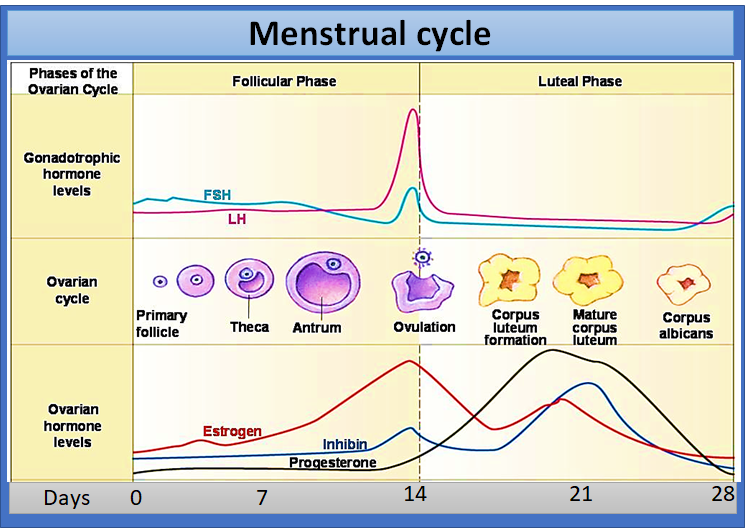
Secretion of LH occurs in different patterns. The major pattern in males is tonic. Gonadal steroids exhibit negative feedback to inhibit secretion of LH and FSH. A cyclic pattern is present in females in which increased plasma estrogens exhibit positive feedback and stimulate the release of LH and FSH during ovulation. LH acts on the developing follicle to stimulate androgen production, which is the precursor of estradiol. There is a fall in FSH antecedent to the surge and then both gonadotropins peak at midcycle. A third pattern of secretion, pulsatile, occurs in males and females and is independent of blood concentration of gonadal steroids or gonadotropins.
Low or absent LH (hypogonadism) may be primary, secondary or tertiary. Primary hypogonadism is characterized by decreased steroid secretion and increased LH, FSH and GnRH due to removal of the negative feedback. Secondary hypogonadism (pituitary) results in decreased FSH and LH levels. Tertiary hypogonadism is caused by decreased GnRH. LH levels may be increased in cases of gonadal lesions.
LH is measured by an electrochemiluminescence immunoassay. Reference ranges are age and gender specific. Adult reference ranges are:
|
Males |
IU/L |
|
Adult |
1.3-9.6 |
|
Female |
IU/L |
|
Follicular |
1.9-14.6 |
|
Midcycle |
12.2-118.0 |
|
Luteal |
0.7-12.9 |
|
Postmenopausal |
5.3-65.4 |
Postmenopausal levels are usually higher than 40 IU/L.
Specimen requirement is one red-top or gel-barrier tube of blood.
References
Beastall GH, et al. Assays for follicle stimulating hormone and luteinizing hormone: Guidelines for the provision of a clinical biochemistry service. Ann Clin Biochem. 1987; 24(Pt 3):246-262.
Johnson MR, et al. Relationship between ovarian steroids, gonadotropins and relaxin during the menstrual cycle. Acta Endocrinol (Copenh). 1993; 129(2):121-125.



 How to resolve AdBlock issue?