

Malaria is a major tropical disease infecting approximately 500 million people worldwide. In the United States, most cases involve individuals who have traveled to endemic areas. Approximately 2,000 cases of malaria and 7 malaria-related deaths have been reported annually to CDC.
Anopheles mosquitoes capable of transmitting malaria are present across most of the United States. The majority of US residents lack protective immunity against malaria. During 2023, ten cases of locally acquired (autochthonous) malaria occurred in 4 states.
Malaria is caused primarily by 4 species of the protozoa Plasmodium: Plasmodium falciparum, Plasmodium vivax, Plasmodium malariae, and Plasmodium ovale. A fifth Plasmodium species, Plasmodium knowlesi, is more common in Southeast Asia. It is especially important to correctly identify Plasmodium falciparum and Plasmodium knowlesi because they cause life-threatening infections. Plasmodium falciparum has become resistant to many commonly used antimalarial medications including chloroquine. Most local US outbreaks have been caused by Plasmodium vivax.
Malaria is transmitted to humans through bites from infective female mosquitoes of the Anopheles genus. Plasmodium infection can result in a spectrum of disease ranging from asymptomatic parasitemia to severe illness and death. Patients might first experience nonspecific signs and symptoms such as fever, chills, headache, weakness, myalgia, vomiting, and diarrhea. More severe symptoms included altered mental status, circulatory failure, shock, multi-system organ failure, and death.
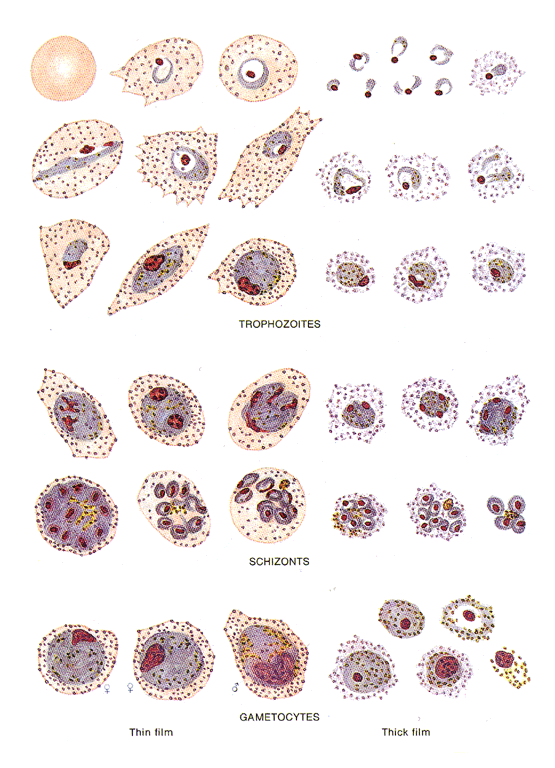
The standard laboratory method for detection and differentiation of malaria parasites is microscopic examination of Giemsa-stained thick and thin blood films. The sensitivity of thick film microscopy is estimated to be 10 to 30 parasites per microliter of blood. Prolonged exposure to EDTA and prior use of antimalarial drugs may alter parasite morphology and impair species identification. Babesia parasites resemble the ring forms of Plasmodium falciparum and may be misidentified as malaria.
Ideally, blood should be drawn in the middle of the paroxysm of chills and fever, because the greatest number of parasites is likely to be present in the blood at this time. Since paroxysms cannot always be predicted, smears should be taken at intervals of 6 to 18 hours for three successive days. Each smear should be examined immediately. Negative smears for three consecutive days during symptoms are consistent with the absence of malarial infection. Reference value is negative, meaning no parasites were seen. If positive, the organism is identified.
The BinaxNOW malaria rapid diagnostic test detects circulating malaria-specific antigens and is approved for use by hospital and commercial laboratories. The test detects histidine-rich protein II (HRPII) antigen, which is specific to P. falciparum, as well as a pan-malarial antigen common to all four major species. The clinical limit of detection for P. falciparum is 1000-1500 parasites/uL. The test distinguishes between P. falciparum and non-falciparum species.
Because lower levels of parasitemia may not be detected, follow-up testing of negative results is recommended when suspicion for infection is high. Follow-up testing may include malarial smears, additional malaria antigen testing ,or malaria PCR. The rapid test may not detect P. knowlesi.
The preferred specimen is three thin and thick smears made at the bedside. If not possible, draw one 5 mL lavender top (EDTA) tube.
References
Ashley EA, Phyo P, Woodrow CJ, Malaria, Lancet, 2018;391(10130):1608-1621.
CDC. Malaria Surveillance-United States, 2014. MMWR Surveillance Summaries, May 26, 2017:66 (12) 1-24.
CDC. Preparation of blood smears. Atlanta, GA: US Department of Health and Human Services; 2013.
CDC. Staining for malaria parasites. Atlanta, GA: US Department of Health and Human Services; 2013. https://www.cdc.gov/dpdx/resources/pdf/benchAids/malaria/malaria_staining_benchaid.pdf
BinaxNOW Malaria [package insert]. Scarborough, Maine: Inverness Medical Professional Diagnostics; 2007.
CDC. Notice to readers: malaria rapid diagnostic test. MMWR Morb Mortal Wkly Rep 2007;56:686.
Ranadive N, et al. CDC Operational Guidance for Investigating Locally Acquired Mosquito-Transmitted Malaria — United States, 2026. MMWR Recomm Rep 2026;75(No. RR-1):1–14.



 How to resolve AdBlock issue?