

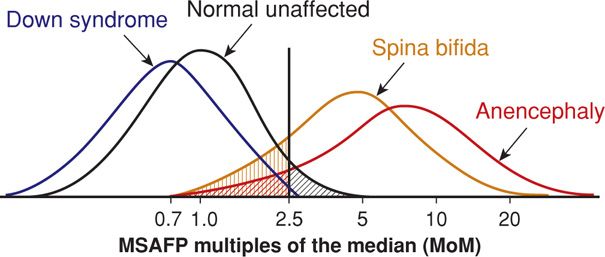
Many pregnant women wish to undergo antenatal testing for the most common birth defects such as Down syndrome (trisomy 21), neural tube defects (NTD), and Trisomy 18 (Edwards Syndrome). Screening provides reassurance that the unborn child is not affected or allows preparation for the birth of an affected baby.
Initially, invasive tests such as amniocentesis or chorionic villus sampling were required to obtain fetal tissue for karyotyping. Invasive testing was offered only to women over 35 years, but this approach identified only one third of fetuses affected with Down syndrome. Another serious limitation was that these procedures were associated with fetal loss in about 1% of cases.
Biochemical screening began in the late 1980s with the observation that second-trimester maternal serum levels of alpha fetoprotein (AFP) were lower in women carrying infants with Down syndrome. Over the years, several other biochemical tests have were combined with age related risk to calculate an individualized risk for birth defects. The proteins that are measured include: alpha-fetoprotein (AFP), unconjugated estriol (uE3), human chorionic gonadotropin (hCG) and inhibin. Maternal serum screening is performed between 15 and 22 weeks of pregnancy.
Increases and/or decreases in the amounts of these proteins are associated with an increased risk for NTD, Down syndrome, or trisomy 18.
|
|
AFP |
Estriol |
hcG |
Inhibin |
|
NTD |
Increase |
|
|
|
|
Down syndrome |
Decrease |
Decrease |
Increase |
Increase |
|
Trisomy 18 |
Decrease |
Decrease |
Decrease |
|
The test is most accurate if the laboratory is also informed of maternal weight, race (Caucasian or Black/African American), presence of insulin-dependent diabetes, number of fetuses, and family history of NTD.
Using a second trimester Down syndrome cut-off risk of 1 in 270, the combination of maternal age, MSAFP, hCG, uE3, and INH-A detects approximately 75% of Down syndrome cases in women who are younger than 35 years with a positive screening rate of 5%, and over 80% of the Down syndrome fetuses in women 35 and older. In most cases of Down syndrome, the AFP and uE3 levels are lower, and hCG and INH-A levels are higher.
Serum screening using three of the analytes (AFP, hCG, uE3) is able to identify women at risk for having a fetus with trisomy 18. In most cases of trisomy 18, the levels are all low. The detection rate for trisomy 18 is at least 70%.
AFP is measured in maternal serum and the value is compared to the median AFP value in an unaffected population to obtain a multiple of the median (MoM). The reference range is 0.25 - 2.50 MoM. An AFP MoM of <2.5 is reported as a negative result. An MoM >2.50 does not confirm a diagnosis of neural tube defect, but indicates the need for further evaluation.
A screen negative result for Down syndrome (Trisomy 21) indicates the calculated risk is below 1 in 270 pregnancies. A screen negative result for Trisomy 18 indicates the estimated risk is below 1 in 100.
A positive screening result does not necessarily mean that a fetus has one of these conditions. Rather, it indicates a risk level for having an affected baby. Approximately 1 out of every 15 women screened has a positive screening result.
There are several factors, unrelated to the health of the fetus, that may produce a positive result. The most common ones are: incorrect pregnancy dating, multiple pregnancies, and inaccurate dating of pregnancy. A dating ultrasound is the most accurate method to assess gestational age and determine how many fetuses are present. If a dating ultrasound differs significantly or multiple fetuses are detected, screening results are recalculated.
If the screening result remains positive, then amniocentesis is offered as a more accurate diagnostic test. Amniotic fluid cells from the fetus are cultured and tested. Amniocentesis is not offered initially because it is a more invasive test than maternal serum screening. Amniocentesis is associated with a miscarriage rate of 0.2% to 0.3%.
An essential component of a maternal serum screening program is that each laboratory must assess its assay performance continually. In addition to running calibrators and controls, monitoring the median MoM (Multiples of Median) values for each analyte gives a very good estimate of assay drift. Minor fluctuations are to be expected, since the patient mix varies (e.g. gestational ages, maternal ages, racial/ethnic groups). However, a trend should be investigated.
The ultimate concern of a screening program is the detection of disorders that are clinically important and that lend themselves to some type of effective intervention. Thus assessment of a program involves determining how well the test(s) discriminate between affected and unaffected pregnancies and what the odds of having an affected fetus are for those with a positive screening result. The easiest method of epidemiological evaluation is to check the initial positive rate (IPR) and the median MoMs for each assay on a regular basis. In the case of DS screening, the maternal age distribution should be considered in evaluating IPR, since women over 35 years would be expected to have more positive screens. However, it is more important to determine the detection rate and odds of having an affected fetus; this requires obtaining outcome results on screened pregnancies. The DR and IPR together can be used to calculate false negative and positive rates. The odds of having a positive result (OAPR), in this case an affected fetus, given a positive screening result is the ratio of true positives to false positives. For example, if 100 women have positive screens but only 20 have an affected fetus, the OAPR would be 20:80, or 1:4.
References
- Haddow JE et al. Prenatal Screening for Down’s Syndrome with Use of Maternal Serum Markers, N Engl J Med, 1992;327:588-593.
- American College of Obstetricians and Gynecologists (ACOG). Maternal Serum Screening for Birth Defects. ACOG Education Pamphlet APO89, April 2000.
- American College of Obstetricians and Gynecologists. Practice Bulletin No. 163: Screening for Fetal Aneuploidy. Obstet Gynecol. 2016;127(5):e123-137
- March of Dimes. Fact Sheet–Blood Screening for Down Syndrome and Neural Tube Defects. Available at http://www .marchofdimes .com/professionals/14332_1166.asp.



 How to resolve AdBlock issue?