

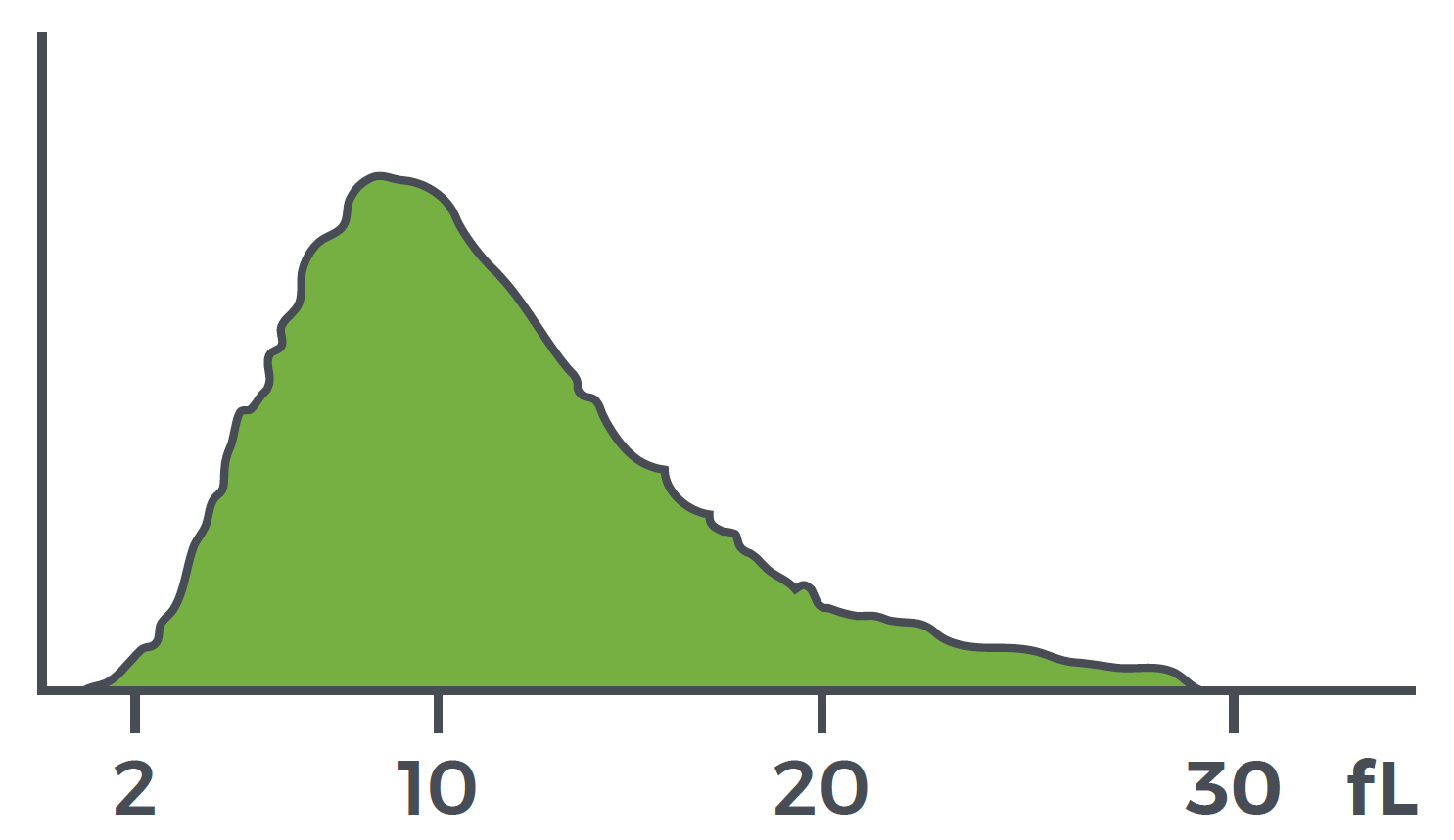
Platelet size can be measured directly by automated hematology analyzers and is reported as the mean platelet volume (MPV). Platelet size is determined at the time of platelet production from megakaryocytes. There is evidence that MPV is increased when both platelet production and destruction are increased, probably mediated by cytokines such as interleukin-3, interleukin-6, and thrombopoietin. There is also evidence that larger platelets are functionally more reactive, produce more thromboxane A2, aggregate more readily in vitro, contain more dense granules, and show increased expression of membrane receptors.
The Mean Platelet Volume (MPV) parameter is the average volume of individual platelets and is derived from the platelet histogram produced by a hematology analyzer. MPV may help in distinguishing whether thrombocytopenia is due to peripheral destruction of platelets or to reduced production of platelets in the bone marrow. MPV is typically elevated when thrombocytopenia is due to peripheral destruction of platelets because the bone marrow responds by producing younger, larger platelets. An example is immune thrombocytopenia. MPV is also increased in myeloproliferative disorders and inherited macrothrombocytopenia. MPV is typically low when thrombocytopenia is due to bone marrow disorders because younger platelets are not being produced. An example is aplastic anemia.
The following table contains a summary of platelet count and platelet size in various platelet disorders.
|
Platelet Disorder |
Platelet Count Reduction |
Platelet Size |
|
Bernard Soulier |
Moderate to severe |
Giant |
|
Familial platelet disorder associated with AML |
Mild to moderate |
Normal |
|
GATA1-related thrombocytopenia |
Severe |
Large |
|
Gray platelet syndrome |
Mild |
Large |
|
Medich platelet syndrome |
Mild |
Large |
|
MYH9 mutation associated disorders |
Mild to moderate |
Large |
|
Paris-Trousseau syndrome |
Moderate to severe |
Normal to slightly increased |
|
Platelet type vWD |
Mild |
Normal or slightly increased |
|
Stormorken syndrome |
Mild to moderate |
Normal |
|
Velocardiofacial syndrome |
Mild |
Large |
|
Wiskott-Aldrich |
Severe |
Small |
|
White platelet syndrome |
Mild |
Large |
MPV <6 fL is seen in Wiskott Aldrich syndrome and MPV >12 is seen in Bernard Soulier. If the platelet count and platelet size suggest that an inherited platelet disorder may be present, platelet function analysis (PFA-100) and platelet aggregation should be ordered. Abnormal findings in these tests may necessitate additional confirmatory tests including platelet electron microscopy, platelet flow cytometry, and genotyping.
MPV has been associated with a large number of clinical conditions, and studies have shown a correlation between MPV and disease outcome. MPV is often increased by thrombosis. Large platelets may predispose to thrombosis or they may occur in response to platelet consumption and platelet turnover in thrombotic conditions.
Elevated MPV has been associated clinically with cardiovascular and cerebrovascular morbidity. Elevated MPV has been identified as an independent risk factor for myocardial infarction in patients with coronary heart disease and for death or recurrent ischemic events after myocardial infarction MPV has also been shown to be a strong independent predictor of impaired angiographic reperfusion and six month mortality in acute myocardial infarction treated with percutaneous coronary intervention. An increase in MPV is independently associated with acute stroke, and an elevated MPV has been associated with a worse outcome in acute ischemic cerebrovascular events.
Increased MPV values have also been reported in patients with vascular risk factors such as diabetes mellitus, hypercholesterolemia, and smoking.
The reference range is 8 to 12 fL. Specimen requirement is a lavender-top tube of blood.
References
Endler G, Mean platelet volume is an independent risk factor for myocardial infarction but not for coronary artery disease, Brit J Haematol, 2002;117(2):399-404.
Martin JF, Bath PM, Burr ML, Influence of platelet size on outcome after myocardial infarction, Lancet, 1991, 338(8780):1409-1411
Huczek Z et al. Mean Platelet Volume on Admission Predicts Impaired Reperfusion and Long-Term Mortality in Acute Myocardial Infarction Treated With Primary Percutaneous Coronary Intervention, J Am Coll Cardiol, 2005, 46(2):284-290.
O’Malley T, et al. Platelet Size in Stroke Patients, Stroke,1995; 26(6):995-999.
Greisenegger S, et al, Is Elevated Mean Platelet Volume Associated With a Worse Outcome in Patients With Acute Ischemic Cerebrovascular Events? Stroke, 2004;35:1688-1691.
Kaito K et al. Platelet size deviation width, platelet large cell ratio, and mean platelet volume have sufficient sensitivity and specificity in the diagnosis of immune thrombocytopenia, Brit J Haematol, 2005;128:698-702.



 How to resolve AdBlock issue?