

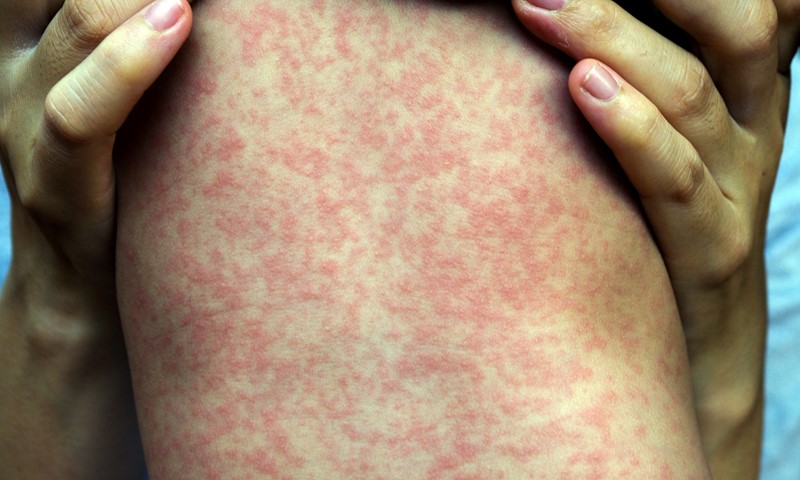
Measles is caused by the rubeola virus, which is a single-stranded, enveloped RNA virus. Humans are the only natural hosts of measles virus. Measles virus normally grows in the cells that line the back of the throat and lungs.
The measles vaccine was developed in 1961 and licensed in 1963. In 1966, a national eradication campaign was launched to vaccinate one-year old children and institute vaccine mandates for schools. In the decade before this campaign, an average of 549,000 measles cases and 495 measles deaths were reported annually in the United States. By 2000, measles was declared eliminated in the U.S. due to the high rate of vaccination. Only 3 people died from measles between 2000 and 2024.
Unfortunately, declines in measles vaccination rates globally have increased the risk of measles outbreaks. Worldwide, measles infected an estimated 10.3 million people in 2023, which was a 20% increase from 2022. In the past year, 138 countries have reported measles cases, with 61 of them experiencing large outbreaks. Europe reported 127,350 cases in 2024, which was a 10-fold increase over 2023 and its highest total since 1997.
In 2024, the US experienced 16 measles outbreaks totaling 285 cases and 114 hospitalizations. At least 198 of these cases were attributed to a domestic outbreak. Measles cases continue to be brought into the US, mostly by unvaccinated U.S. residents who become infected while traveling to other countries. Also, vaccination coverage among U.S. kindergartners decreased from 95.2% during the 2019-2020 school year to 92.7% during the 2022-2023 school year, leaving an additional 250,000 kindergartners susceptible to measles each year. A more recent report from Truveta found that only 80.4% of US children had received both MMR doses by age 6 in 2024. Approximately 30% of children have not received their first MMR dose by the recommended age of 15 months. To achieve heard immunity, CDC recommends that a community reach a 95% vaccination rate.
In 2021, an estimated 61 million measles vaccine doses were postponed or missed due to COVID-19 related delays in immunization campaigns in 18 countries. Vaccination programs have continued to be hampered by reduced funding and weakened disease surveillance. Anti-vaccine misinformation has fueled vaccine hesitancy, contributing to the largest sustained drop in childhood immunizations in 30 years.
The 2025 measles outbreak in the US began in January in Texas and grew to 762 confirmed cases in 10 counties. The Texas outbreak began in Gaines County had a very low measles vaccination rate of 82% at the beginning of 2025. Within Gaines counties, there was wide variation in school-by-school vaccination rates. School-based measles vaccination rates ranged from 46.2% to 94.3%. Gaines County is the home of a large unvaccinated Mennonite community. Ninety nine patients were hospitalized. Two school-aged girls, both unvaccinated, have died. A third person, from a New Mexico county near the Texas epicenter, tested positive for measles after his death.
The Texas outbreak spilled over to three other states including New Mexico, Kansas, Oklahoma, and Colorado. There have been 46 separate outbreaks recorded across the US in 2025. Eighty seven percent of measles cases have been associated with these outbreaks.
As of December 31, 2025, at least 2,065 measles cases had been reported in the United States. Measles was confirmed in 42 states and the District of Columbia: Alaska, Arkansas, Arizona, California, Colorado, District of Columbia, Florida, Georgia, Hawaii, Idaho, Illinois, Indiana, Iowa, Kansas, Kentucky, Louisiana, Maryland, Michigan, Minnesota, Missouri, Montana, Nebraska, New Jersey, New Mexico, New York state, North Carolina, North Dakota, Ohio, Oklahoma, Oregon, Pennsylvania, Rhode Island, South Carolina, South Dakota, Tennessee, Texas, Utah, Vermont, Virginia, Washington, Wisconsin, and Wyoming. Additionally, 23 cases have been reported among international visitors to the U.S.
This was the largest outbreak in the U.S. since measles was declared eliminated in the US in 2000. The previous record was set in 1992, when the US had 2,237 measles cases.
Of the total patients, 92% were unvaccinated or had unknown vaccination status, 4% had received one MMR vaccine dose, and 4% had received two doses. Children under 5 years of age accounted for 27% of cases; children ages 5 to 19 years old make up 38%; adults 20 years and older accounted for 34%. Age was unknown for 1% of cases. Of the total 1,618 cases, 198 (12%) have been hospitalized. Three patients have died, two children in Texas and one adult in New Mexico. The actual number of cases is believed to be much higher than the official count because so many cases are unreported.
The Texas outbreak extended into Mexico. At least 5,741 cases were confirmed in 2025, mostly in Chihuahua. Twenty four of these patients died.
Canada eliminated measles in 1998, two years before the United States. However, during 2025, Canada confirmed 5,393 cases in 10 jurisdictions. Cases occurred in Alberta, British Columbia, Manitoba, New Brunswick, Northwest Territories, Nova Scotia, Ontario, Prince Edward Island, Quebec, and Saskatchewan. Ninety three percent of the patients were unvaccinated or had unknown vaccination status. At least 389 patients required hospitalization and 2 pre-term infants born with congenital measles died.
From 1998 to 2024, Canada averaged 91 measles case a year, with spikes in 2011 (751 cases) and 2014 (418). Like the US, Canada has seen waning MMR vaccine coverage since the COVID-19 pandemic. Only 74.9% of 7 year-old children had received the standard two doses of the MMR vaccine in 2023.
Measles is one of the most highly contagious viral diseases that is transmitted by airborne spread when an infected person breathes, coughs, or sneezes. The rubeola virus can remain active in the air or on surfaces for up to two hours. Ninety percent of unvaccinated individuals who are exposed to measles become infected and 20% are hospitalized. Patients are considered to be contagious from 4 days before until 4 days after the appearance of a rash.
The incubation period for measles, which is the interval between exposure to the onset of fever, ranges from 7 to 12 days. Early symptoms include high fever, cough, coryza, conjunctivitis, and Koplik spots. Koplik’s spots on the buccal mucosa are considered pathognomonic of measles. An erythematous rash usually appears 2 to 4 days later. The rash spreads from the head to the trunk to the lower extremities. It should begin to resolve from the head downward after 5 to 6 days. Cough may last 1 to 2 weeks longer. Suspected measles patients should be isolated at home for 21 days.
Most people who get measles recover completely but measles can cause severe health complications. Approximately 1 in 10 children with measles develops an ear infection, 1 in 20 pneumonia, 1 in 1,000 encephalitis, and 1 in 1,000 die. Subacute sclerosing panencephalitis (SSPE) is a rare fatal neurodegenerative disease that develops 2 to10 years after measles infection. It occurs in about 1 in 10,00 people with measles, but the risk may be higher (about 1 in 600) for infants who are infected.
On September 11, 2025, the Los Angeles County Department of Public Health announced that a child infected with measles as an infant, before they were eligible to receive the MMR vaccine, had died of SSPE.
Severe complications are more common in adults, children <5 years, and immunocompromised patients. Measles illness in pregnancy might be associated with increased rates of spontaneous abortion, premature labor and preterm delivery, and low birthweight infants.
One of the most concerning aspects of measles is its ability to erase immune system memory. Affected individuals are more susceptible to other infections for months or years after recovery.
Detection of measles RNA is most successful when specimens are collected during the first 3 days following the onset of rash. Detection of measles RNA by reverse transcription polymerase chain reaction (rRT-PCR). rRT–PCR may be successful as late as 10-14 days after rash onset. Throat or nasopharyngeal swab specimens should be collected as soon as measles is suspected.
A diagnosis of measles can also be confirmed by testing for rubeola/measles-specific IgG and IgM antibodies. The sensitivity of measles IgM assays varies and may be diminished during the first 72 hours after rash onset. If the result is negative for measles IgM and the patient has a generalized rash lasting more than 72 hours, a second serum specimen should be obtained for repeat measles IgM testing. Positive IgG results with negative IgM results indicate immunity to infection. Positive IgM results with or without positive IgG indicates recent infection. Negative IgM and IgG results usually indicate non-immunity and absence of current infection. Positive cases should be reported immediately to local and/or state public health departments.
Persons who have documentation of adequate vaccination for measles at age 12 months or later, laboratory evidence of measles IgG antibody, laboratory confirmation of disease, or who were born before 1957 have acceptable presumptive evidence of measles immunity.
Measles is almost entirely preventable through vaccination with the measles-mumps-rubella-varicella (MMR) vaccine. CDC recommends routine childhood immunization with two doses of the MMR vaccine. The first dose should be administered between 12 and 15 months of age and the second dose at 4 through 6 years of age. According to the Centers for Disease Control and Prevention (CDC), one dose of MMRV is 93% effective against measles and two doses are 97% effective. When more than 95% of people in a community are vaccinated most people are protected against infection through community immunity. Measles immunity is lifelong.
Health and Human Services Secretary Robert F. Kennedy Jr. has downplayed the threat of measles. He has directed the CDC to explore new treatment protocols using drugs and vitamins instead of focusing on vaccination. Kennedy has promoted unproven treatments such as budesonide, clarithormycin, and vitamin A. He has claimed these therapies have shown “miraculous and instantaneous recovery” in some cases.
The Trump administration’s gutting of global aid could collapse the Global Measles and Rubella Laboratory Network (GMRLN). The network is made up of more than 7600 laboratories around the world that conduct surveillance and sequence the genomes of circulating viral strains. Without GMRLN, measles and rubella viruses would be able to spread undetected and unchecked.
References
Measles (Rubeola) for Healthcare Providers, https://www.cdc.gov/measles/hcp/index.html
Measles Cases and Outbreaks, June 6, 2025, https://www.cdc.gov/measles/data-research/index.html
CDC Health Advisory. Increase in Global and Domestic Measles Cases and Outbreaks: Ensure Children in the United States and Those Traveling Internationally 6 Months and Older are Current on MMR Vaccination. CDCHAN-00504, March 18, 2024.



 How to resolve AdBlock issue?