

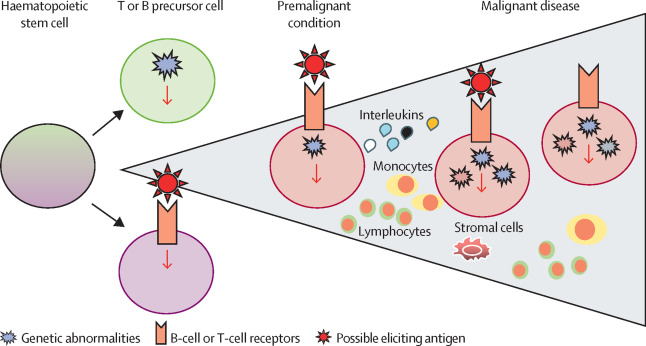
Multiparametric flow cytometry allows the detection of very small clones of monoclonal B-cells in peripheral blood from normal individuals. The significance and long term implications of these is uncertain, and the term monoclonal B-cell lymphocytosis (MBL), as defined below, is recommended to distinguish these cases from patients with B-cell chronic lymphocytic leukemia (B-CLL). One of the earliest population based studies of MBL was performed in 2007 at Saint Luke’s Hospital in collaboration with Community Blood Center of Greater Kansas City. This and other population studies showed the prevalence of MBL to be 0.14%-5.1%. The diagnostic criteria for MBL and B-CLL were updated in 2008 by the International Workshop on Chronic Lymphocytic Leukemia. According to the recommendations from this workshop, the diagnostic criteria for MBL include the presence of a monoclonal B-cell population with:
- B-cells in blood <5,000/µL
- Absence of lymphadenopathy and hepatosplenomegaly (by physical examination and CT scans)
- Absence of cytopenias due to marrow involvement by the monoclonal proliferation
The immunophenotype of the clonal B-cells of MBL is most often identical to that seen in B-CLL, with expression of B-cell markers CD19, CD20, and CD23, co-expression of CD5, and dim intensity of surface light chain expression. Other immuno-phenotypes are rare, including some cases that lack CD5 expression. The relationship between MBL and B-CLL was investigated in a recent study from the United Kingdom. In this study, MBL with B-CLL immunophenotype was detected in 5.1% of 1520 individuals without lymphocytosis. Symptomatic B-CLL requiring treatment developed at the rate of 1.1% per year in a subset of these patients that were followed for a median of 6.7 y. In this respect, MBL is similar to monoclonal gammopathy of undetermined significance (MGUS), with a very low rate of progression to symptomatic disease.
Patients diagnosed with MBL based on flow cytometric evaluation of blood should be worked up to exclude B-CLL or other B-cell lymphoproliferative disorders, and then offered periodic follow up to watch for progression.
References
Rachel JM et al, Monoclonal B-cell lymphocytosis in blood donors, Brit J Haematol 2007;139:832-836.
Hallek M et al, Guidelines for the diagnosis and treatment of chronic lymphocytic leukemia: a report from the International Workshop on Chronic Lymphocytic Leukemia updating the National Cancer Institute–Working Group 1996 guidelines, Blood 2008;111(12):5446-5456
Marti G, et al, Overview of monoclonal B-cell lymphocytosis, Brit J Haematol 2007;139:701-708
Rawstron AC, et al, Monoclonal B-Cell Lymphocytosis and Chronic Lymphocytic Leukemia, N Engl J Med 2008;359:575-583



 How to resolve AdBlock issue?