

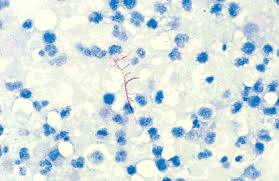
Mycobacterium kansasii is a slow growing photochromogen, an organism that grows unpigmented colonies in the dark but produces a bright lemon yellow pigment upon exposed to light. It is also an acid-fast positive long bacillus that causes TB-like chronic pneumonia, which is the second most common non-TB mycobacterial infection after MAC in the AIDS population. There are five genotypes of Mycobacterium kansasii. Genotypes I and II infect humans, with I being the most prevalent. Because environmental sources of M. kansasii are rarely identified, isolation of M. kansasii from a culture is never considered a contaminant.
M. kansasii is usually found in the tap water in cities endemic for the infection. In the U.S., it is most prevalent in the central and southern states including Louisiana, Illinois, Texas, and Florida. Internationally, it is most prevalent in Israel, Korea, France, Japan, Portugal, with the highest incidence in England, Wales, and among South American gold miners.
The majority of patients with M. kansasii infection have an underlying pulmonary disease such as COPD, bronchiectasis, or TB infection. The clinical manifestation of M. kansasii infection includes a primarily unilateral cavitary infiltrate in the lungs without pleural effusions. Patients are generally older compared with those infected with TB. They present with productive cough, weight loss, fever, night sweats, and dyspnea. Symptoms are usually less severe but more chronic compared with those of TB pneumonia. M. kansasii can also present as cutaneous lesions similar to sporothrichosis. Lesions include nodules, pustules, red plaques, and ulcers.
M. kansasii infection is diagnosed by chest X-ray or chest CT, and clinical exclusion of other diagnoses. Laboratory diagnosis begins with the collection and analysis of respiratory specimens, The standard protocol involves the evaluation of at least 3 sputum samples using acid-fast bacilli (AFB) staining and culture techniques. This approach may be expanded to include more invasive procedures such as bronchoalveolar lavage or biopsies from sterile sites if initial sputum samples are inconclusive or if the clinical presentation suggests more extensive disease.The criteria for a positive culture include either two consecutive positive sputum cultures, one positive culture from bronchoscopy specimens, or one positive culture with compatible clinical symptoms.
Blood cultures should also be ordered to detect M kansasii bacteremia. This is especially important for immunocompromised patients, such as those with HIV, where approximately 10% develop bacteremia.
The availability of polymerase chain reaction (PCR) has increased the sensitivity and specificity of M. kansasii detection. PCR can rapidly identify M. kansasii from liquid culture media. M. kansasii can also be identified by MALDI-TOF mass spectrometry.
The treatment of M. kansasii infection depends on the resistance of the organism to rifampin. Rifampin-sensitive organisms are treated with at least three drugs including rifampin, ethambutol, isoniazid, and pyridoxine. Rifampin-resistant organisms are treated with three drugs including clarithromycin or azithromycin, moxifloxacin, ethambutol, sulfamethoxazole, or streptomycin. Due to drug interaction, rifampin is contra-indicated among HIV patients taking protease inhibitors and nonnucleoside reverse transcriptase inhibitors. Because rifampin increases the metabolism of these HIV medications, it can lead to HIV drug resistance among these patients.
References
Akram SM, Bhimji SS. Mycobacterium Kansasii. StatPearls. 2023. https://www.ncbi.nlm.nih.gov/books/NBK430906/
Maliwan N, Zvetina JR. Clinical features and follow up of 302 patients with Mycobacterium kansasii pulmonary infection: a 50 year experience. Postgrad Med J. 2005;81(958):530-3.



 How to resolve AdBlock issue?