

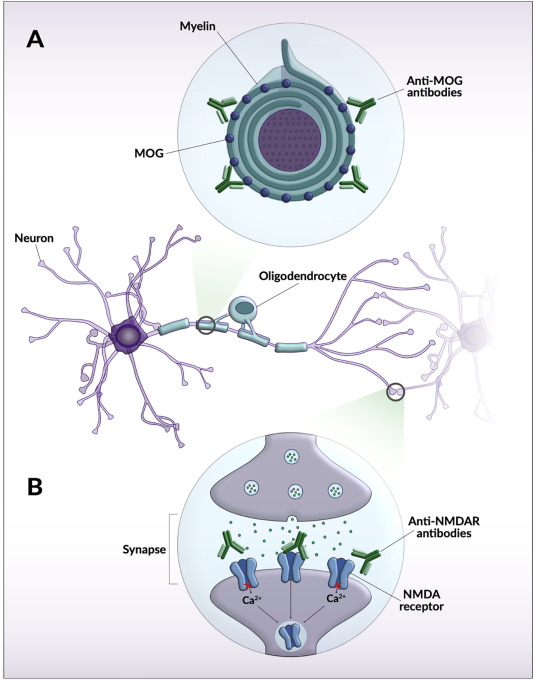
Myelin oligodendrocyte glycoprotein is a CNS antigen expressed on the myelin sheath. Myelin oligodendrocyte glycoprotein antibody-associated disease (MOGAD) is a demyelinating disease that is distinct from multiple sclerosis (MS) and-4 antibody–positive neuromyelitis optica spectrum disorder (AQP4+NMOSD). MOGAD is a rare disease, with an estimated prevalence of 2.0 per 100,000 people.
The most common presentation in adults is optic neuritis. It is often bilateral and accompanied by disc edema. Adults may also present with extensive transverse myelitis that is associated with long-term disability. Children most often have acute disseminated encephalomyelitis (ADEM). Less common presentations are cerebral cortical encephalitis with seizures and brainstem or cerebellar syndromes. Some patients have a mono-phasic disease course while others have relapsing disease.
The 2023 International MOGAD Panel diagnostic criteria include:
- A core clinical demyelinating event.
- MOG-IgG positivity by a cell-based assay.
- Exclusion of alternative diagnoses, especially MS.
International comparative studies of different MOG-IgG1 assays have shown that live cell–based assays yield the highest specificity for MOGAD. Cell-based testing for MOG-IgG1 is performed with an fluorescence-activated cell-sorting assay that uses cells transfected with full-length MOG in its conformational form. Serum samples are incubated with cells transfected with MOG and non transfected cells. A fluorescent anti-IgG antibody is added to detect IgG bound to the cells.The median fluorescence intensity of MOG transfected cells is compared to the fluorescent intensity of nontransfected cells to calculate , the IgG-binding index (ratio of median fluorescence intensities of MOG-transfected vs MOG-nontransfected cells). Samples having an index of 2.5 or more, are then diluted at 1:20, 1:40, 1:100, and 10-fold thereafter to establish an end-titer. This is the last dilution that has an IBI of 2.5.
The reference value a negative result at a dilution of 1:20. Specimen requirement is a red top tube of blood.
Because MOGAD is a rare disease, false positive results can occur when testing is ordered indiscriminately in low-pretest-probability populations of patients. For example, MOG-IgG testing should not be ordered for all patients with typical MS. MOG-IgG is detected in less than 2.0% of confirmed MS patients.
References
Banwell B, et al. Diagnosis of myelin oligodendrocyte glycoprotein antibody-associated disease: international MOGAD Panel proposed criteria. Lancet Neurol. 2023;22(3):268-282.
Sechi E , et al. Positive predictive value of myelin oligodendrocyte glycoprotein autoantibody testing. JAMA Neurol. 2021;78(6):741-746.



 How to resolve AdBlock issue?