

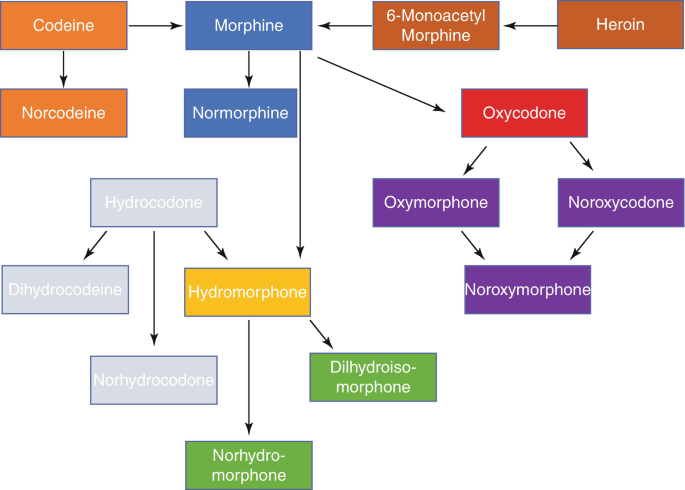
Oxycodone is a pure agonist opioid whose principle therapeutic action is analgesia. Other members of the opioid agonists include morphine, hydromorphone, fentanyl, codeine and hydrocodone. In the U.S., several prescription drugs contain oxycodone in immediate-release formulation. Two common examples are Numorphin, Opana, and Oxycontin.The latter is a controlled-release formulation of oxycodone.
The usual adult oral dose of immediate release oxycodone is 2.5 to 5.0 mg every six hours. Patients with moderately severe pain may take 10 to 30 mg every four hours. The drug’s effects usually start in 10 to 30 minutes, peak in 60 to 90 minutes, and last for 4 to 6 hours. Controlled-release tablets are available in 10, 20, 40, 80 and 160 mg. In general, OxyContin tablets are taken every 12 hours. Steady state plasma levels are achieved within 24 to 36 hours. Plasma concentrations of oxycodone usually average about 30 ng/mL and are almost always less than 100 ng/mL. Plasma concentrations tend to be 25% higher in females than in males even after adjustment for body weight.
After absorption, oxycodone is widely distributed to skeletal muscle, liver, intestinal tract, lungs, spleen and brain. It is also excreted in breast milk. Oxycodone is metabolized to noroxycodone and oxymorphone. Oxymorphone is metabolized in the liver to noroxymorphone. After glucouronidation, it is excreted by the kidneys into urine.
OxyContin has a very high potential for abuse because:
- It is highly potent
- Produces euphoria in addition to analgesia
- Is highly effective when taken orally
- Is readily available as a prescription drug.
Although OxyContin is intended to be swallowed whole, abusers often chew or crush tablets to get a rapid release of the drug. Crushed tablets can also be sniffed, snorted, smoked or taken rectally or transdermally. They can be dissolved in water and injected intramuscularly or intravenously. Intravenous administration gives abusers immediate effects within 5 minutes, while rectal administration takes 30 to 60 minutes.
Oxycodone overdose produces a constellation of signs develops that are referred to as the opioid toxindrome including:
- Mental depression
- Hypoventilation
- Miosis
- Reduced bowel movement
- Cold and clammy skin
- Skeletal muscle flaccidity
The most severe consequence of an oxycodone overdose is central nervous system and respiratory depression, leading to stupor and coma. Administration of the opioid antagonist, naloxone, will generally reverse the toxic effects.
Oxycodone is detected by liquid chromatography/tandem mass spectrometry. Reference value is negative. Positive results are quantitated. The thresholds for detection of oxycodone and its metabolites are:
- Oxycodone-25 ng/mL
- Noroxycodone- 25 ng/mL
- Oxymorphone- 25 ng/mL
- Noroxymorphone- 25 ng/mL
A positive result indicates exposure to oxycodone within the previous 2 to 3 days of specimen collection.
Specimen requirement is 2 mL of urine.
References
Riley J, et al. Oxycodone: a review of its use in the management of pain. Curr Med Res Opin. 2008 Jan;24(1):175-92.
Inturrisi CE. Clinical pharmacology of opioids for pain. Clin J Pain. 2002 Jul-Aug;18(4 Suppl):S3-13.
Kiyatkin EA. Respiratory depression and brain hypoxia induced by opioid drugs: Morphine, oxycodone, heroin, and fentanyl. Neuropharmacology. 2019 Jun;151:219-226.



 How to resolve AdBlock issue?