

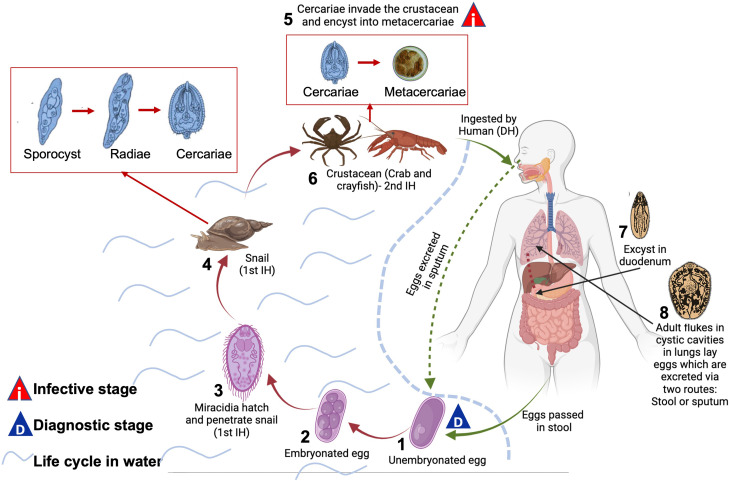
Paragonimus is a parasitic fluke, most often associated with lung infections (paragonimiasis) in Southeast Asia. The Asian fluke species, Paragonimus westermani, occurs primarily in China, the Philippines, Japan, Vietnam, South Korea, Taiwan, and Thailand. P. Africanus causes infections in Africa and P. Mexicanus in Central and South America.
Paragnonimus is most commonly acquired by consumption of specialty dishes in which shellfish are consumed raw or prepared only in vinegar, brine, or wine without cooking. Raw crabs or crayfish are also used in traditional medicine practices in Korea, Japan, and some parts of Africa.
Less commonly, human paragonimiasis from P. kellicotti has occurred in the United States. In 2012, a series of nine paragonimiasis cases associated with consumption of crustaceans found in Missouri rivers, was described by Washington University in St. Louis. P. kellicotti infestations have occurred most commonly in young men who became infected following consumption of raw crayfish while on a river float trip. Infections have been associated with crayfish found in the Current, Huzzah, Meramac, Jacks Fork, and Missouri Rivers.
The incubation period before the onset of signs or symptoms ranges from 2-12 weeks. Following ingestion, the parasite penetrates the intestinal wall, then migrates through the diaphragm to the pleural cavity and into the lungs. Eggs are deposited into lung tissue, usually within fibrous cysts that develop around the adult worm. Extrapulmonary sites including liver, lymph node, skin, spinal cord and brain may also become infected.
Common clinical findings in these cases include cough, hemoptysis, weight loss, fever and pleural effusions. The majority of patients have significant eosinophilia (>15%) and abnormal chest radiographs which may include nodules and pericardial effusions. Examination of sputum, bronchoscopy, pleural fluid, and stool specimens for the Paragonimus eggs has high specificity for the diagnosis, but has very low sensitivity (<10% positive). Eggs are yellowish brown, 80-120 µm long by 45-70 µm wide, thick-shelled, and have an operculum.
Serologic tests for antibody to Paragonimus are especially useful for detecting early infections, prior to the maturation of flukes, or for ectopic infections where eggs are not passed in stool.
References
Lane MA, Paragonimus kellicotti Flukes in Missouri, USA, Emerg Infect Dis,2012;18(8):1263-1267.
Procop GW. North American paragonimiasis (Caused by Paragonimus kellicotti) in the context of global paragonimiasis. Clin Microbiol Rev. 2009;22(3):415-46.



 How to resolve AdBlock issue?