

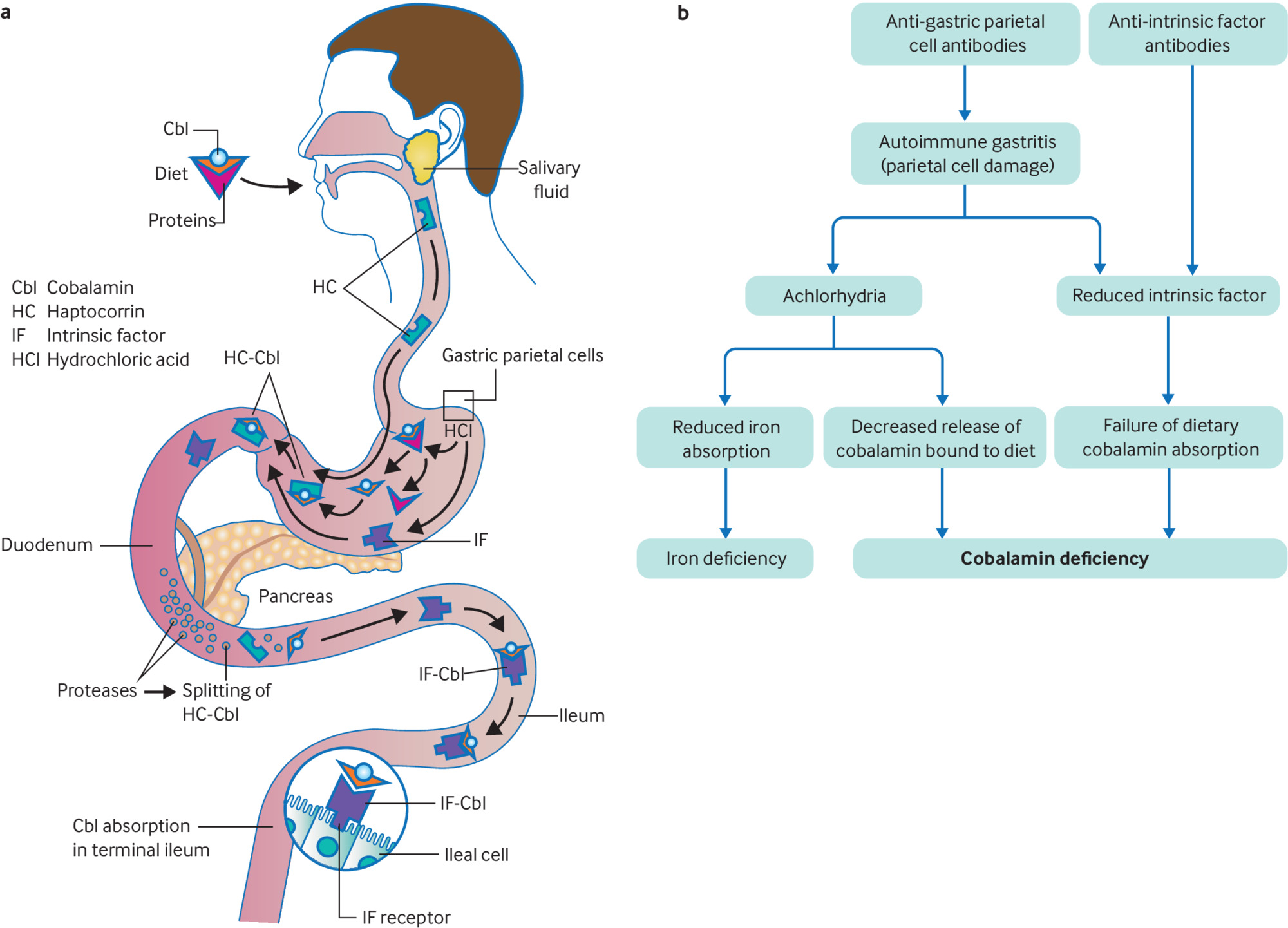
Pernicious anemia is an autoimmune disease that is characterized by the severe gastric mucosal atrophy and failure to produce intrinsic factor (IF). IF is a glycoprotein synthesized and secreted by parietal cells. It binds vitamin B12 in the stomach and facilitates its transport to the terminal ileum for absorption. The IF-B12 complex binds to cubam receptors in the terminal ileum and is taken up into cells by endocytosis. B12 binds to transcobalamin, is released into the bloodstream, and transported to transcobalamin cell receptors. After cellular uptake and intracellular release, B12 is converted to adenosylcobalamin and methylcobalamin. Both compounds serve as cofactors for the two B12-dependent enzymatic reactions.
Pernicious anemia develops slowly, with a progression time to apparent clinical B12 deficiency of 2 to 5 year. Classical symptoms of vitamin B12 deficiency include macrocytic anemia, glossitis, peripheral neuropathy, weakness, hyperreflexia, ataxia, and other neurological manifestations. It is common, however, to encounter patients with vitamin B12 deficiency who have atypical clinical or laboratory features. For example, many patients present with neurological defects without macrocytic anemia.
Intrinsic factor blocking antibodies are detectable in the serum of 40 to 60% of patients with pernicious anemia, and are highly specific for the diagnosis. Specificity is almost 100%. A positive result for this assay establishes a diagnosis of pernicious anemia, but a negative result does not rule it out.
Anti-parietal cell antibodies are present in 90% of patients with pernicious anemia, but they are less specific than anti-IF antibodies. They bind to the alpha and beta subunits of H+K+ ATPase on the membrane of parietal cells. Anti-parietal cell antibodies are also detectable in 30 to 60% of patients with chronic atrophic gastritis, 20% with gastric ulcers, 30% with Sjogren’s syndrome, 30% of first degree relatives of patients with pernicious anemia, and 7% of healthy adults.
Testing for both antibodies significantly increases their diagnostic performance for pernicious anemia (73% sensitivity and 100% specificity).
Parietal Cell antibodies are detected by an enzyme immunoassay using H+K+ ATPase as the target antigen. Reference value is 0-20.0 units. Specimen requirement is one red top SST tube of blood.
For a more comprehensive discussion, see article entitled: “Pernicious Anemia.”
References
Bizzaro N, Antico A. Diagnosis and classification of pernicious anemia. Autoimmun Rev. 2014;13(4-5):565-568.
Toh BH, et al. Pernicious Anemia, New Engl J Med, 1997;337:1441-1448.
Toh BH: Pathophysiology and laboratory diagnosis of pernicious anemia. Immunol Res. 2017;65(1):326-330.
Devalia V, Hamilton MS, Moloy AM, British Committee for Standards in Haematology. Guidelines for the diagnosis and treatment of cobalamin and folate disorders. Br J Haematol, 2014;166(4):496-513.



 How to resolve AdBlock issue?