

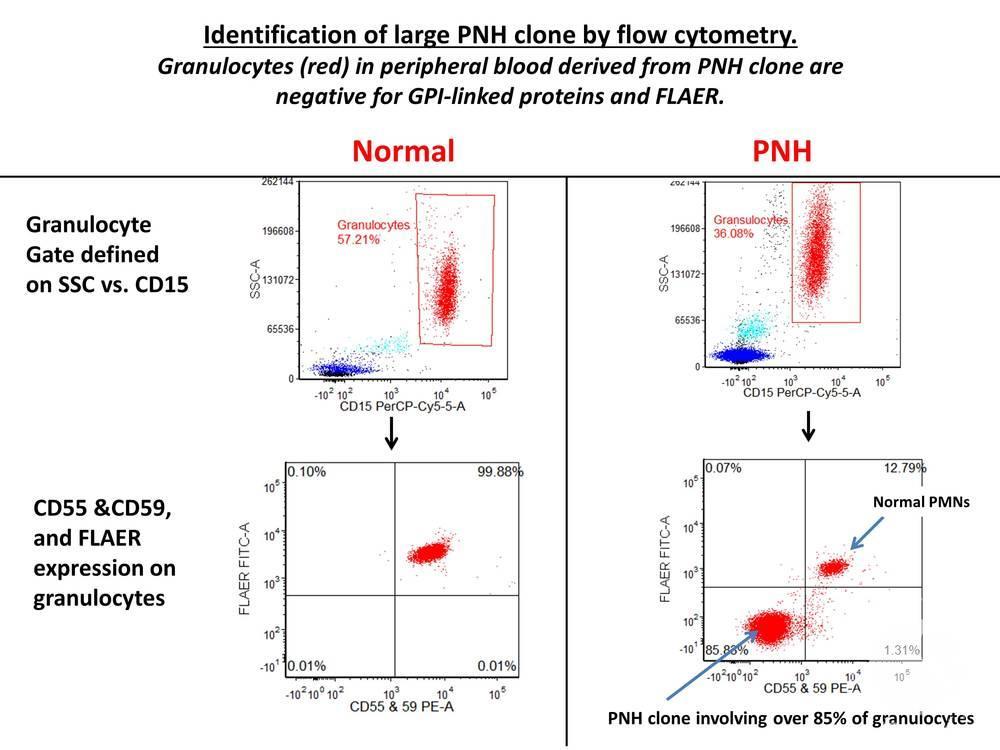
Paroxysmal nocturnal hemoglobinemia (PNH) is an acquired hematopoietic stem cell disorder in which somatic mutation of the X-linked PIG-A gene results in partial or absolute deficiency of all proteins normally linked to the cell membrane by a glycopphosphatidylinositol (GPI) anchor. The abnormal gene occurs in somatic cells, especially hematopoietic stem cells, but not in germ cells, making PNH an acquired disorder. So far, PIG-A gene mutations have not been detected in somatic cells outside of the hematopoietic system. All hematopoietic cell lineages are affected including erythrocytes, platelets, granulocytes and monocytes. Approximately 174 somatic mutations in the PIG-A gene have been identified. The initial mutagenic event remains unknown.
PNH is rare; the estimated incidence is 1.3 new cases per one million individuals per year. Development of clinical disease requires the combination of a hypoplastic or dysplastic bone marrow, somatic mutation in the PIG-A gene, and clonal expansion of PNH stem cells. Clinical features vary greatly from patient to patient during the course of the disease but there are three main pathophysiologic features:
- Intravascular hemolysis
- Venous thrombosis
- Bone marrow aplasia or dysplasia
Hemolysis is a consequence of abnormal erythrocyte sensitivity to complement-mediated lysis. PNH erythrocytes are abnormally sensitive to complement because they are deficient in two complement regulatory proteins, decay accelerating factor (DAF, CD55) and membrane inhibitor of reactive lysis (MIRL, CD59). DAF regulates the early portion of complement activation including C3-C5 while MIRL inhibits the incorporation of C9 into the membrane attack complex. The absence of CD59 is primarily responsible for red cell hemolysis and may contribute to thrombosis.
Deficiency of CD59 on platelets is also thought to play a role in thrombosis. CD59 deficient platelets are more readily activated by complement, leading to greater procoagulant activity and thrombin generation. Venous thrombosis often occurs in unusual anatomic locations such as mesenteric, hepatic portal (Budd Chiari Syndrome),splenic, dermal veins and cerebral sinuses. Thrombosis, which is often recurrent and resistant to treatment, is the major cause of death in Western patients with PNH while pancytopenia is the major manifestation of PNH in younger and Asian patients.
The International PNH Group recommends that patients with the following conditions should be tested for PNH:
- Coombs-negative, non-schistocytic hemolytic anemia
- Unexplained hemoglobinuria
- Venous thrombosis involving unusual sites
- Dysphagia with elevated LDH
- Aplastic Anemia (AA)
- Myelodysplasia (MDS)
The frequent association of PNH clones in patients with AA supports the theory that a hypocellular aplastic marrow may be conducive to the development of PNH. Recent data showed that small PNH clones can be detected in a relatively high percentage of cases of aplastic anemia and the myelodysplastic disorder refractory anemia with unilineage dysplasia.
The defining phenotypic feature of PNH cells is their deficiency of proteins that require a GPI anchor for attachment to the cell membrane. A partial list of GPI-linked proteins includes CD14, CD16, CD24, CD55, CD56, CD58, CD59, C8-binding protein, alkaline phosphatase, acetylcholine esterase, and a variety of high frequency human blood group antigens.
Flow cytometric analysis of peripheral blood is the current gold standard for laboratory detection of PNH. Flow cytometry uses fluorescently labeled monoclonal antibodies and FLAER to detect the presence or absence of GPI-linked proteins on granulocytes, monocytes, and erythrocytes. FLAER is a fluorescently labeled variant of the channel forming protein, aerolysin that binds specifically to GPI anchors. Individuals with PNH have decreased or absent expression of CD14 on monocytes, CD 16 on neutrophils and NK cells, CD24 on neutrophils, CD59 on red blood cells and FLAER on neutrophils and monocytes. The Ham’s and sugar water tests are now considered obsolete.
Patients with established diagnoses of PNH should have their PNH clone size monitored at regular intervals. If the disease is stable, annual monitoring may be sufficient. Any change in clinical or hematologic parameters requires more frequent monitoring. Regular monitoring is useful in patients receiving eculizumab therapy, but a consensus has not been reached regarding frequency of testing.
Eculizumab, is a recombinant humanized monoclonal antibody directed against C5. The drug shows a high affinity to C5 and when bound remains until the complex of drug-complement is removed from circulation. Blocking complement at this step prevents the genesis of the membrane attack complex and inhibits the release of the inflammatory mediator C5a.
Transfusion may be necessary during episodes of severe hemolysis. Patients with PNH should be transfused with ABO-specific red blood cells (RBCs), which do not need to be washed. If, ABO specific red cells are not available, group O red blood cells should be washed prior to tranfusion. Red cells should also be leukocyte reduced because recipient antibodies to granulocyte antigens can trigger hemolytic episodes in PNH.
References
Rosse WF, Dr Ham’s Test Revisited, Blood, 1991;78:547-550.
Krauss JS, Laboratory Diagnosis of Paroxysmal Nocturnal Hemoglobinuria, Ann Clin Lab Science, 2003;33(4):401-406.
Preis M, Lowrey CH, Laboratory Tests for paroxysmal nocturnal hemoglobinuria, Amer J Hematol, 2014;89(3):339-341.



 How to resolve AdBlock issue?