

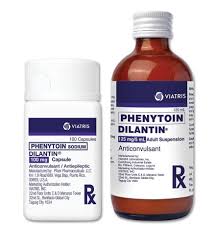
Phenytoin is used to treat tonic-clonic and psychomotor seizures. If phenytoin alone does not control seizure activity, phenobarbital can be added.
Phenytoin absorption is variable and dosage should be adjusted after 5 days of treatment after measuring the blood concentration. Phenytoin exhibits zero-order pharmacokinetics, meaning the rate of clearance is dependent on the concentration of drug present.
Phenytoin has a notoriously high risk/benefit ratio. At serum levels of 30 ug/mL, the drug is toxic in up to 50% of patients. The first sign of toxicity is usually nystagmus, which occurs at levels of 20 ug/mL. Cerebellar ataxia, tremor, and hyperreflexia occur at about 30 ug/mL. Confusion, lethargy, and coma at 40 ug/mL and higher. Overdoses are generally treated by drug withdrawal and gastric lavage with activated charcoal. Deaths from phenytoin toxicity are rare.
Drugs known to increase the serum level of phenytoin include amiodarone, cimetidine, fluconazole, isoniazid, and certain sulfonamides.
Serum trough values are recommended to establish and monitor phenytoin dosage regimens.The recommended sampling time for trough levels is immediately preceding the next dose. Steady state levels are reached after 7 to 10 days of treatment.
Phenytoin is measured by immunoassay. Therapeutic range is 10-20 ug/mL. Levels of 30 ug/mL or higher are considered critical values.
Specimen requirement is one plain red top tube of blood.
Reference
Richens A: Clinical pharmacokinetics of phenytoin. Clin Pharmacokinet 1979;4:153-169



 How to resolve AdBlock issue?