

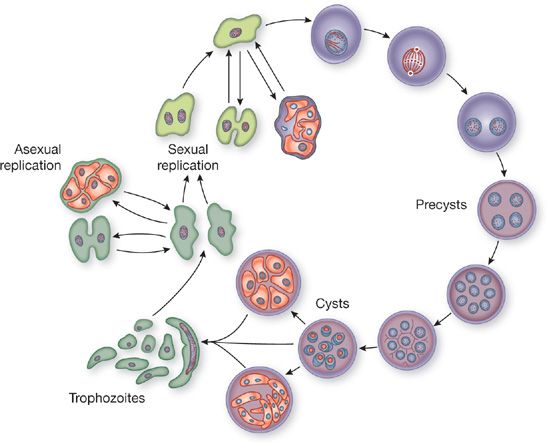
Pneumocystis is a ubiquitous fungus. It has been designated a fungus based on DNA analysis, but it has several biologic features of protozoa. Pneumocystis jirovecii is the distinct species that infects humans.
Pneumocystis most likely spreads by the airborne route. Disease occurs by both new acquisition of infection and reactivation of latent infection. Most humans are infected with Pneumocystis early in life. Most children have detectable Pneumocystis antibodies by age 13. Immunocompetent infants with the infection are either asymptomatic or have mild respiratory symptoms.
Pneumocystis pneumonia (PCP) occurs almost exclusively in immunocompromised people. Before the widespread use of PCP prophylaxis and antiretroviral therapy (ART), PCP occurred in 70% to 80% of people with advanced HIV and had a 20% to 40% mortality rate. Approximately 90% of PCP cases occurred in people with HIV with CD4 T lymphocyte (CD4) cell counts <200 cells/uL.
In people with HIV, the most common manifestations of PCP are subacute onset of progressive dyspnea, fever, non-productive cough, and chest discomfort that worsens within days to weeks. A chest radiograph typically demonstrates diffuse, bilateral, symmetrical “ground-glass” interstitial infiltrates emanating from the hila in a butterfly pattern.
A definitive diagnosis of PCP requires demonstration of the organism in pulmonary tissues or fluids in the presence of pneumonitis.Traditionally, pneumocystis cysts have been detected in respiratory specimens by means of special staining, either by the Gomori methenamine silver stain, toluidine blue. Wright stain detects trophozoites and intracystic sporozoites but does not stain the cyst wall. Direct immunofluorescent staining is often used in conjunction with stains to detect cysts and trophozoites.
Different studies have shown the sensitivities of stained respiratory tract samples to range from: <50% to >90% for induced sputum, 90% to 99% for bronchoscopy with BAL, 95% to 100% for transbronchial biopsy, and 95% to 100% for open lung biopsy.
The disadvantages of special stains are lack of sensitivity, expertise required for interpretation, and labor intensiveness of the process. Real time polymerase chain reaction (PCR) assay for detection of Pneumocystis has replaced staining methods in many laboratories. PCR is highly sensitive and specific for Pneumocystis.
A positive result indicates the presence of Pneumocystis DNA. A negative result indicates the absence of detectable Pneumocystis DNA. PCR cannot reliably distinguish colonization from active disease.
Bronchoalveolar lavage fluid (0.5 mL minimum) is the preferred specimen. Induced sputum, bronchial washings, and tracheal aspirates are also acceptable.
References
Senecal J, et al: Non-invasive diagnosis of Pneumocystis jirovecii pneumonia: a systematic review and meta-analysis. Clin Microbiol Infect. 2022;28(1):23-30.
Fishman JA. Pneumocystis jiroveci. Semin Respir Crit Care Med. 2020;41(1):141-157.
Arcenas RC,et al: A real-time PCR assay for detection of Pneumocystis from bronchoalveolar lavage fluid. Diagn Microbiol Infect Dis. 2006;54(3):169-175.



 How to resolve AdBlock issue?