

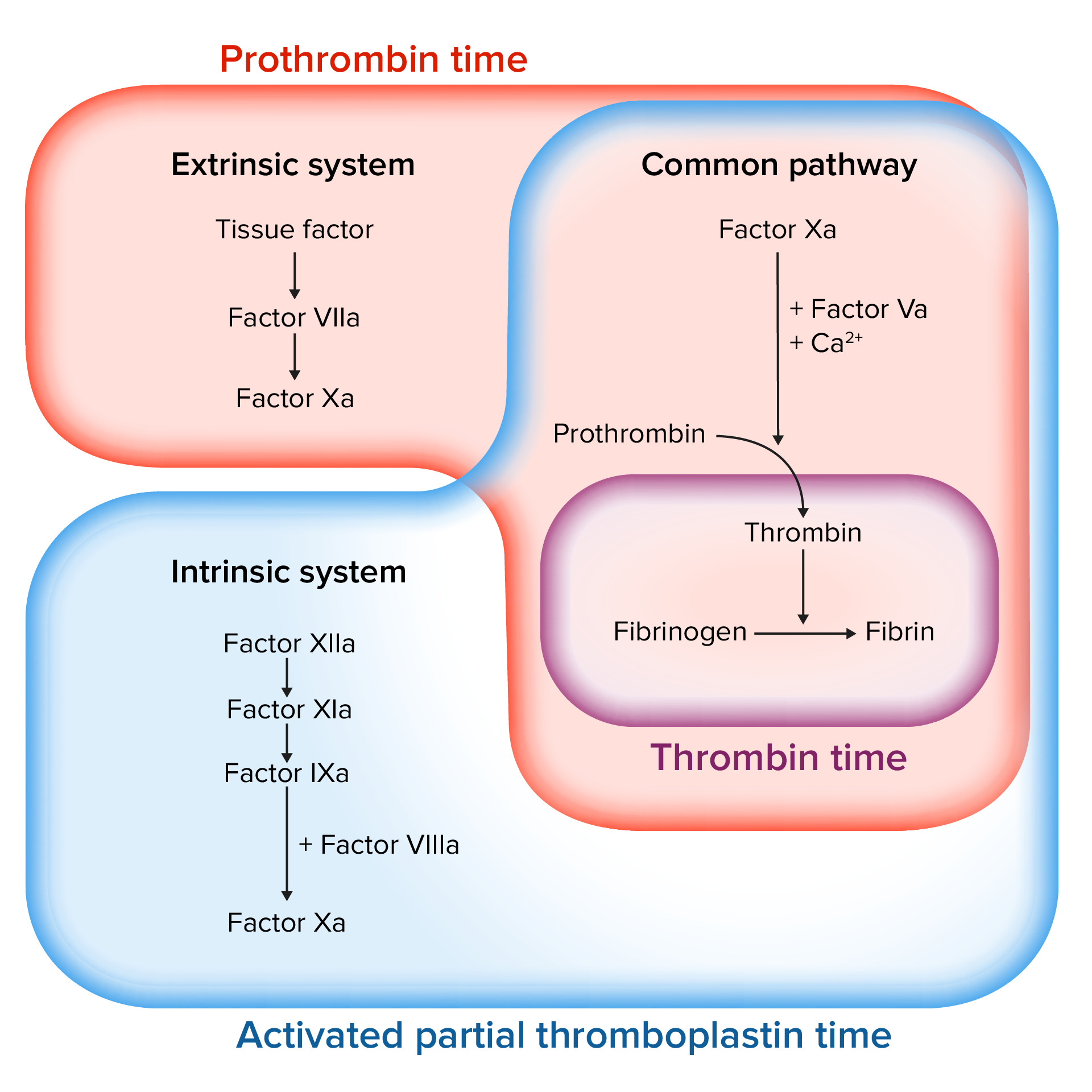
The most important part of a preoperative screen of hemostasis is a carefully documented clinical history. Emphasis should be placed on a history of excessive bleeding associated with dental extractions, tonsillectomies, other surgery, childbirth or injury. Other important information to elicit in the history includes any underlying medical problems, medications and family history of a bleeding tendency.
Several studies have shown no benefit in obtaining routine preoperative screening coagulation tests in patients with a negative clinical history related to hemostasis. In one study of 750 preoperative patients, only 13 of 480 patients (2.7%) with a negative history had an abnormal PT or APTT, and in 12 of these 13 patients repeat testing was normal or surgery was uneventful without repeat testing.
In another study, 3,242 surgery patients had routine preoperative PT, APTT, platelet count, and bleeding time. Of those with an abnormality of the screening tests, specific treatment to correct a hemostatic defect was required in 26 of 172 patients (15%) with a positive clinical history, and in only 1 of 340 patients (0.3%) with a negative history.
Routine laboratory tests are available to screen for a bleeding diathesis.The extent of preoperative laboratory testing in each case depends entirely on the screening history.
Preoperative Hemostasis Tests
|
Clinical History |
Preoperative Tests |
|
Negative |
None |
|
Liver disease, Anticoagulants |
PT, APTT |
|
Leukemia |
PT, APTT, Platelet count |
|
History of bleeding disorder (personal or family) |
PT, APTT, Platelet count, Platelet function test |
|
Chronic renal failure |
Platelet function test |
If the history is entirely negative, no screening tests are recommended. If the screening history raises the likelihood of defective hemostasis (liver disease, use of anticoagulant drugs or leukemia) a PT and APTT are indicated. A platelet count should be added for patients with leukemia. For patients with a personal or family history of a bleeding disorder a full screening panel is recommended.
References
Bock M, et al, Preoperative Laboratory Testing, Anesthesiology Clin, 2016;34:43-58.
Martin SK, Cifu AS, Routine preoperative laboratory tests for elective surgery, J Amer Med Assoc, 2017;318(6):567-568.
Kirkham KR, et al, Preoperative Laboratory Investigations: Rates and Variability Prior to Low-Risk Surgical Procedures, Anesthesiology, 2016;124(4):804-814.
Society of General Internal Medicine. Don’t perform routine pre-operative testing before low-risk surgical procedures. Choosing Wisely. An initiative of the ABIM Foundation. September 12, 2013. www.choosingwisely.org/clinician-lists/society-general-internal-medicine-routine-preoperative-testing-before-low-risk-surgery/. Accessed August 31, 2015.
Rohrer MJ, Michelotti MC, Nahrwold DL. A prospective evaluation of the efficacy of preoperative coagulation testing. Ann Surg 1988; 208:554–557.
Schein OD, Katz J, Bass EB, et al. The value of routine preoperative medical testing before cataract surgery. Study of Medical Testing for Cataract Surgery. N Engl J Med 2000; 342:168–175.



 How to resolve AdBlock issue?