

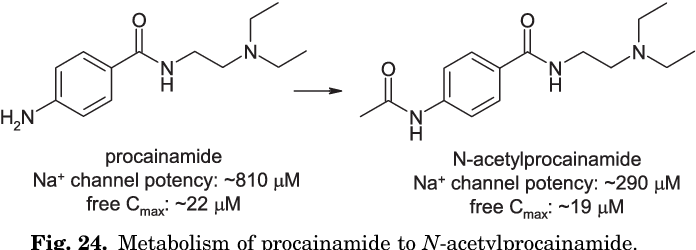
Procainamide is an anti-arrhythmic medication that is primarily used to treat ventricular tachydysrhythmias. The drug can be taken orally as well as injected IV and IM. Oral administration is used for chronic therapy. Total daily doses of 3 to 6 grams are usually required. IV administration is generally used in acute or unstable conditions. A loading dose is never given as a single IV injection because of the risk of hypotension. Intermittent IV dosing is recommended with 100 mg injected over one minute, with the dose repeated every 5 minutes until the arrhythmia is controlled.
Oral doses of procainamide are rapidly and nearly completely absorbed. Peak plasma levels are reached about 60 minutes after ingestion of capsules, but are significantly delayed if the dose is in tablet form. Fifteen to 20% of procainamide is protein bound. Steady state is reached after 13.5 hours. The circulating half-life is 3 hours in normal subjects and 5 to 8 hours in patients with cardiac disease.
At therapeutic doses, 40 to 70% of procainamide is excreted unchanged by the kidney. Hepatic metabolism by N-acetyltransferase produces N-acetylprocainamide (NAPA), an active metabolite with approximately 70% of the anti-arrhythmic activity of the parent drug. Patients who are fast aceylators may have higher plasma NAPA than parent drug levels. NAPA is cleared more slowly by the kidney than procainamide. NAPA concentrations can become quite high in patients with renal or congestive heart failure. For these reasons, it is important to consider both procainamide and NAPA levels when evaluating the status of a patient.
The incidence of adverse effects is high. Side effects include GI disturbances, headache, mild hypotension, rash, insomnia, dizziness, ataxia, hallucinations, mental depression, weakness, hypersensitivity reactions and slight changes in ECG. Procainamide induced lupus is reversible when procainamide is discontinued.
Because of rapid equilibration between serum and cardiac tissues, serum levels accurately reflect the drug's concentration at the site of action. Trough levels should be drawn immediately preceding the next oral dose. Because of NAPA’s longer half-life, levels should be obtained 4048 hours after therapy is initiated or altered.
Procainamide and NAP are measured by a homogeneous immunoassay. Therapeutic concentration is 4-10 ug/mL for procainamide and 12-18 ug/mL for NAPA. Procainamide levels >12 ug/mL and NAPA levels of 40 ug/mL or higher are considered to be critical values.
Trough levels should be collected just before the next dose. Testing is indicated for patients with persistent arrhythmias despite apparently adequate dosing, or if toxicity is suspected. Specimen requirement is a red- top gel barrier tube of blood.
References
Lawson DH, Jick H. Adverse reactions to procainamide. Br J Clin Pharmacol. 1977;4(5):507-11.
Writing Group Members. January CT, et al. 2019 AHA/ACC/HRS focused update of the 2014 AHA/ACC/HRS guideline for the management of patients with atrial fibrillation: A Report of the American College of Cardiology/American Heart Association Task Force on Clinical Practice Guidelines and the Heart Rhythm Society. Heart Rhythm. 2019;16(8):e66-e93.
Pritchard B, Thompson H. Procainamide. [Updated 2023 May 8]. In: StatPearls [Internet]. Treasure Island (FL): StatPearls Publishing; 2025 Jan-. Available from: https://www.ncbi.nlm.nih.gov/books/NBK557788/



 How to resolve AdBlock issue?