

Bone remodeling allows for bone growth, bone repair and elimination of microfractures. Osteoclasts resorb old bone, while osteoblasts synthesize new protein, known as osteoid. Within several months, osteoid becomes calcified. After the age of 40 years, bone destruction begins to exceed formation, leading to osteoporosis. For every 10% of bone that is lost, the risk of fracture doubles.
The medications most commonly used to treat osteoporosis are estrogen, calcitonin and bisphosphonates (etidronate, alendronate, risedronate). Their mechanism of action is to inhibit osteoclastic activity and decrease bone resorption. Treatment with bisphosphonates must be continuously monitored because overdosage can eventually weaken bone.
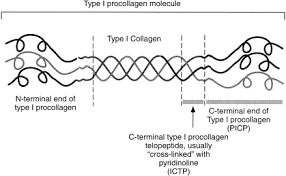
More than 90% of the osteoid matrix of bone consists of type I collagen. Noncollagenous proteins, such as osteocalcin, comprise the remaining 10%. Osteoblasts synthesize procollagen, which is the precursor of collagen. Procollagen contains a short signal sequence as well as amino and carboxy terminal propeptides. Propeptides are cleaved from procollagen by proteinases to form collagen. Both propeptides enter the circulation in a concentration that reflects the synthesis rate of collagen type I. Procollagen Type 1 N-terminal propeptide (PINP) is considered to be the most sensitive biomarker of bone formation.
Procollagen I intact N-terminal propeptide (PINP) values should not be used as a screening test for osteoporosis in the general population. PINP is used to monitor bone formation and anti-resorptive therapies. PINP should be measured prior to the start of therapy to determine a baseline value and again at 3 to 6 months after initiation of therapy. Therapeutic response is evaluated by comparing pre and post-treatment values. The direction and degree of the change vary with the type of osteoporosis treatment. PINP levels have been shown to decrease as much as 70% during bisphosponate therapy. Hormone replacement therapy also decreases PINP levels, but to a lesser extent. Recombinant human parathyroid hormone 1-34 (teriparatide) stimulates osteoblasts and bone formation. An increase in PINP can be seen as early as one month after initiation or treatment and peaks at 6 months. Increases of 10 ug/L or more at 3 months of therapy is considered an adequate response.
PINP exhibits diurnal variation, with higher values occurring at night. Serial measurements should be collected at the same time of the day. PINP is metabolized in the liver. Individuals with severe liver disease have decreased clearance and elevated PINP levels.
Reference ranges using a competitive radioimmunoassay are listed below.
|
Population |
Concentration |
|
Adult male |
22-87 ug/L |
|
Adult female premenopausal |
19-83 ug/L |
|
Adult female postmenopausal |
16-96 ug/L |
Specimen requirement is a red top tube of blood.
References
Szulc P, Naylor K, Hoyle NR, Eastell R, Leary ET; National Bone Health Alliance Bone Turnover Marker Project. Use of CTX-I and PINP as bone turnover markers: National Bone Health Alliance recommendations to standardize sample handling and patient preparation to reduce pre-analytical variability. Osteoporos Int. 2017;28(9):2541-2556.
Bauer DC, Clinical Use of Bone Turnover Markers, J Amer Med Assoc, published online July 11, 2019.



 How to resolve AdBlock issue?