

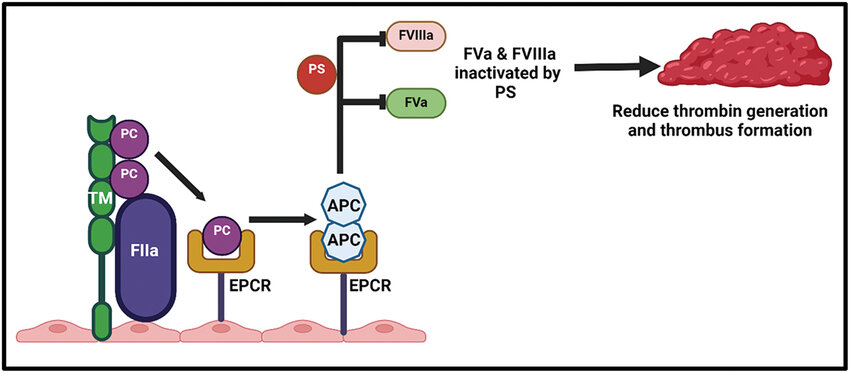
Protein C is a vitamin K dependent plasma protein that inhibits coagulation. For Protein C to serve as an anticoagulant, it must be converted to its active form (Protein Ca) by thrombin. After activation it potently inhibits coagulation by inactivating Factors V and VIII, and enhances fibrinolysis by neutralizing an inhibitor of plasminogen activator.
Protein C deficiency increases the risk of venous thromboembolism. Protein C deficiency can be congenital or acquired. Congenital protein C deficiency results from mutations in the PROC gene. It is inherited as an autosomal dominant condition. Heterozygotes have a mutation in a single copy of the gene and usually have mild deficiency. Homozygotes have mutations in both copies of the gene and develop severe protein C deficiency.
Homozygous individuals with severe deficiency develop disseminated intravascular coagulation (DIC) and purpura fulminans soon after birth. Affected neonates present with an often fatal syndrome of purpura fulminans with spreading skin necrosis, thrombosis and disseminated intravascular coagulation (DIC).
Patients with moderately severe protein C deficiency might not present until adolescence and experience recurrent venous thrombotic events including deep vein thrombosis (DVT), pulmonary embolism (PE), and parenchymal thrombi.
Individuals who are heterozygous can have symptoms ranging from asymptomatic to recurrent thrombosis. In addition to DVT and PE, they may have pregnancy-associated thrombosis and stroke.
Acquired Protein C deficiency may be seen in a wide variety of clinical situations including DIC, extensive thrombosis, liver disease, post-surgery, malignancy, and warfarin therapy. It is uncertain whether or not acquired deficiency contributes to a thrombotic tendency. Since acquired deficiencies of Protein C occur frequently in hospitalized patients, it is preferable to perform the assays at a time when the patient is in stable condition, and ideally in remission from thrombotic events.
Skin necrosis may develop in patients with reduced Protein C levels at the beginning of warfarin therapy. This is due to a transient hypercoagulable state following the rapid warfarin-induced fall in Protein C levels, before the levels of Factors II, IX, and X decrease.
The indications for ordering a protein C assay include the investigation of any patient with unexplained thromboembolism, especially venous, particularly if thrombotic episodes:
- Occur at a relatively young age
- Are recurrent
- Are associated with a positive family history of thrombotic disease
Since Protein C is a vitamin K dependent protein, decreased levels may be expected if a patient is on warfarin therapy. Testing for protein C should be deferred until a patient has been off warfarin for at least 10 days. If it is not possible to discontinue oral anticoagulants and protein C assay is felt to be essential, consideration should be given to stopping the warfarin for 10 days prior to the assays while the patient is temporarily covered with heparin (standard or low molecular weight).
Protein C activity is measured using a chromogenic assay. The adult reference range is 70-150% for the functional assay. A Protein C level of less than 60% may represent a hereditary deficiency in a stable non-anticoagulated adult. Protein C is usually undetectable in individuals with severe homozygous protein C deficiency.
The mean plasma concentration of protein C in a normal term infant is 40%, increasing to approximately 60% at 6 months old.
In general, a diagnosis of hereditary deficiency of Protein C should only be made when a low value has been obtained after repeated testing (4-6 week interval), and the possibility of acquired deficiency has been excluded. Testing of family members may be helpful in confirming the diagnosis.
Specimen requirement is one light blue top (sodium citrate) tube of blood.
Protein C deficiency can be confirmed by next-generation sequencing of the PROC gene.
References
Goldenberg NA, Manco-Johnson MJ. Protein C deficiency. Haemophilia. 2008;14(6):1214-21.
Chalmers E, et al, Purpura fulminans: recognition, diagnosis and management. Arch Dis Child. 2011;96(11):1066-71.
Connors JM, Thrombophilia Testing and Venous Thrombosis, N Engl J Med 2017;377(12):1177-1187.
Rendon P, et al, Optimizing diagnostic testing for venous thromboembolism, Cleve Clin J Med, 2017;84(7):545-554.



 How to resolve AdBlock issue?