

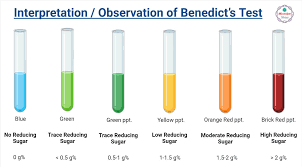
Detection of non-specific reducing substances in urine was begun more than 50 years ago as a screening test for inborn errors of carbohydrate metabolism in pediatric patients. The clinical basis of this test goes back to the early-to-mid 1960s when investigations showed a relationship between the presence of reducing substances in the urine of newborns, and the presence of specific sugars. The qualitative measurement of urinary reducing substances was accepted as a quick screening test of asymptomatic patients in the absence of any other screening procedure.
Clinitest was usually run as a reflex test on urine samples with a negative dipstick glucose result. A negative dipstick glucose assay and a positive reducing test suggested that some substance other than glucose was present in the urine. These sugars included galactose, lactose, and fructose. However, Clinitest was not specific for these sugars and often turned positive due to drugs excreted in urine.
Today, require mandatory newborn screening for more than 30 inborn errors of metabolism using tandem mass spectrometry. This testing detects galactosemia, which is the most common inborn error of carbohydrate metabolism. Other diseases of carbohydrate metabolism (except diabetes) have much lower prevalence or are clinically more benign than galactosemia and do not require screening of asymptomatic newborns.
For this reason, most laboratories have discontinued automatic reflex testing for reducing substances in children less than 2 years of age. Testing for reducing substances remains available at the specific order of a physician.
Reference
Naumova NN, Schappert J, Kaplan L, Reducing Substances in Urine : a Paradigm for Changes in a Standard Test, Ann Clin Lab Sci, 2006;36(4):447-448.



 How to resolve AdBlock issue?