

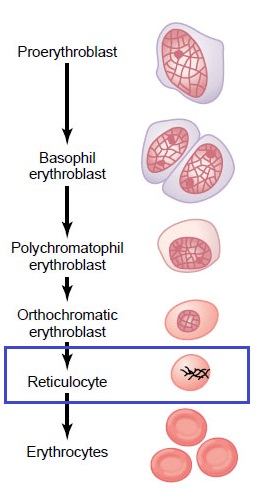
Reticulocytes are non-nucleated immature red cells in peripheral blood, containing residual RNA. After erythroid precursors lose their nuclei, another 4 days is required for the resulting reticulocytes to mature and lose their RNA. Normally the first 3 days are spent in the marrow, and the last one to two days in peripheral blood. Early reticulocytes continue to synthesize hemoglobin; approximately 25% of total red cell hemoglobin content is produced during this stage of development.
Reticulocytes are larger than mature red blood cells (MCV~160) and normally comprise about 1% of the red blood cell count. During periods of increased erythropoietic demand, reticulocyte lifespan in peripheral blood increases to 3 or more days, as a result of premature release of immature or “stress” reticulocytes from the bone marrow.
Reticulocyte’s name is derived from the reticular (web-like) ribosomal RNA seen within the cell when stained with methylene blue. The presence of ribosomal RNA is why reticulocytes appear slightly blue when stained with Wright Giemsa.
Clinical laboratory techniques of reticulocyte enumeration are based on detection of cytoplasmic RNA. Originally, the reticulocyte count was performed by microscopic examination of peripheral blood smears stained with a supravital dye. Today, reticulocyte counts are included in complete blood cell count performed by automated hematology analyzers. Automated methods have the advantage of enumerating large numbers of cells, thereby greatly improving precision, accuracy and efficiency. Additional reticulocyte parameters such as reticulocyte maturation index and immature reticulocyte fraction can also be determined.
Automated reticulocyte counting is based on flow cytometry technology that includes light scatter and immunofluorescence of a RNA specific dye. Sysmex hematology analyzers use auramine-O. Red blood cells are discriminated from platelets and white blood cells by forward versus side scatter analysis. Reticulocytes are then differentiated from mature red cells from reticulocytes by the level of green fluorescence intensity. The reticulocyte population is automatically divided into low, intermediate and high fluorescence populations and the percentage of cells in each fraction is calculated.
The reticulocyte count is useful as an index of effective erythropoiesis. It is usually expressed as a percentage of total red cells and as an absolute count (# of reticulocytes per uL). The percentage value is falsely elevated in patients with anemia. Automated hematology analyzers correct for this bias using the following formula.
Corrected Reticulocyte Count = Reticulocyte % X Patient’s red cell count/5.00 million per uL
The absolute reticulocyte count does not require correction.
Indications for ordering a reticulocyte count include:
- Investigation of anemia
- Monitoring the effect of hematinic or recombinant erythropoietin therapy
- Monitoring bone marrow regenerative capacity after chemotherapy or bone marrow transplantation
The reticulocyte count is one of the major parameters used in the initial classification of anemia. It helps to distinguish hypoproliferative from hyperproliferative causes. Reticulocytes are increased in anemic patients with functional bone marrows. This includes patients with blood loss or hemolytic anemias and patients who have been successfully treated for other types of anemia. In contrast, patients with bone marrow aplasia, bone marrow infiltration, or nutritional deficiencies have a very low reticulocyte count (less than 2%).
|
Reticulocytes |
Causes |
|
Increased |
|
|
Decreased |
|
|
Normal |
|
Automated reticulocyte counting methods have led to the ability to measure stages of reticulocyte maturity, based on RNA content. It is now possible to precisely quantitate the proportion of all reticulocytes that is immature. This is termed the immature reticulocyte fraction (IRF). Immature reticulocytes exhibit higher fluorescence. It is calculated as the ratio of immature reticulocytes to the total number of reticulocytes.
IRF provides a very early and sensitive index of marrow erythropoietic activity. A rise in IRF is one of the earliest indicators of bone marrow engraftment or recovery from intensive chemotherapy. The IRF can also be used as an early indicator of response to erythropoietin therapy in patients with chronic renal failure and other diseases.
Evaluation of the IRF together with the absolute reticulocyte count can provide additional useful information, as shown in the following table.
|
Clinical Condition |
IRF |
Absolute Retics |
|
Aplastic marrow |
Decreased |
Decreased |
|
Early erythropoietic response after marrow aplasia, Marrow engraftment after BMT |
Normal or Increased |
Decreased |
|
Response to EPO Rx or early acute hemorrhage |
Increased |
Normal |
|
Hemolytic anemia or hemorrhage |
Increased |
Increased |
The adult reference range for reticulocyte count is 0.6-2.7%. The adult reference range for the absolute reticulocyte count is 30.4-111 x 10(9)/L.
The adult reference range for IRF is 2.3%-15.9%.
Specimen requirement is one 5mL lavender top tube of blood (same tube used for CBC).
References
Kim NH, Assessment of Immature Reticulocyte Fraction as an Early Predictor of Marrow Engraftment After Hematopoietic Stem Cell Transplantation, Transplant Cell Therapy, 2011;17(2),S235.
Piva E et al, Clinical Utility of Reticulocyte Parameters, Clinical Lab Med.2015;35(1):133-63.
Buttarello M. Laboratory diagnosis of anemia: are the old and new red cell parameters useful in classification and treatment, how? Int Jn Lab Hematol. 2016;38 Suppl 1:123-132



 How to resolve AdBlock issue?