

A test for fetal maternal hemorrhage (FMH) should be performed approximately one hour after delivery on a maternal sample from all D negative women who deliver a D positive fetus. Testing for FMH should be done regardless of the presence of detectable passive anti-D in maternal serum.
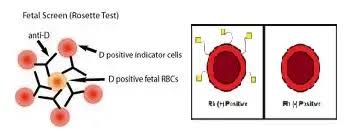
The rosette test is a sensitive qualitative screening method that can detect 10 mL or more of fetal whole blood in the maternal circulation. A maternal blood sample is incubated with anti-D antibody which binds to any D positive fetal RBCs present in the suspension. Maternal red cells are then washed to remove unbound antibody.
A red cell suspension from a D negative mother is first incubated with monoclonal IgM anti-D for 5 minutes at room temperature and then washed to remove all unbound antibody. A dilute suspension of D positive indicator cells is then added, and the mixture of maternal red cells and indicator red cells is centrifuged. Since any minor population of D positive fetal red cells will have been coated with anti-D, the D positive indicator red cells will bind to them and form visible agglutinates (rosettes) around them.
After centrifugation, the mixture is resuspended and spread on a microscope slide. Five fields are examined at low power. Observation of four or fewer rosettes is considered negative. A few rosettes can be seen with a FMH of as little as 2.5 mL. If five or more rosettes are observed, the test is positive for D-positive fetal red cells. The presence of 5 or more rosettes indicates that a FMH of at least 30 mL has occurred. Approximately 0.3% of term deliveries have FMH of this magnitude.
The rosette test cannot detect FMH if the mother is D positive or the infant is D negative. The rosette test may be falsely positive if the mother has a variant of the D antigen known as weak D, and falsely negative if the fetus/neonate is weak D. A false positive result may also occur if the mother has a positive direct antiglobulin test (DAT) due to an autoantibody because of crosslinking and agglutination of the mother’s antibody coated red cells.
If the rosette test is positive, the degree of FMH should be quantified by using the Kleihauer Betke acid elution method or flow cytometry.
References
Hajjaj OI et al. Laboratory assessment of fetomaternal haemorrhage and Rh immune globulin management: Canadian practice and scoping review, Brit J Haem, https://doi.org/10.1111/bjh.20246.
Kim YA, Makar RS, Detection of fetomaternal hemorrhage, 2011; https://doi.org/10.1002/ajh.22255



 How to resolve AdBlock issue?