

Serologic tests for autoantibodies, including antinuclear antibodies (ANAs) and antibodies to specific nuclear antigens such as double-stranded DNA (dsDNA), play an important role in the diagnosis of systemic rheumatic diseases. However, test results for autoantibodies alone are insufficient to establish the diagnosis of a systemic rheumatic disease. No tests for autoantibodies should be performed without a clinical evaluation that leads to a presumptive diagnosis.
The original discovery of ANA was based on indirect immunofluorescence. Immunofluorescent antibody (IFA) is still the most commonly utilized method for detection of antinuclear antibodies. In this method, diluted patient serum is incubated on a slide containing a monolayer of human epithelial cells. If antibody is present, it binds to cell nuclei. After washing, bound antibody is detected by adding fluorescent anti-human IgG. Positive cells demonstrate bright green nuclear fluorescence with a distinct staining pattern. Patient samples are initially tested at a dilution of 1:40 to 1:160. Positive samples are then diluted and both the fluorescent pattern and titer are reported. The titer is the highest dilution of serum that still shows immunofluorescent nuclear staining.
Hep-2 cells are the preferred cell line due to their human origin, high mitotic activity, and the ability to induce expression of clinically important antigens. HEp-2 cells have an estimated 100 to 150 antigens, the most of any method, allowing for detection of the greatest number of antibody specificities.
Specific follow-up tests for antibodies to the following antigens are available: dsDNA, Sm, RNP, SS-A (Ro), SS-B (La,) Scl-70, histones, and Jo-1. With rare exceptions, these tests should not be ordered if the ANA was negative or weakly positive, because less than 5% of patients with ANA titers <1:160 will have positive follow-up tests.
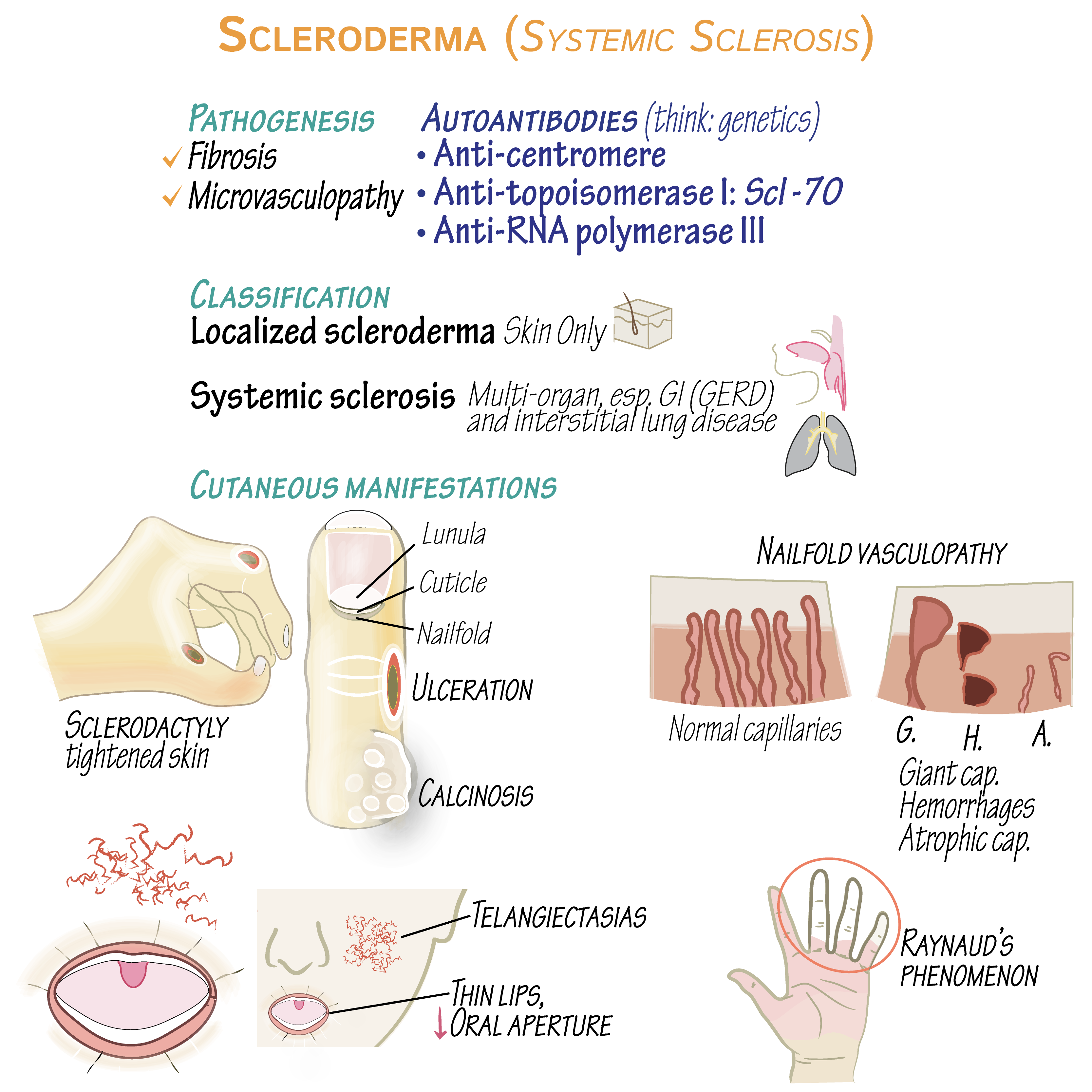
Patients with scleroderma are categorized primarily into two types of disease: limited and diffuse. Patients with limited disease (also known as CREST syndrome) tend to have a better prognosis than those with diffuse disease.
Autoantibodies may be useful in differentiating the two types of disease. Limited disease is most commonly associated with the anti-centromere pattern of ANA staining. Approximately 60% of patients with limited scleroderma have anti-centromere antibodies. They occur more frequently in Caucasians than in African Americans, Hispanics, or Asians. The specificity of anti-centromere antibodies for limited scleroderma is 95%.
Approximately 40% of patients with diffuse scleroderma have autoantibodies to Scl-70. Scl-70 is an antigen present on DNA topoisomerase I, which is the nuclear enzyme responsible for twisting and untwisting the DNA helix during gene transcription. Antibodies directed against Scl-70 usually give a nucleolar ANA pattern.
Scleroderma patients with anti-Scl-70 antibodies tend to have more widespread skin disease and internal organ damage, especially pulmonary fibrosis. Anti-Scl-70 and anti-centromere antibodies seldom coexist in the same individual.
Results are reported as negative or positive. Reference value is negative.
Specimen requirement is one SST tube of blood.
References
Andrade LEC, et al. International consensus on antinuclear antibody patterns: definition of the ac-29 pattern associated with antibodies to DNA topoisomerase I. Clin Chem Lab Med. 2018;56(10):1783-1788.
van den Hoogen F, et al. 2013 classification criteria for systemic sclerosis: an American College of rheumatology/European League against rheumatism collaborative initiative. Ann Rheum Dis. 2013;72(11):1747-1755.
Nihtyanova SI, et al. Using autoantibodies and cutaneous subset to develop outcome-based disease classification in systemic sclerosis. Arthritis Rheumatol. 2020;72(3):465-476.
Mahler M, Silverman ED, Schulte-Pelkum J, Fritzler MJ. Anti-Scl-70 (topo-I) antibodies in SLE: Myth or reality? Autoimmun Rev. 2010 Sep;9(11):756-60.



 How to resolve AdBlock issue?