

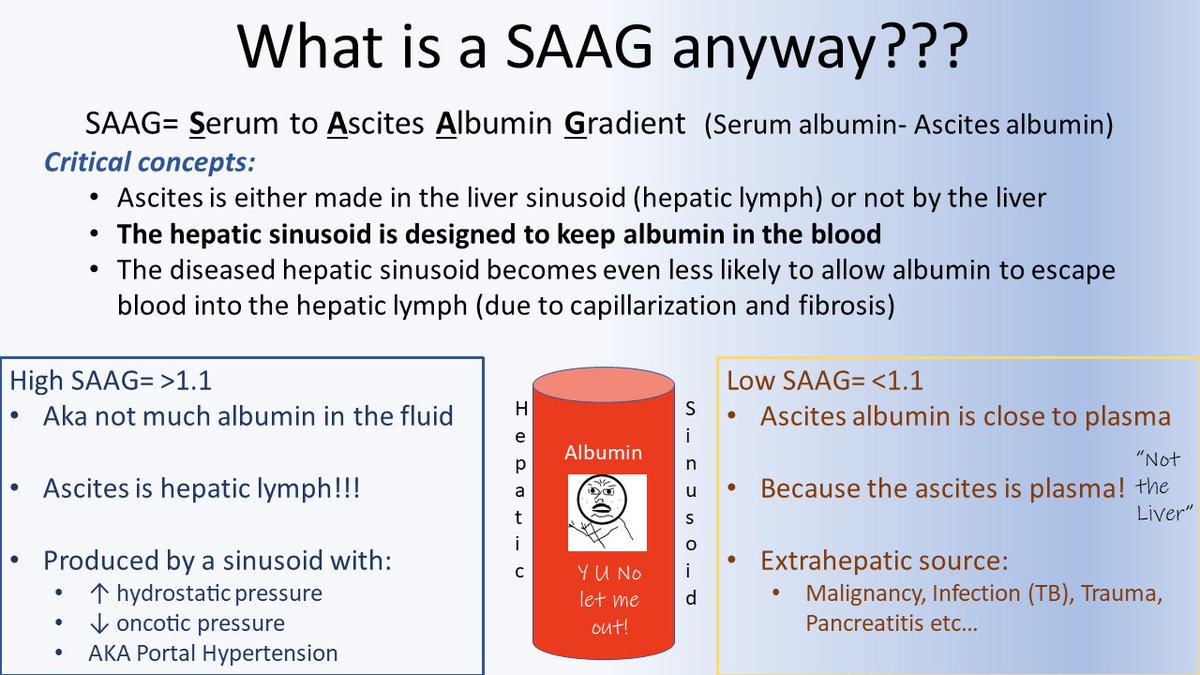
The application of Light's criteria for classifying transudates and exudates is often misleading when applied to peritoneal fluid (ascites). The measurement of albumin in ascitic fluid as a surrogate marker of portal hypertension has largely replaced the practice of distinguishing transudates from exudates.
Calculation of a serum to ascites albumin gradient (SAAG) is a more physiologically appropriate test. It is calculated as the serum albumin concentration minus the peritoneal fluid albumin. A high gradient (>1.1 g/dL) indicates ascites related to portal hypertension, usually due to cirrhosis. Increased hydrostatic pressure within hepatic portal veins forces water, but not large proteins, such as albumin, into the peritoneal cavity. Heart failure can also produce a high gradient. A low gradient <1.1 g/dL is usually associated with peritoneal seeding by cancer, tuberculosis, and other infections.
References
Runyon BA, et al, The serum-ascites albumin gradient is superior to the exudate-transudate concept in the differential diagnosis of ascites, Ann Intern Med, 1992;117(3):215-220.
Pare P et al, Serum-ascites albumin concentration gradient: A physiologic approach to the differential diagnosis of ascites, Gastroenterology, 1983; 85(2):240-244.



 How to resolve AdBlock issue?