

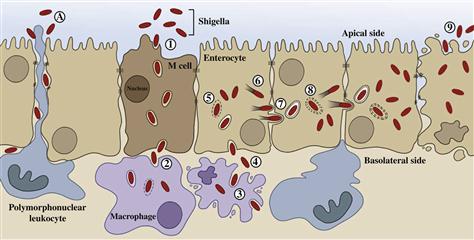
Shigella species are a common cause of bacterial diarrhea worldwide. Shigella causes an estimated 450,00 infection in the United States each year. Transmission occurs through direct contact with an infected person or exposure to contaminated food, water, or fomites. Ingestion of as few as 10 organisms can cause diarrheal illness. Shigella are relatively resistant to killing by gastric acid. Thus, ingested bacteria pass into the small intestine where they multiply. In the colonic mucosa, Shigella invades colonic enterocytes, disrupting their normal function and causing inflammation. Symptoms of shigellosis include diarrhea, fever, nausea, vomiting and cramps.
In the United States, where sewage disposal is usually adequate, most cases are probably transmitted by the fecal-oral route from people with symptomatic or recently symptomatic shigellosis. Thus, outbreaks of shigellosis in the United States occur predominantly in institutions such as day care centers or custodial institutions and less commonly by contamination of food or drinking water. In the developing world where sewage disposal is suboptimal or nonexistent, both fecal-oral spread and contamination of common food and water supplies are important mechanisms of transmission.
Shigella are nonmotile, facultatively anaerobic, gram negative rods. There are four species of Shigella:
- S. dysenteriae (serogroup A)
- S. flexneri (serogroup B)
- S. boydii (serogroup C)
- S. sonnei (serogroup D)
Most cases of shigellosis in the United States are caused by S. sonnei (>75 percent), with S. flexneri the next most frequent isolate. S. dysenteriae was the most common isolate both in Europe and the United States at the beginning of this century but is now rare. In the United States, S. dysenteriae infection is generally limited to imported cases from Mexico and Central America or from laboratory contamination.
The spectrum of disease severity varies according to the serogroup of the infecting organism. S. sonnei commonly causes mild disease, which may be limited to watery diarrhea, while S. dysenteriae 1 or S. flexneri commonly causes bloody diarrhea.
Symptoms usually begin within one to two days after infection. In a normal healthy host, the course of disease is generally self-limited, lasting no more than seven days when left untreated.
Shigellosis is diagnosed by stool culture, which should be performed in all suspected cases prior to therapy. The fecal specimen is inoculated onto hektoen enteric agar, a selective and differential agar designed to recover Shigella species. Suspected colonies can be identified by MALDI-TOF, biochemical tests, or nucleic acid sequencing of 16S ribosomal RNA gene.
Since 2015, a growing proportion of cases has been caused by extensively drug-resistant (XDR) Shigella species. XDR is defined as being resistant to ampicillin, azithromycin, ceftriaxone, ciprofloxacin, and trimethoprim-sulfamethoxazole. According to the CDC, the percentage of Shigella isolates that were were XDR increased from 0% in 2015 to 8.5% in 2023. No Food and Drug Administration–approved oral antimicrobial agents are available to treat these XDR infections. Susceptibility testing is routinely performed on all Shigella isolates.
Shigellosis is a nationally notifiable disease that should be communicated to the local health department within 24 hours of diagnosis.
References
DuPont HL. Persistent diarrhea: A clinical review. JAMA. 2016;315(24):2712-2723.
Echeverria P, Sethabutr O, Pitarangsi C. Microbiology and diagnosis of infections with Shigella and enteroinvasive Escherichia coli. Rev Infect Dis. 1991;13 Suppl 4:S220-5.
Shane AL, et al. 2017 Infectious Diseases Society of America Clinical Practice Guidelines for the Diagnosis and Management of Infectious Diarrhea. Clin Infect Dis. 2017;65(12):1963-1973.
Kotloff KL et al. Shigellosis. Lancet. 2018;391:801-812.
Logan N, et al. Emergence of Extensively Drug-Resistant Shigellosis — United States, 2011–2023. MMWR Morb Mortal Wkly Rep 2026;75:173–178.



 How to resolve AdBlock issue?