

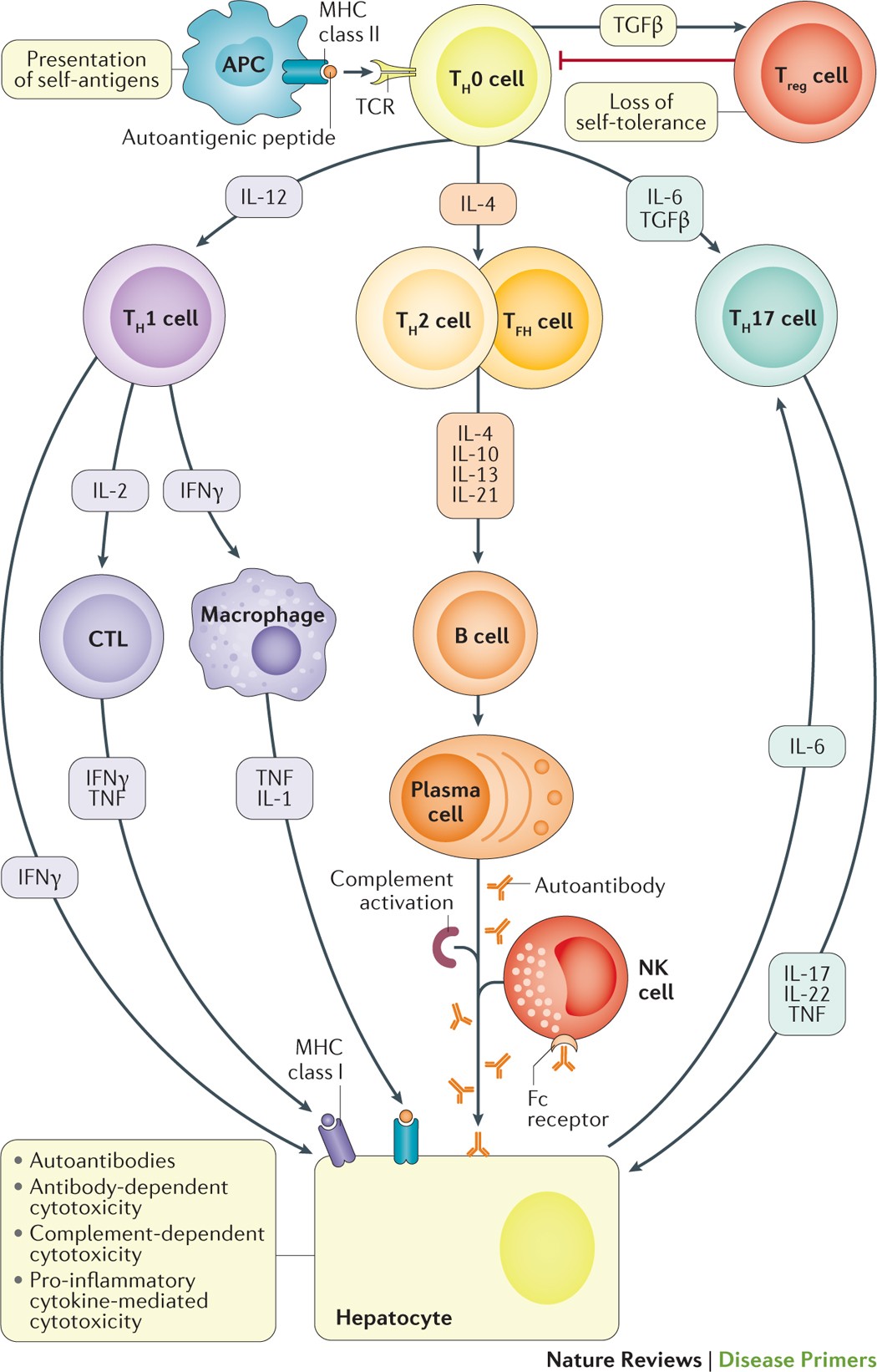
Autoimmune hepatitis is an unresolving inflammation of the liver of unknown etiology that is associated with high concentrations of autoantibodies, pronounced hypergammaglobulinemia and the absence of cholestasis. The definitive diagnosis requires exclusion of viral, hereditary, and drug induced liver disease. Autoimmune hepatitis occurs predominantly in women and affects all ages. It is responsible for up to 18% of chronic hepatitis cases not attributable to viruses or alcohol.
Two types of autoimmune hepatitis have been proposed based on autoantibody associations.
|
Type |
Population Affected |
Autoantibody |
|
1 |
Young- middle aged women |
ANA &/or ASMA |
|
2 |
Western European children Rare in U.S. |
Liver kidney microsomal (LKM) antibody |
Eighty percent of individuals with autoimmune hepatitis have type 1 AIH. Type 1 autoimmune liver disease is characterized by the presence of high levels of anti-nuclear antibody (ANA) or anti-smooth muscle antibody (ASMA). ASMA are IgG or IgM antibodies that are often directed against filamentous actin (F-actin). Since F-actin is present in all smooth muscle fibers, these antibodies are not organ specific. The sensitivity and specificity of anti-actin antibodies for AIH are 80% and 90%, respectively. ANA and ASMA levels fluctuate during the disease course. Antibody levels cannot be used to predict the clinical course or outcome. F-actin antibodies have also been detected in 30 to 60% of cases of primary biliary cholangitis/AIH overlap syndrome.
The presence of LKM autoantibodies has been used to define type 2 AIH, which is typically negative for ANA and ASMA. Type 2 AIH is more common in children and is often more aggressive than type 1 AIH. In the United States, only about 4% of adults with AIH have type 2 disease.
Traditionally, ASMA were detected with an immunofluorescent assay that looked for antibody binding to smooth muscle in tissue sections such as mouse stomach. Results were expressed as a titer, which was the highest dilution of patient sera giving a positive result. A titer greater than 1:20 was considered positive. With the immunofluorescent assay, many weakly positive ASMA were observed. An enzyme immunoassay using purified F-actin filaments has better specificity. The reference range is shown in the following table.
|
Interpretation |
Value |
|
Negative |
0-19 Units |
|
Weak Positive |
20–30 Units |
|
Positive |
>30 Units |
Smooth muscle antibody is measured by an enzyme-linked immunosorbent assay (ELISA). A numerical result is reported along with a negative or positive interpretation. Specimen requirement is one red top gel barrier tube of blood.
References
Zeman MV et al. Autoantibodies and Liver disease: Uses and Abuses. Can J Gastroenterol 2010;24:225-31.
Terziroli Beretta-Piccoli B, Mieli-Vergani G, Vergani D: Serology in autoimmune hepatitis: A clinical-practice approach. Eur J Intern Med. 2018;48:35-43.
Terziroli Beretta-Piccoli B, Mieli-Vergani G, Vergani D. Autoimmune hepatitis: Serum autoantibodies in clinical practice. Clin Rev Allergy Immunol. 2022;63(2):124-137.
European Association for the Study of the Liver. EASL clinical practice guidelines: autoimmune hepatitis. J Hepatol. 2015;63(4):971-1004.



 How to resolve AdBlock issue?