

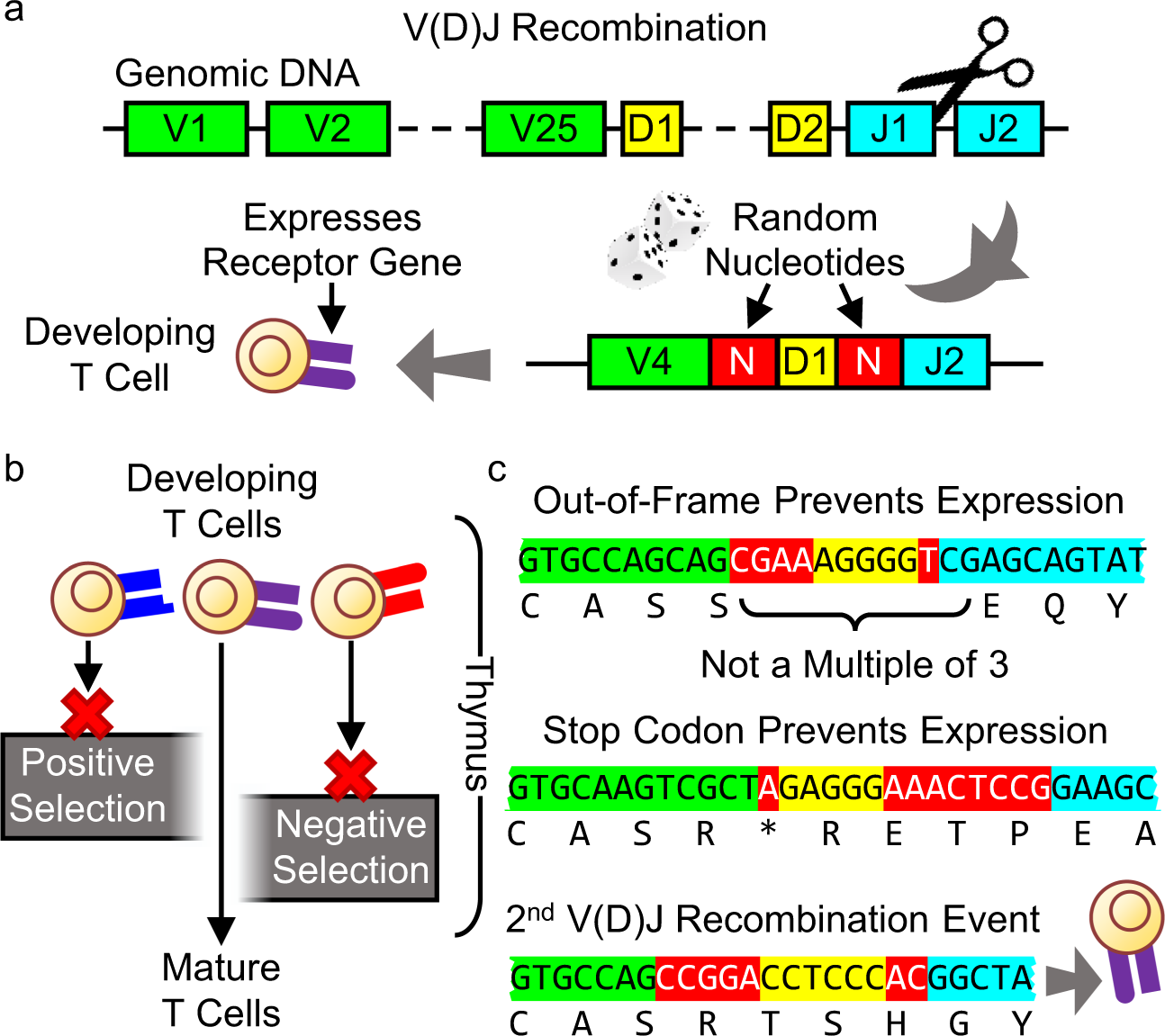
T lymphocytes recognize and respond to foreign antigens by means of specific T cell receptors (TcR). The human genome does not contain enough unique DNA sequences to code for the vast repertoire of receptors needed to recognize all of the foreign antigens a person is exposed to during their lifetime. To overcome this limitation, TcR genes undergo a complex series of DNA rearrangements to produce more than one billion unique receptors.
Four types of TcR genes have been identified: alpha, beta, delta, and gamma. TcR beta and gamma genes are located on chromosome 7 and TcR alpha and delta genes are located on chromosome 14. Beta genes rearrange in the early thymocyte of stage of T cell development. Alpha chains rearrange a little later during the common thymocyte stage. Both rearrangements occur before the CD3-TcR complex is expressed on the cell surface.
These genes undergo somatic rearrangement to produce heterodimeric TcRs on the surface of T cells. The alpha-beta receptor is expressed on 90% to 95% of T cells and the gamma- delta on 5% to 10% of T cells.
T cell lineage disorders are more difficult to classify than B cell disorders.Often, T cell disorders cannot be definitively diagnosed by morphology and flow cytometry. T lineage disorders lack a phenotypic marker of clonality like the kappa and lambda light chain restriction in B lineage disorders. Sometimes T cell clonality can be inferred when the lymphocytes express a predominance of CD4 or CD8 antigens.
A leukemia or lymphoma is derived from clonal expansion of a single abnormal cell. A monoclonal proliferation of T cells results in the predominance of a single TcR gene rearrangement.In contrast, a polyclonal proliferation of lymphocytes is due to division of millions of different B and T cells, each containing a different set of gene rearrangements. No single gene rearrangement predominates.
Molecular analysis of the beta TcR gene rearrangements provides the most definitive assessment of T cell clonality. Genomic DNA is extracted from a specimen of whole blood. TcR-beta and TcR-gamma genes are amplified by polymerase chain reaction. PCR products are identified by capillary gel electrophoresis. Results are interpreted by a pathologist and reported as negative, indeterminate, or positive for a clonal T-cell population.
TcR gene rearrangements are useful in the diagnosis of T cell malignancies such as T cell ALL and lymphoblastic lymphoma, mycosis fungoides, Sezary syndrome, T cell PLL/CLL, and adult T cell leukemia.
References
Liu H, et al. A practical strategy for the routine use of BIOMED-2 PCR assays for detection of B- and T-cell clonality in diagnostic haematopathology. Br J Haematol. 2007;138(1):31-43.
Langerak AW, et al. EuroClonality/BIOMED-2 guidelines for interpretation and reporting of Ig/TCR clonality testing in suspected lymphoproliferations. Leukemia, 2012;26(10):2159-2171



 How to resolve AdBlock issue?