

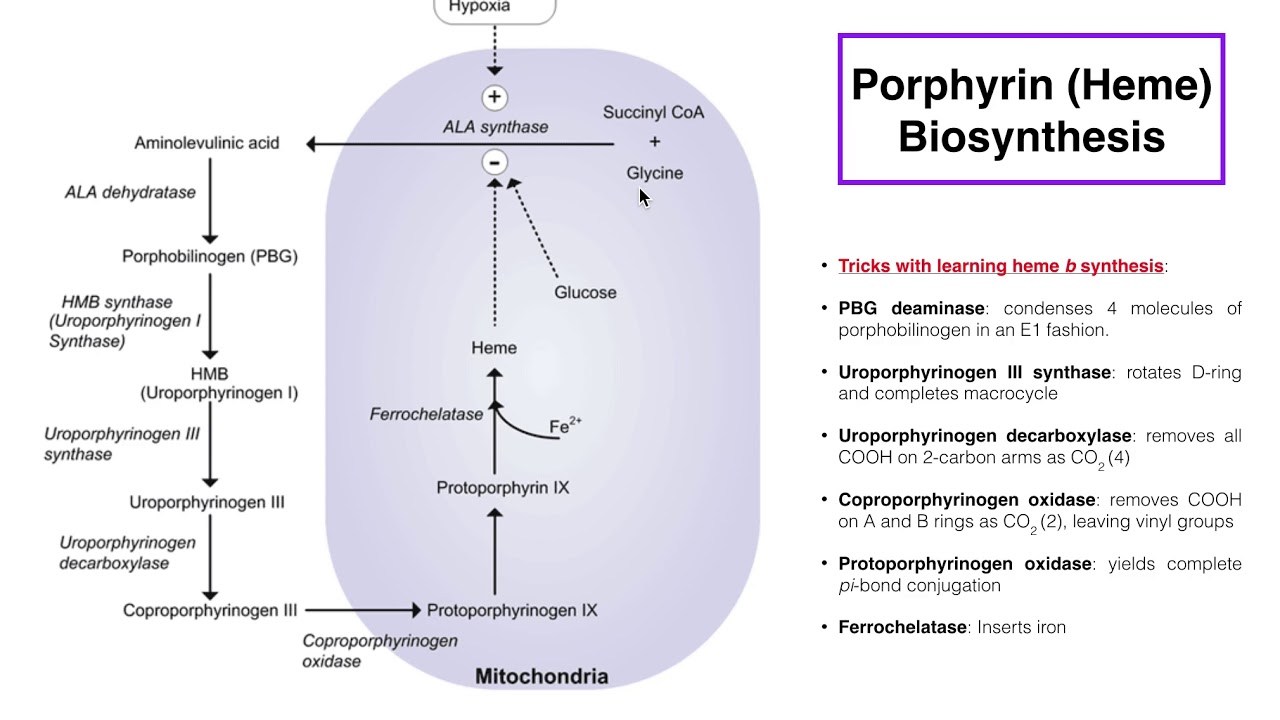
Porphyria cutanea tarda (PCT) is the most common porphyria and most responsive to treatment. Approximately 75% of cases are acquired and 25% are inherited. Acquired cases are precipitated by complications from hepatitis C, hemochromatosis, alcohol abuse, iron overload, smoking, estrogen therapy and occupational exposure to polychlorinated cyclic hydrocarbons. Familial PCT is caused by partial deficiency of uroporphyrinogen decarboxylase and is inherited as an autosomal dominant trait. It is characterized by photosensitivity and skin fragility. Sun exposed skin is most often affected. Hypertrichosis, hyperpigmentation, or alopecia may be observed. Liver function tests are usually abnormal as a result of uroporphyrinogen accumulation in the liver. PCT is diagnosed by demonstrating elevated uroporphyrin and heptacarboxylporphyrin in urine. Urine uroporphyrin is usually elevated more than 4 times the upper limit of normal. Heptaocarboxylporphyrin is usually 25% of the uroporphyrin level. Elevated uroporphyrin with normal heptacarboxylporphyrin is more indicative of an acute neurologic porphyria. Acquired versus familial PCT can be distinguished by measuring uroporphyrinogen decarboxylase levels in erythrocytes.
Hepatoerythropoietic porphyria (HEP) is a rare but severe porphyria due to markedly deficient uroporphyrinogen decarboxylase activity. It is inherited as an autosomal recessive disorder. Onset usually occurs in infancy or childhood. Patients have severe photosensitivity leading to blistering and scarring. Hemolytic anemia and hepatosplenomegaly may also be present. HEP is caused by a severe deficiency of uroporphyrinogen decarboxylase, with activity levels 10% of normal in both hepatocytes and erythrocytes.
Uroporphyrinogen Decarboxylase is measured by lysing red blood cells and incubating them with delta-aminolevulinic acid. Reference range is 1.00 RU or higher. RU is an abbreviation for relative units. Specimen requirement is a green or lavender top tube of whole blood.
For a more comprehensive discussion, see the article entitled: “Porphyrins.”
References
Williams GR, Nerenz RD, Not Your Ordinary Rash, Clin Chem 2019;65(6):733-738.
Bissell MD, et al, Porphyria, New Engl J Med, 2017;377:862-872.
Balwani M, Desnick RJ, The Porphyrias: advances in diagnosis and treatment, Blood, 2012;120(23):4496-4504.



 How to resolve AdBlock issue?