

Volatile compounds are low molecular weight organic solvents such as methanol, isopropanol and acetone. Although ethylene glycol is not actually a volatile compound, ingestion results in a similar clinical presentation. These solvents may be ingested either intentionally by adults or unintentionally by infants. According to the 2005 annual report of the American Association of Poison Control Centers the most commonly reported exposures in order of decreasing frequency were isopropanol > ethylene glycol > acetone > methanol. Methanol and isopropanol are sometimes used as substitutes for ethanol by alcoholics. Methanol ingestions most frequently involve automotive products such as gasoline additives and deicers, while isopropanol ingestions usually involve products labeled as rubbing alcohol. Acetone poisoning may result from either ingestion of solvents, such as nail polish remover, or glue sniffing. Ethylene glycol is the major constituent in automotive antifreeze, deicers, hydraulic brake fluid and industrial drying agents.
Methanol
Methanol is the simplest of alcohols, with the chemical formula CH3OH. It is also known as wood alcohol, wood spirit, wood naphtha, carbinol, or methylhydrate. It is a common cause of poisoning. Methanol resembles ethanol in taste, odor and intoxicating properties and is less expensive to purchase. Methanol intoxication most commonly follows ingestion of automotive windshield-washer fluid, duplicating fluid, nonpermanent antifreeze, glass cleaners, solvents, paint remover and embalming fluid.
Ingested methanol is completely absorbed, reaching peak blood concentration about 30 to 60 minutes after ingestion. After absorption, it is distributed in total body water (0.6 L/kg) and may be concentrated in the vitreous humor and cerebrospinal fluid. Toxic exposure can also arise from inhalation or prolonged skin contact.
The toxic dose of methanol is highly variable. The fatal dose is commonly stated to be 100 mL, but some patients have died after drinking 6 mL and others have survived after drinking 500 mL. Usually there is a lag time of 12 hours between ingestion and onset of symptoms. Symptoms may be delayed as long as 72 to 96 hours if ethanol is co-ingested. Symptoms include nausea, vomiting, abdominal pain, visual disturbances, headache, generalized weakness, seizures, CNS depression and coma. The most worrisome long-term complication in survivors is blindness.
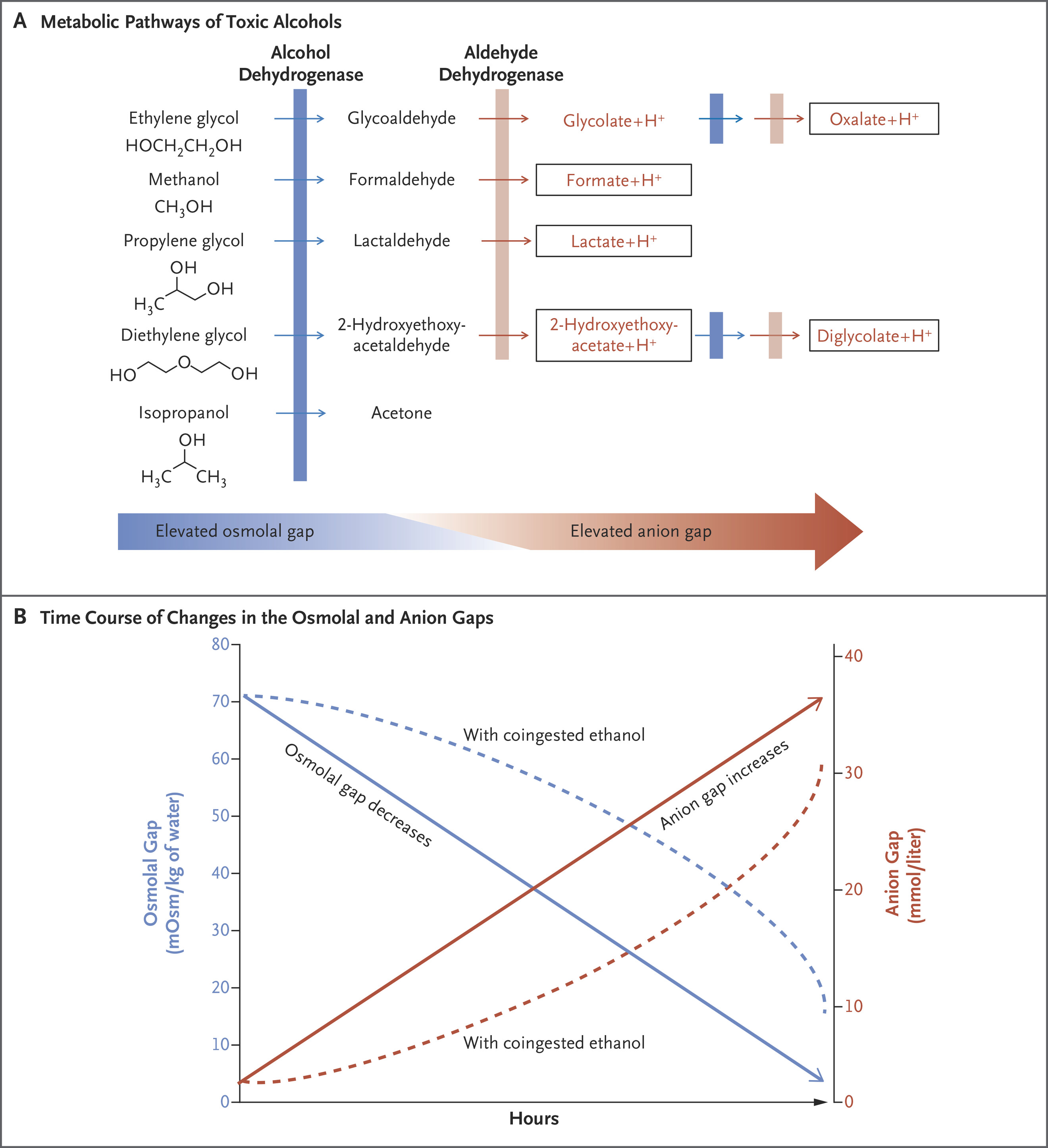
Approximately 20% of methanol is eliminated unchanged by the lungs and kidneys. The remainder is metabolized in the liver. Alcohol dehydrogenase converts methanol to formaldehyde, which is almost immediately converted to formic acid by aldehyde dehydrogenase. Most of the pathologic effects of methanol ingestion are due to accumulation of formic acid. It inhibits aerobic metabolism and increases anaerobic glycolysis and lactate production, causing a severe metabolic acidosis.Blood pH often ranges between 6.8 and 7.3. Poorer outcomes are associated with more severe acidosis.
Most hospital laboratories do not measure methanol levels. However, other laboratory tests are helpful in making the diagnosis of methanol poisoning. Electrolytes reveal a low bicarbonate and elevated anion gap, consistent with metabolic acidosis. Anion gap rises as methanol is metabolized to formic acid.
Acetone
Acetone is rapidly absorbed from the gastrointestinal tract, lungs, and the skin. Acetone is highly soluble in water and widely distributed to all tissues and organs. Acetone is predominantly excreted unchanged through the lungs and lesser amount urine. A small fraction is metabolized to acetate and formate. Acetone is usually completely eliminated within 48 to 72 hours after exposure.
Acetone ingestion can cause nausea, vomiting, abdominal pain, esophageal and gastric erosions, and gastrointestinal hemorrhage. Inhaled acetone irritates the nose, throat, trachea, and lungs. Acetone Acetone is a central nervous system (CNS) depressant that may cause confusion, drowsiness and hyperventilation. Patients with diabetic ketoacidosis who present with these CNS symptoms usually have blood acetone levels of 15-75 mg/dL. CNS narcosis and coma have occurred after ingestion of 900 mL of acetone.
Ethylene Glycol
Ethylene glycol is considered to be a toxic alcohol. Common sources of ethylene glycol include automotive antifreeze, engine coolants and deicing fluids. Ethylene glycol is most commonly ingested by adults who drink antifreeze or adulterated spirits in an attempt to commit suicide. Children most commonly ingest it unintentionally. Ingestion of 1 g/kg of ethylene glycol is considered to be a lethal dose in adults. Ethylene glycol is rapidly and completely absorbed from the GI tract after oral ingestion. Peak serum ethylene glycol concentration occurs in one to two hours after ingestion. The estimated serum half-life ranges between 3 and 9 hours.
Ethylene glycol itself is non-toxic. However, it is quickly metabolized by alcohol dehydrogenase and aldehyde dehydrogenase to glycolic and oxalic acids, which are toxic. These acids cause a high anion gap metabolic acidosis. Oxalic acid binds with calcium and precipitates in tissue, particularly the kidney, causing further damage.
Initially, patients who ingest ethylene glycol may shows signs of intoxication and CNS depression depending on the amount consumed. Higher molecular weight alcohols, such as ethylene glycol, have more intoxicating effects than lower molecular weight alcohols such as methanol. Cranial nerve palsies have been attributed to ethylene glycol poisoning. If left untreated ethylene glycol toxicity will lead to a profound metabolic acidosis, renal failure, and death. Neurologic dysfunction develops in the first 12 hours, followed by cardiac, and pulmonary dysfunction in 12 to 24 hours and acute kidney injury after 48 to 72 hours after exposure. Hypocalcemia and tetany may occur following formation of calcium oxalate crystals. Co-ingestion of ethanol can delay the onset of symptoms. Ethylene glycol toxicity can be prevented and/or treated with fomepizole and hemodialysis.
Most hospital laboratories do not measure ethylene glycol levels. However, other laboratory tests are helpful in making the diagnosis of methanol poisoning. Electrolytes reveal low bicarbonate and elevated anion gap, consistent with metabolic acidosis. The anion gap increases as ethylene glycol is metabolized to glycolic and oxalic acids.
When ethylene glycol is suspected, examination of the urine may be helpful. Most antifreeze solutions have a fluroescein additive, which can be detected by examination of a urine sample under an ultraviolet lamp. Microscopic examination of urine for calcium oxalate crystals can also help make the diagnosis of ethylene glycol toxicity.
Isopropanol
Isopropanol intoxication usually results from ingestion of rubbing alcohol, hand sanitizer, and various industrial products, but intoxication can also be due to inhalation or absorption through dermal or rectal routes. Isopropanol is metabolized to acetone. Common clinical features include inebriation, depressed sensorium and abdominal pain. Severe cases may have respiratory depression, cardiovascular collapse, acute pancreatitis, hypotension, and lactic acidosis. Symptoms usually begin within two to four hours after exposure.
Serum isopropanol concentrations above 500 mg/dL (83 mmol/L) are clinically significant, and those greater than 1500 mg/dL (250 mmol/L) are associated with deep coma. Major laboratory findings include increased osmolal gap, acetonemia and ketonuria. Acetone can produce a spurious increase in serum creatinine concentration as a result of interference with laboratory measurement.
Patients with volatile ingestion typically present in the Emergency Department intoxicated or unconscious, with or without a history of ingestion of one of these substances. The laboratory test used to measure ethanol in most hospital laboratories, which is based on alcohol dehydrogenase, does not reliably detect these volatile compounds.
Anion Gap & Osmolal Gap
Diagnosis of poisoning by one of these compounds is dependent on calculation of the anion gap and osmolal gap. The most commonly used formula to measure the anion gap is: Sodium - (Chloride + Bicarbonate) = Anion Gap. In organic acidosis, the anion gap increases because bicarbonate decreases, chloride remains constant, and the unmeasured anion increases. An anion gap of >15 is considered elevated.
Measurement of serum osmolality and calculation of the osmolal gap are also useful. Accumulation of the alcohol increases the serum osmolality and the osmolal gap, which is the difference between the serum osmolality, measured by freezing-point depression, and calculated serum osmolarity. The osmolal gap varies during the course of intoxication. Accumulation of the parent alcohol initially elevates the osmolal gap, but as metabolism progresses, osmolal gap decreases.
Osmolal gap is calculated by subtracting the calculated osmolality from the measured osmolality: Measured Osmolality – Calculated Osmolality = Osmolal Gap. The classical formula for calculating serum osmolality is: Serum osmolality = 1.86 x sodium + Glucose/18 + BUN/2.8. A simplified formula with excellent clinical utility is: Serum osmolality = 2 x Sodium + Glucose/20 + BUN/3. BUN and glucose are reported in mg/dL for both of these formulas.
The expected normal osmolal gap is 10 to 20 mOsm per kilogram of water. An osmolal gap greater than 20 mOsm/kg is consistent with ingestion of a foreign substance (see Osmolality for further details). A normal osmolal gap cannot be used to rule out toxic alcohol ingestion because some patients with toxic alcohol poisonings have osmolal gaps within the normal range.
The results of the two gap calculations can provide valuable information about the likelihood of ingestion of a volatile substance.
- If acidosis is low or nonexistent, but there is a significant ketosis and an increased osmolal gap, acetone or isopropanol are the most likely ingestants. Ketosis is due to acetone and both compounds contribute to the increased osmolality.
- A significant metabolic acidosis with increased anion gap not accounted for by lactate, and without ketosis, but accompanied by an increased osmolal gap, is consistent with methanol or ethylene glycol poisoning.
It is important to remember that co-ingestion of ethanol with methanol or ethylene glycol may inhibit the conversion of methanol or ethylene glycol to their acidic metabolites. In this situation, only the osmolal gap will be elevated. Combined elevation of anion and osmolal gaps can also be seen with severe alcoholic ketoacidosis or diabetic ketoacidosis.
References
Kraut JA and Mullins ME. Toxic Alcohols. New Engl J Med 2018;378:270-80.
Kraut JA, Approach to the Treatment of Methanol Intoxication, Amer J Kid Dis, 2016;68(1):161-167.
Brent J, Fomepizole for Ethylene Glycol and Methanol Poisoning, New Engl J Med 2009;360:2216-2223.
Slaughter RJ, et al. Isopropanol poisoning. Clin Toxicol (Phila) 2014; 52: 470-478.
Agency for Toxic Substances and Disease Registry, Toxicological Profile for Acetone, June 2022.
Umeh C, et al, Acetone Ingestion Resulting in Cardiac Arrest and Death, Cureus, 2021;13(10):e18466.



 How to resolve AdBlock issue?