

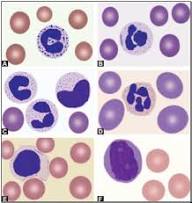
An automated CBC with differential white blood cell count can determine 32 different hematological parameters. The complete blood count (CBC) includes: hemoglobin, hematocrit, red blood cell (RBC) count, white blood cell (WBC) count, RBC indices, platelet count, mean platelet volume (MPV), and red cell distribution width (RDW).
Hemoglobin, WBC count, RBC count, mean corpuscular volume (MCV), and platelet count are measured electronically by an automated hematology analyzer. Hematocrit, mean corpuscular hemoglobin (MCH), mean corpuscular hemoglobin concentration (MCHC) and RDW are calculated.
Automated blood cell counters also measure the percentage and absolute number of each of the five major types of WBC: Neutrophils, lymphocytes, monocytes, eosinophils, and basophils.
Automated cell counters also incorporate a method for flagging white blood cell (WBC), red blood cell (RBC) and platelet abnormalities. The flagged abnormalities prompt a medical scientist to perform a manual peripheral smear review and differential to verify the abnormality flagged as well as allow identification of additional morphological abnormalities.
An automated cell counter can be programmed to flag the following WBC abnormalities:
- Abnormal lymphocytes/lymphoblasts
- Atypical lymphocytes
- Basophilia
- Blasts
- Eosinophilia
- Immature granulocytes
- Left shift
- Leukocytopenia
- Leukocytosis
- Lymphopenia
- Monocytosis
- Neutropenia
- Neutrophilia
- Nucleated red blood cell abnormal scatter
- WBC abnormal scatter
Infection, inflammation, tissue necrosis, metabolic disorders, drugs, hormones and malignant neoplasms may cause reactive neutrophil leukocytosis. An increase in bands (left shift) is typically associated with bacterial infections. Reactive lymphocytosis may be secondary to viral infections, drugs, inflammation or stress. Eosinophilia may be seen with parasitic infestation, allergic states, drug allergies, and malignant neoplasms. Monocytosis may occur in infections (TB), inflammatory disorders and malignancy.
Neoplastic increases in WBC with grossly abnormal differential counts are encountered in acute and chronic leukemia and the myeloproliferative disorders. A leukoerythroblastic reaction (appearance of immature granulocytes and nucleated red cells in the peripheral blood) indicates bone marrow infiltration or marked bone marrow hyperplasia.
Neutropenia may be secondary to various drugs, infections, bone marrow infiltration, autoimmune disease, splenomegaly, or may be a cyclical phenomenon. Lymphopenia may be associated with acute infections, carcinoma, Hodgkin's Disease, collagen vascular disease and HIV infection.
Reference range for adults is:
|
Cell |
Percent |
Absolute # |
|
Bands |
0-14 |
NA |
|
Neutrophils |
45-78 |
1.7-6.8 |
|
Lymphocytes |
15-47 |
1.0-3.3 |
|
Monocytes |
0-12 |
0.2-0.9 |
|
Eosinophils |
0-7 |
0.0-0.4 |
|
Basophils |
0-2 |
0.0-0.2 |
The absolute white blood cell count is expressed as thousands of cells per uL of blood.
Specimen requirement is one lavender top (EDTA) tube of blood. WBC differential is not part of the routine CBC and must ordered specifically.
References
Doig K, Thompson LA, A Methodical Approach to Interpreting the White Blood Cell Parameters of the Complete Blood Count, Clin Lab Sci,2017;30(3):186-193.
Longanbach S, Miers MK. Automated blood cell analysis. In: Keohane EM, Smith LJ, Walenga JM, editors. Rodak's Hematology: Clinical Principles and Applications, Ed. 5. St. Louis: Elsevier; 2012.
Gulati G, Uppal G, Gong J. Unreliable Automated Complete Blood Count Results: Causes, Recognition, and Resolution. Ann Lab Med. 2022 Sep 01;42(5):515-530.
Riley LK, Rupert J. Evaluation of Patients with Leukocytosis. Am Fam Physician. 2015 Dec 01;92(11):1004-11



 How to resolve AdBlock issue?