

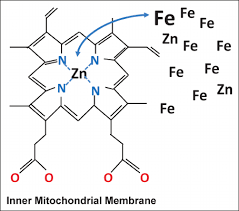
Zinc protoporphyrin (ZPP) is a normal metabolite that normally accumulates in trace amounts in erythrocytes during hemoglobin synthesis. The final biochemical reaction in the heme pathway is the insertion of ferrous iron into protoporphyrin IX to form heme. During iron deficiency, or when lead inhibits heme synthesis, protoporphyrin combines with zinc, instead of iron, to form ZPP. ZPP accumulates to high enough concentrations, that it became an early biomarker for iron deficiency or lead exposure.
ZPP was widely used for lead screening until October 1991, when the Centers for Disease Control and Prevention (CDC) issued new guidelines for lead screening of children. These guidelines recommended that lead be detectable to 10 ug/dL in whole blood. Because the ZPP response to lead exposure is not dependable at lead levels below 25 ug/dL, the CDC stopped recommending this test for screening children.
For work related testing, OSHA requires measurements of ZPP in addition to blood lead. ZPP values are generally elevated in workers whose blood lead concentration exceeds 25 ug/dL. Most states require reporting lead levels of 25 ug/dL or greater to OSHA. ZPP levels rise more slowly than blood lead and remain elevated for longer periods. ZPP elevation, like most other biological markers, is not specific for lead exposure.
ZPP should no longer be used as a primary screening test for lead exposure. Instead, a blood lead level should be ordered.
A hematofluorometer is used to directly measure ZPP fluorescence in whole blood without extraction. The instrument measures the ratio of ZPP fluorescence to heme absorption. Reference range is 30-80 umol ZPP/mol heme or 15-36 ug/dL.
Specimen requirement is one royal blue top (metal free, EDTA) tube for adults or one lavender top (metal free, EDTA) Microtainer for children. Hemolyzed or icteric specimens cannot be processed.
References
Labbe RF, Vreman JH, Stevenson DK, Zinc protoporphyrin: A metabolite with a mission, Clin Chem, 1999;45(12):2060-2072.
Marsh WL Jr, Nelson DP, Koenig HM. Free erythrocyte protoporphyrin (FEP) I. Normal values for adults and evaluation of the hematofluorometer. Am J Clin Pathol. 1983;79(6):655-660.
DeBaun MR, Sox HC Jr. Setting the optimal erythrocyte protoporphyrin screening decision threshold for lead poisoning: A decision analytic approach. Pediatrics. 1991 Jul,88(1):121-131



 How to resolve AdBlock issue?