

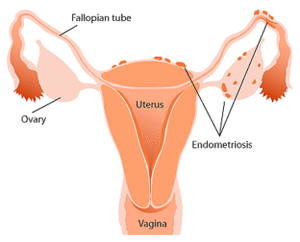
On July 24, 2025, Kephera Diagnostics announced the introduction of EndomTest, the first commercially available non-invasive diagnostic test for endometriosis in the United States. It utilizes a combination of serum biomarkers—cancer antigen 125 (CA125) and brain-derived neurotrophic factor (BDNF) along with 6 clinical variables derived from patient history. Clinical variables include previous surgical history for endometriosis, presence of painful periods leading to referral, severity of menstrual pain, age at first use of painkillers, age at first diagnosis of ovarian cysts, and age at onset of dyspareunia. Results are processed through a diagnostic algorithm to yield a binary outcome of either positive or negative.
Validation of the test was conducted using samples from the Oxford Endometriosis CaRe Centre biobank in the United Kingdom. The development study included 204 patients, and the external validation study included 79 patients. Endometriosis diagnoses in both cohorts were based on laparoscopic and histological confirmation.
In the validation study, EndomTest demonstrated a specificity of 100% (95% CI: 86.7–100%) and a sensitivity of 46.2% (95% CI: 25.5–66.8%). It had a sensitivity of 32% for superficial endometriosis, which is difficult to detect with imaging. Sensitivity was higher sensitivity in cases with deep infiltrating endometriosis (DIE) and endometrioma. Sensitivity was 69.7% when both lesions co-existed.
In March, 2026, The American College of Obstetricians & Gynecologists’ (ACOG) Committee on Clinical Practice Guidelines–Gynecology published their recommendations for the evaluation and diagnosis of endometriosis. Although pelvic laparoscopy has been considered the gold standard for diagnosing endometriosis, ACOG stated that only an assessment of symptoms or a physical examination were needed to initiate treatment. Transvaginal ultrasound should be the first imaging modality used for diagnosis. If it is not possible or the results are unclear, ACOG recommended a pelvic MRI. If the diagnosis is still uncertain. laparoscopy should be the performed.
Notably, ACOG recommended against the use of biomarker tests that analyze blood, urine, or other samples. The guideline noted that there has been no evidence to demonstrate biomarkers are better than either a laparoscopy or an analysis of a patient’s medical history in combination with a physical exam and pelvic ultrasound.
References
Kephera Diagnostics. First Blood Test for Endometriosis Launched by Kephera Diagnostics. Kephera. July 24, 2025. Accessed July 24, 2025. https://kephera.com/first-blood-test-for-endometriosis-launched-by-kephera-diagnostics/
Herranz-Blanco B, Daoud E, Viganò P, García-Velasco JA, Colli E. Development and Validation of an Endometriosis Diagnostic Method Based on Serum Biomarkers and Clinical Variables. Biomolecules. 2023;13(7):1052.
Daoud E, Archer DF, Fabio Parazzini, Bárbara Herranz-Blanco. Validation of an In Vitro Diagnostic Test for Endometriosis: Impact of Confounding Medical Conditions and Lesion Location. International Journal of Molecular Sciences. 2024;25(14):7667-7667.
American College of Obstetricians & Gynecologists’ (ACOG) Committee on Clinical Practice Guidelines–Gynecology, Diagnosis of Endometriosis, Clinical Practice Guideline Number 11, March 2026.



 How to resolve AdBlock issue?